
In my extensive career as an industrial engineer specializing in heavy machinery and oilfield operations, I have consistently sought methods to enhance efficiency, safety, and quality. A recurring theme across these domains is the critical role of precision in material processing and equipment performance. Among the various materials I have handled, cast iron parts stand out due to their widespread use in engines, pumps, valves, and drilling apparatus. The integrity of these cast iron parts directly influences the durability and functionality of entire systems. Similarly, in drilling, maintaining wellbore trajectory is paramount to avoid costly deviations. This article shares my firsthand experiences and insights, focusing on advanced techniques for processing cast iron parts and related drilling technologies, with an emphasis on practical applications, summarized through tables and formulas.
My journey began in the oil and gas sector, where I was involved in vertical drilling projects. One tool that significantly impacted our operations was the eccentric drill collar. Its design aims to prevent and correct wellbore deviation, a common issue in directional drilling. From my observations, using eccentric collars requires careful attention to several factors. For instance, bit balling must be avoided to maintain drilling efficiency, and during drill bit changes, specific procedures are necessary to prevent inclination increases. Typically, after a bit change, we applied a drill weight of 10 tons to advance about 10 meters, allowing the eccentric collar to settle into a smaller borehole section before resuming normal drilling. Regular inclination surveys were crucial for timely adjustments.
Preliminary assessments of eccentric collars revealed notable advantages. Their structure is simple, facilitating easy connection and disassembly without needing subs or stabilizers, which reduces pump pressure and minimizes sticking risks. In tests, when inclination reached about 2° above the standard layer, applying 8-10 tons of weight over 1-2 single rods could reduce it to approximately 1°. Below the standard layer, with inclination around 1.5°, using 12 tons of weight helped maintain stability until completion. This contributed to faster drilling speeds; average completion times improved to 5 days, 23 hours, and 50 minutes. However, questions remain: Can this tool be widely adopted as standard in non-deviation-prone areas? Can drill weight be increased further for faster vertical drilling? These require more experimentation. Nonetheless, the eccentric collar exemplifies how tailored tools can optimize processes, much like how specialized methods enhance the processing of cast iron parts.
Transitioning to foundry operations, I encountered the persistent challenge of cleaning cast iron parts after casting. Flash, burrs, and excess material on cast iron parts must be removed to ensure dimensional accuracy, smooth surfaces, and proper fit in assemblies. Traditionally, methods like grinding, chiseling, or flame cutting were employed, but they are often labor-intensive, noisy, and inefficient, with limited access to tight spaces. In my work at a heavy machinery plant, we revolutionized this by adopting arc air gouging for cleaning cast iron parts. This technique uses an electric arc to melt the unwanted material, which is then blown away by a stream of compressed air, offering a cleaner, faster, and more flexible solution.
The application of arc air gouging for cast iron parts involves several key parameters. We used a side-blow air gouging torch, where compressed air is directed to one side of the arc. This concentrates the airflow, providing strong force to eject molten iron efficiently while keeping the metal ahead of the arc warmer for stable combustion. The electrode, typically a copper-coated carbon rod with a rectangular cross-section, is selected based on burr thickness. For burrs of 3-5 mm, we employed 6 mm or 8 mm wide rods; for thicker sections or planar cuts, 10 mm rods were ideal. Common specifications included 5 × 12.5 × 300 mm rods. During operation, we first activated the air supply, then slowly initiated the arc, holding the carbon rod at a 20-30° angle to the workpiece, targeting the burr root. Operating conditions were optimized: voltage at 30-40 V, current around 500 A, and air pressure at 5-6 atmospheres. This balance ensured quality cuts, reduced carbon rod consumption, and high efficiency. The arc length was maintained at 2-3 mm for stable burning, with a carbon rod extension of about 80 mm.
To illustrate, here is an image showcasing typical cast iron parts that undergo such cleaning processes:
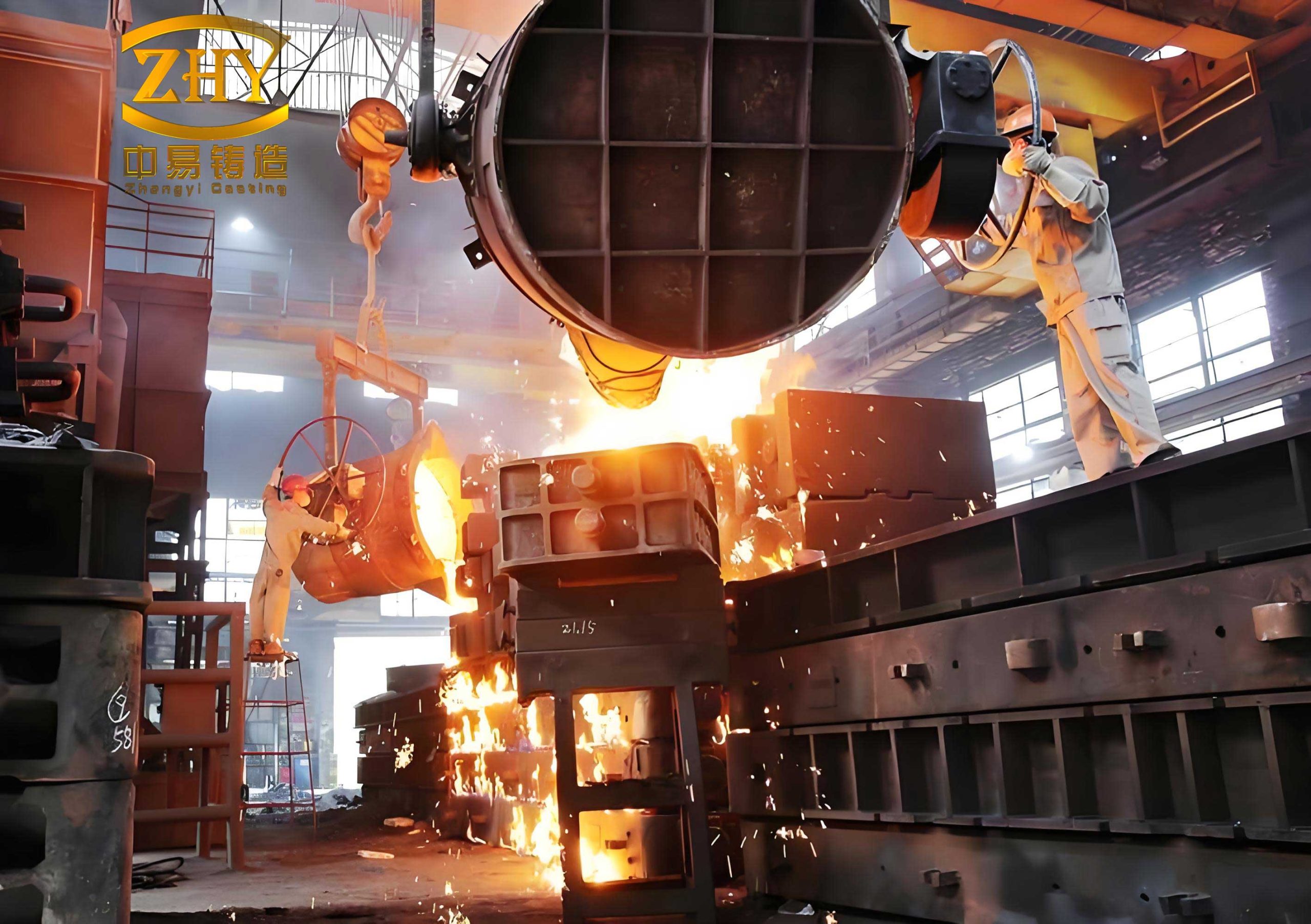
This visual highlights the complexity and scale of cast iron parts, emphasizing the need for effective cleaning techniques. In my experience, arc air gouging improved efficiency by 3-5 times compared to traditional methods, reduced labor intensity, minimized noise, and allowed access to hard-to-reach areas without affecting subsequent machining. The benefits extend beyond mere speed; it enhances the overall quality of cast iron parts, ensuring they meet stringent industrial standards.
To summarize the operational parameters for arc air gouging on cast iron parts, I have compiled the following table based on my field data:
| Parameter | Typical Value | Description |
|---|---|---|
| Carbon Rod Type | Rectangular, copper-coated | Width varies with burr thickness on cast iron parts |
| Rod Width for 3-5 mm Burrs | 6 mm or 8 mm | Optimal for thin to medium burrs on cast iron parts |
| Rod Width for Thick Cuts | 10 mm | Used for planar or heavy burrs on cast iron parts |
| Operating Voltage | 30-40 V | Ensures stable arc formation |
| Operating Current | ~500 A | Provides sufficient heat input |
| Air Pressure | 5-6 atm | Delivers forceful removal of molten material |
| Arc Length | 2-3 mm | Maintains arc stability and efficiency |
| Carbon Rod Extension | 80 mm | Balances control and cooling |
| Angle to Workpiece | 20-30° | Optimizes cutting action on cast iron parts |
This table serves as a quick reference for engineers handling cast iron parts, ensuring consistent results. Moreover, the physics behind arc air gouging can be expressed through formulas. The heat input per unit time, crucial for melting the cast iron, is given by:
$$P = I \times V$$
where \(P\) is the power in watts, \(I\) is the current in amperes, and \(V\) is the voltage in volts. For a given operation time \(t\) in seconds, the total energy \(E\) in joules is:
$$E = P \times t = I \times V \times t$$
This energy must suffice to melt the excess material on cast iron parts. The mass of material removed can be estimated using the specific heat capacity and latent heat of fusion of cast iron. Assuming cast iron has a specific heat capacity \(c \approx 0.46 \, \text{J/g}°\text{C}\), a melting point around \(1200°\text{C}\), and a latent heat \(L \approx 96 \, \text{J/g}\), the energy required to melt a mass \(m\) in grams from room temperature (20°C) is:
$$Q_{\text{total}} = m \left[ c \times (1200 – 20) + L \right] = m \left[ 0.46 \times 1180 + 96 \right] \approx m \times 638.8 \, \text{J/g}$$
Thus, the efficiency \(\eta\) of the process can be defined as the ratio of energy used for melting to the total electrical energy input:
$$\eta = \frac{Q_{\text{total}}}{E} \times 100\%$$
In practice, \(\eta\) ranges from 40% to 60% due to heat losses, but this framework helps optimize parameters for cleaning cast iron parts. Additionally, the removal rate \(R\) in grams per second can be modeled as:
$$R = \frac{m}{t} = \frac{\eta \times I \times V}{638.8}$$
This formula aids in predicting productivity when processing large batches of cast iron parts.
Beyond arc air gouging, I have explored other methods for enhancing cast iron parts. For instance, thermal and mechanical properties of cast iron parts can be analyzed using stress-strain relationships. The tensile strength \(\sigma_t\) of gray cast iron often follows:
$$\sigma_t = A – B \times \text{% graphite}$$
where \(A\) and \(B\) are material constants. Similarly, in drilling contexts, the force dynamics on eccentric collars relate to the stabilization of cast iron parts used in drill strings. The bending moment \(M\) in a deviated wellbore is given by:
$$M = F \times d \times \sin(\theta)$$
with \(F\) as the weight on bit, \(d\) as the eccentric distance, and \(\theta\) as the inclination angle. This interplay shows how precision in both drilling and material processing—like ensuring cast iron parts are defect-free—contributes to overall system reliability.
To further illustrate the impact of these techniques, consider a comparative analysis of cleaning methods for cast iron parts. The table below contrasts arc air gouging with traditional grinding and chiseling:
| Aspect | Arc Air Gouging | Traditional Grinding/Chiseling |
|---|---|---|
| Efficiency | High (3-5x faster) | Low |
| Labor Intensity | Reduced, ergonomic | High, physically demanding |
| Noise Level | Moderate | High |
| Access to Tight Spaces | Excellent | Limited |
| Surface Finish on Cast Iron Parts | Good, minimal damage | Variable, risk of gouging |
| Tool Consumption | Carbon rods (moderate) | Grinding wheels (high) |
| Energy Consumption | ~500 A electrical input | Mechanical or pneumatic power |
This comparison underscores why arc air gouging has become my preferred method for cleaning cast iron parts. It aligns with modern industrial trends toward automation and sustainability. For example, by reducing processing time, it lowers energy consumption per unit of cast iron parts produced, contributing to greener manufacturing.
In drilling applications, the lessons from processing cast iron parts also apply. Just as we optimize parameters for cleaning, drilling requires precise control of weight, speed, and torque. The rate of penetration (ROP) in drilling can be expressed as:
$$\text{ROP} = K \times \left( \frac{W}{D} \right)^a \times N^b$$
where \(K\) is a formation constant, \(W\) is the weight on bit, \(D\) is the bit diameter, \(N\) is the rotary speed, and \(a, b\) are exponents. This empirical formula helps in planning operations to minimize deviation, akin to how we adjust current and voltage for optimal cleaning of cast iron parts. Furthermore, the use of eccentric collars can be analyzed through vibration models. The natural frequency \(f_n\) of a drill string section is:
$$f_n = \frac{1}{2\pi} \sqrt{\frac{k}{m}}$$
with \(k\) as stiffness and \(m\) as mass. Avoiding resonance is crucial to prevent damage to components, including cast iron parts in the bottom hole assembly.
Looking ahead, I see immense potential in integrating digital technologies with these processes. For cast iron parts, real-time monitoring of arc air gouging via sensors could adjust parameters dynamically, ensuring consistent quality. Imagine a system where thermal cameras detect temperature gradients on cast iron parts, feeding data to controllers that optimize current and air flow. Similarly, in drilling, IoT-enabled eccentric collars could transmit inclination data for automated corrections. The synergy between advanced material processing and drilling tech will drive innovation, particularly as industries demand higher precision and efficiency.
In conclusion, my experiences with eccentric drill collars and arc air gouging highlight the importance of tailored solutions in engineering. Whether preventing wellbore deviation or cleaning cast iron parts, the principles remain similar: understand the physics, optimize parameters, and embrace technologies that enhance productivity. Cast iron parts, as foundational elements in machinery, benefit immensely from techniques like arc air gouging, which I have detailed through tables and formulas. As we move forward, continuous improvement in these areas will be key to meeting industrial challenges, ensuring that cast iron parts and drilling systems perform reliably in demanding environments. Through firsthand application and analysis, I advocate for these methods, hoping they inspire further advancements across sectors.