
Abstract:
This article details the research and development process of high hardness roller teeth steel castings, addressing the technical challenges posed by their complex structure, high hardness requirements, and stringent dimensional tolerances. Through meticulous process planning, ProCAST simulation optimization, and precise control of alloy composition and heat treatment, we successfully produced roller teeth that met the customer’s demanding specifications. The successful development of these roller teeth represents a significant technological innovation and has positively impacted our company’s export market expansion.
1. Introduction
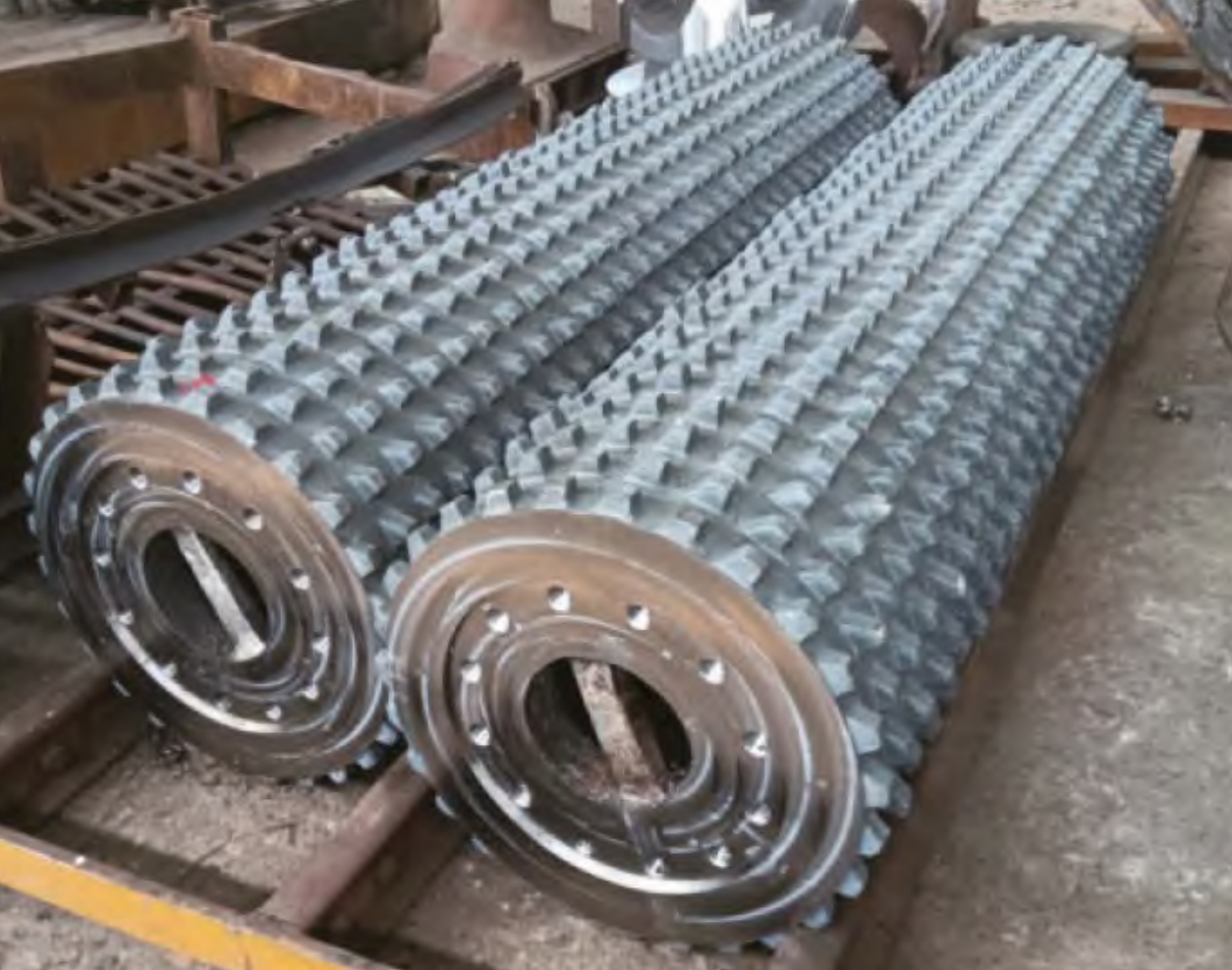
Roller teeth serve as the core component in drum-type crushers, used to crush materials through the interlocking action of two side-by-side, counter-rotating teeth. Due to the harsh operating environment and variable hardness of the crushed materials, roller teeth must possess dense internal quality and high hardness to ensure longevity. Furthermore, the teeth must maintain a complete shape and high positional accuracy for perfect engagement during operation.
In this study, we were tasked with developing roller teeth for a foreign client. Prior to collaborating with our company, the client had engaged another domestic foundry, which failed three consecutive trials due to issues such as core misalignment and steel leakage during pouring. Our technical team, through rigorous technical quality planning, achieved success in a single trial. This article discusses the process design optimization, achievement of high hardness, and control experiences during production, including tooth profile accuracy, dimensional accuracy, and pouring leak prevention.
2. Technical Requirements for Roller Teeth Steel Casting
2.1 Product Parameters
The roller teeth casting weighs 2,500 kg, with an outer diameter of 700 mm, a height of 2,550 mm, a main body wall thickness of 55 mm, and 864 teeth. The material is MCL400, a custom cast steel grade developed based on the client’s specified chemical composition (Table 1).
Table 1. Chemical Composition Requirements for Roller Teeth (mass fraction, %)
| Element | Client Requirement |
|---|---|
| C | 0.25-0.29 |
| Mn | 1.00-1.20 |
| Si | 0.20-0.40 |
| P | ≤0.025 |
| S | ≤0.015 |
| Cr | 1.25-2.00 |
| Ni | 3.20-4.00 |
| Mo | 0.25-0.50 |
2.2 Main Technical Requirements
- Quality Assurance: Since the roller body cannot undergo ultrasonic testing (UT), the client requires verification of the casting process through CAE simulation results. Additionally, magnetic particle inspection (MPI) is performed on the entire casting according to GB/T 9444-2019, with acceptance based on Grade 2 criteria.
- Mechanical Properties: The hardness of the casting body must not be less than 400 HBW.
- Dimensional Tolerance: Dimensional tolerances follow GB/T 6414-2017, Grade CT12. A template provided by the client is used to inspect the tooth positions, requiring all 864 teeth to pass the inspection simultaneously.
2.3 Technical Challenges
- Complex Casting Structure: The casting has a complex structure with dispersed hot spots, making it difficult to ensure proper feeding and shrinkage compensation.
- High Hardness Requirements: Meeting the high hardness requirements necessitates precise control of alloy composition and a tailored heat treatment process.
- High Aspect Ratio and Dimensional Tolerance: The high aspect ratio, stringent dimensional tolerances, and limited molding and core assembly workspace make it challenging to ensure complete filling of tooth positions and prevent pouring-related issues such as swelling and leakage.
3. Casting Process Design Scheme
3.1 Solving Solidification and Shrinkage Issues
- Heating Risers: Three heating risers are placed at the top of the casting to ensure effective feeding.
- Pouring System: A buffered stepped gate system is employed, with five layers of cross gates and four variable-diameter slot gates per layer. External chill molds are placed at the corresponding locations of the inner gates to prevent shrinkage defects.
- Casting Weight and Yield: The gross weight of the roller teeth is 2,500 kg, with a pouring weight of 3,200 kg, resulting in a process yield of 78.1%.
- Heating Covering Agent: After pouring, 2.5 kg of heating covering agent is evenly applied to each riser.
Using ProCAST simulation software for solidification simulation, the results indicate simultaneous solidification without significant isolated liquid phases. The shrinkage porosity analysis reveals only a small equivalent diameter of porosity, not exceeding φ5 mm, meeting the technical requirements.
3.2 Ensuring High Hardness of Roller Teeth Steel Casting
3.2.1 Composition Control
Due to the high hardness requirements and complex operating environment, stricter control of the chemical composition range is implemented:
Table 2. Adjusted Alloy Composition Range for High Hardness (mass fraction, %)
| Element | Adjusted Range |
|---|---|
| Cr | 1.6-2.0 (upper mid-range) |
| Ni | 3.6-4.0 (upper mid-range) |
| Mo | 0.4-0.5 (upper mid-range) |
| Mn | 1.1-1.2 (upper mid-range) |
| Si | 0.3-0.4 (upper mid-range) |
3.2.2 Heat Treatment Process Design
Conventional normalizing + tempering heat treatment cannot meet the high hardness requirements. Quenching and tempering, while effective, is costly and prone to deformation and cracking in this structural configuration, posing high quality risks. Instead, we adopted a rapid, strong air blowing, and spraying method after normalizing, achieving the required mechanical properties specified by the client.
3.3 Key Safeguards During Casting Process
3.3.1 Wood Pattern Manufacturing Control
- Core Box Rigidity: Iron frame templates are used to increase the rigidity and strength of the core boxes, preventing core deformation.
- Precision of Core Box: The tooth dimensions in the core box are precise, with reasonable movable block settings for easy mold stripping without damaging the tooth profile.
3.3.2 Molding Operation Control
- Core Material: Baozhu furan resin sand is used for cores. Formed external chill molds are placed on the actual samples and core boxes, with accurate positioning, quantity, and size.
- Gate Brick Placement: Core bones are firmly welded together after combining the two semicircular cores, which is crucial for preventing swelling and leakage.
- Coating Application: The sand mold and cores are brushed with alcohol-based coating twice, with inspection to ensure coating quality, especially even and non-accumulated coating on the tooth positions.
- Mold Assembly Control: After placing the cores in position according to size, flat steel is used to support the core backs to prevent swelling.
- Cavity Inspection: Before closing the mold, floating sand and debris are removed, and the cavity is inspected again before pouring.
3.3.3 Pouring Process Control
The pouring temperature is 1,560 °C, with a moderate initial pouring speed to facilitate impurity floating and better filling of tooth positions. The pouring is slowed down later to prevent false filling of risers.
3.3.4 Post-Process Finishing
The roller teeth steel casting is inspected using a template and then finished and polished.
4. Research and Development Results
Due to thorough preparation, our company successfully produced the high hardness export roller teeth steel casting in a single trial, followed by the successful production of over a dozen pieces The product meets the client’s requirements, with several different specifications of roller teeth in the trial production stage.
5. Conclusion
The successful development of roller teeth represents a significant technological and process innovation, playing a positive role in ZHY Casting’s expansion into export markets. The following experiences were accumulated during the trial production of this product:
(1) Casting Process: The principle of simultaneous solidification was applied, combined with meticulous process planning and ProCAST simulation optimization, to meet the stringent quality requirements of the product without compromising process yield.
(2) Hardness and Special Mechanical Properties Control: The mechanical strength of the castings was ensured through precise control of the alloy’s elemental content, including Cr, Ni, Mn, Mo, etc. The hardness of the castings was enhanced through specific heat treatment processes such as rapid furnace discharging, intense air blast, and spray mist control.
(3) Dimensional Control: An effective method for controlling product dimensions throughout the entire process, accounting for complex influencing factors, was developed.
(4) Process Control: By establishing a comprehensive quality plan, clarifying the responsibilities of relevant personnel, preventing quality issues throughout the process, and conducting full-process tracking and monitoring, the occurrence of quality problems was effectively mitigated.