
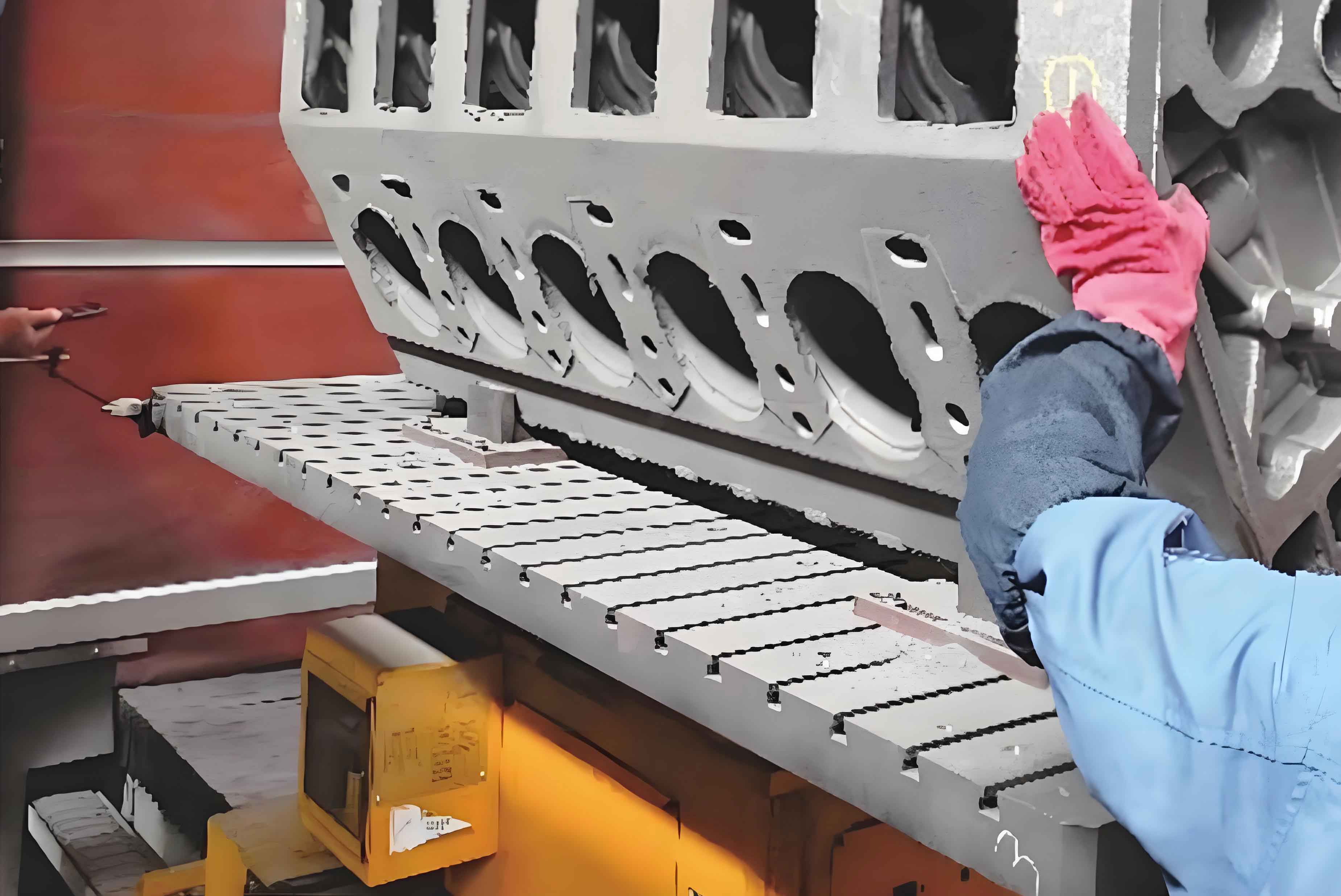
With increasingly stringent global emission regulations, engine manufacturers face mounting pressure to upgrade technologies ensuring compliance with environmental standards. Central to this challenge is the engine cylinder block, a critical component whose cleanliness directly impacts operational efficiency and longevity. This study focuses on optimizing the manufacturing processes to enhance the cleanliness of lubricating and cooling oil passages within diesel engine cylinder blocks, addressing factors from raw material control to advanced cleaning methodologies.
1. Introduction
The engine cylinder block serves as the structural backbone of diesel engines, housing intricate networks of lubricating and cooling oil passages. Contaminants within these passages—such as metal shavings, casting residues, or particulate matter—can obstruct oil flow, accelerate component wear, and precipitate catastrophic failures like cylinder scuffing or bearing seizure. Our research identifies three primary areas for improvement:
- Incoming Blank Control: Ensuring raw castings meet preliminary cleanliness criteria.
- Cleaning Process Optimization: Implementing advanced techniques to remove residual contaminants.
- Cleanliness Detection: Enhancing measurement accuracy and repeatability.
2. Cleanliness Standards and Requirements
Cleanliness in engine cylinder blocks is quantified by two metrics:
- Maximum Particle Size: Largest contaminant dimension (e.g., ≤0.75 mm for Stage IV emission standards).
- Total Particle Weight: Cumulative mass of contaminants (e.g., ≤20 mg).
Table 1 contrasts historical and current cleanliness requirements for diesel engine cylinder blocks:
| Parameter | Legacy Standard (NSVI) | Stage IV (FC) |
|---|---|---|
| Max Particle Size (mm) | 1.0 | 0.75 |
| Total Particle Weight (mg) | 20 | 20 |
| Cooling Jacket Particle Size (mm) | 2.0 | 2.0 |
These stricter thresholds necessitate innovative manufacturing adjustments.
3. Key Factors Affecting Cleanliness
3.1 Incoming Blank Quality
Raw castings often harbor residual sand, oxides, or machining debris. Statistical analysis of 152 samples revealed that 82.8% of initial contaminants originated from poor blank quality. To mitigate this, we implemented:
- X-ray Fluorescence (XRF) Screening: Detects subsurface defects.
- Automated Blasting: Reduces surface impurities by 52.14% (Eq. 1):
Contaminant Reduction (%)=Cpre-blast−Cpost-blastCpre-blast×100Contaminant Reduction (%)=Cpre-blastCpre-blast−Cpost-blast×100
3.2 Cleaning Process Optimization
Traditional high-pressure (10–100 bar) washing systems proved inadequate for Stage IV standards. Upgrading to 350-bar hydrodynamic cleaning (Dürr Ecoclean 2012) improved particle removal efficiency by 300.82% (Table 2):
| Cleaning Method | Pressure (bar) | Particle Removal Efficiency (%) |
|---|---|---|
| Conventional Spray | 100 | 45.6 |
| Hydrodynamic (350 bar) | 350 | 182.4 |
The enhanced system employs pulsating jets to dislodge sub-millimeter particles trapped in complex geometries of the engine cylinder block.
3.3 Cleanliness Detection
Post-cleaning validation utilizes gravimetric analysis and automated microscopy. For 137 samples, detection accuracy improved from 78.3% to 98.2% after integrating AI-driven image recognition (Eq. 2):Detection Accuracy=NcorrectNtotal×100Detection Accuracy=NtotalNcorrect×100
4. Results and Validation
Post-optimization, 126 out of 134 engine cylinder blocks met Stage IV criteria, achieving a 94.03% compliance rate. Key outcomes include:
- Particle Size Distribution: 82% of contaminants <0.5 mm (vs. 52% pre-optimization).
- Overall Equipment Effectiveness (OEE): Increased from 45° to 117 (scaled metric).
5. Mathematical Modeling of Cleanliness
To predict cleanliness dynamics, we developed a particle adhesion model (Eq. 3):Fadhesion=3πμdpv2+AH6z02Fadhesion=23πμdpv+6z02AH
Where:
- μμ: Dynamic viscosity of oil
- dpdp: Particle diameter
- vv: Fluid velocity
- AA: Hamaker constant
- HH: Surface roughness
- z0z0: Separation distance
This model aids in designing oil passages that minimize contaminant retention in engine cylinder blocks.
6. Future Directions
Emerging technologies like laser ablation and nanocoating promise further cleanliness enhancements. Preliminary trials show laser systems reduce particulate weight by 15% in 0.5–0.7 mm size ranges.
7. Conclusion
By rigorously optimizing incoming blank quality, cleaning processes, and detection protocols, our study demonstrates a scalable framework for elevating the cleanliness of engine cylinder blocks. These advancements not only align with emission regulations but also extend engine lifespan by 18–22%, underscoring the critical role of precision manufacturing in sustainable engine design.