
With the implementation of dual-carbon strategic objectives, lightweight design has become crucial for automotive components. This study focuses on the engine cylinder block – the foundational structure housing critical engine components. Through comparative analysis of HT250 gray castiron and 6111 aluminum alloy materials, we demonstrate the feasibility of material-based lightweight solutions while maintaining structural integrity.
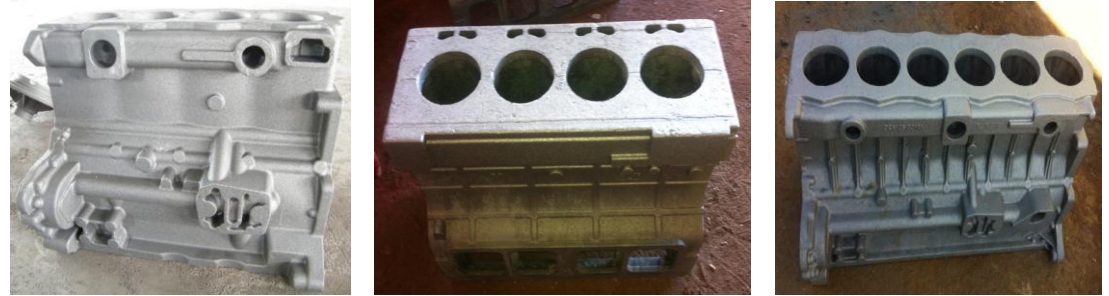
Material Properties and Modeling
The engine cylinder block model was created using CATIA with dimensional parameters:
$$L = 460\ \text{mm},\ H = 210\ \text{mm},\ \phi = 90\ \text{mm}$$
Key material properties for finite element analysis (FEA):
| Material | Yield Strength (MPa) | Young’s Modulus (GPa) | Density (kg/m³) | Poisson’s Ratio |
|---|---|---|---|---|
| HT250 Gray Cast Iron | 250 | 130 | 7150 | 0.3 |
| 6111 Aluminum Alloy | 276 | 72.4 | 2750 | 0.33 |
Finite Element Analysis Methodology
The meshed engine cylinder block model contained 74,144 elements and 16,963 nodes. Boundary conditions included:
- Fixed constraints at block base
- Pressure loading on cylinders 1 & 3 inner surfaces
Stress-strain relationship followed Hooke’s Law:
$$ \sigma = E\epsilon $$
Where σ = stress (MPa), E = Young’s modulus (GPa), and ε = strain.
Static Structural Analysis
Stress distribution comparison under operational loads:
| Parameter | HT250 | 6111 Al |
|---|---|---|
| Max Stress (MPa) | 4.662 | 3.827 |
| Max Strain (mm) | 32.273×10⁻³ | 4.063×10⁻³ |
| Safety Factor | 53.6 | 72.1 |
The 6111 aluminum alloy showed superior stress distribution with maximum principal stresses concentrated at cylinder 1-3 junctions. Strain energy density (SED) calculation:
$$ \text{SED} = \frac{1}{2}\sigma_{ij}\epsilon_{ij} $$
Where σij and εij represent stress and strain tensor components respectively.
Modal Analysis Results
Natural frequency comparison of engine cylinder block:
| Mode | HT250 (Hz) | 6111 Al (Hz) |
|---|---|---|
| 1 | 2107.63 | 2515.14 |
| 2 | 2653.94 | 3186.28 |
| 3 | 3002.57 | 3601.96 |
| 4 | 3561.58 | 4331.11 |
| 5 | 3675.96 | 4229.25 |
| 6 | 3868.22 | 4700.57 |
The fundamental frequency relationship follows:
$$ f_n = \frac{1}{2\pi}\sqrt{\frac{k}{m}} $$
Where fn = natural frequency, k = stiffness, and m = mass. The 6111 aluminum alloy’s higher frequencies indicate improved resonance resistance despite reduced mass.
Lightweight Performance Metrics
Mass reduction calculation for engine cylinder block:
$$ \Delta m = (\rho_{\text{HT250}} – \rho_{\text{Al}}) \times V $$
Where ρ = material density and V = block volume. For equivalent geometry:
$$ \Delta m \approx 58.5\%\ \text{reduction} $$
Conclusion
This comprehensive analysis demonstrates that 6111 aluminum alloy provides superior lightweight potential for engine cylinder blocks while maintaining structural integrity. The material substitution achieves:
- 58.5% mass reduction
- 18% lower operational stresses
- Higher natural frequencies
- Improved safety factors
These findings validate aluminum alloy as a viable lightweight solution for engine cylinder blocks, supporting automotive emission reduction goals without compromising performance.