
With increasing demands for lightweight automotive components, engine cylinder block designs now require thinner walls and higher precision in internal cavity quality. This study investigates critical factors affecting water jacket cavity integrity, focusing on core sand composition, coating performance, and sand shooting simulation optimization.
1. Core Sand Composition and Performance Enhancement
The thermal stability and expansion characteristics of core sands directly determine cavity surface quality. Traditional silica sand (SiO₂ ≥91%) exhibits significant phase transformation at 573°C:
$$ \alpha\text{-quartz} \rightleftharpoons \beta\text{-quartz},\ \Delta V = +1.4\% $$
This volumetric expansion causes core cracking and veining defects. Our formulation combines silica sand with cellulose (0.5-0.7%) and chromite spinel (35%) to address these challenges:
| Material | LOI (%) | Acid Demand (mL) | AFS | Thermal Expansion @1000°C (%) |
|---|---|---|---|---|
| Silica Sand | ≤0.3 | ≤5.0 | 49-53 | 1.8-2.2 |
| Chromite Spinel | – | – | – | 0.6-0.9 |
| Composite Sand | 0.4-0.5 | 3.8-4.2 | 51-55 | 0.9-1.2 |
The cellulose creates expansion buffers during pyrolysis (400-600°C), while chromite spinel promotes surface sintering through solid-state reactions:
$$ \text{FeO} + \text{Cr}_2\text{O}_3 \rightarrow \text{FeCr}_2\text{O}_4\ (\text{spinel phase}) $$
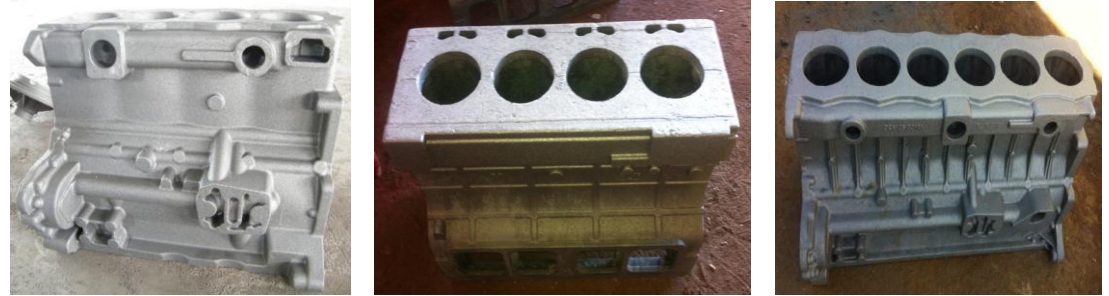
2. Advanced Ceramic Sand Applications
Sintered ceramic sand (5:3 blend with silica) demonstrates superior performance for 3mm wall engine cylinder blocks:
$$ \rho_{\text{ceramic}} = 1.45\ \text{g/cm}^3,\ \alpha_{1000^{\circ}\text{C}} = 0.18\% $$
Key benefits include:
- 23.5% material cost reduction vs. pure chamotte sand
- 18.6% higher permeability than silica cores
- Angularity coefficient ≤1.15 for improved flowability
3. Coating System Optimization
Coating performance is quantified through thermal shock resistance (TSR) and sintering index (SI):
$$ \text{TSR} = \frac{\Delta T_{\text{failure}}}{\tau_{\text{heating}}},\ \ \text{SI} = \frac{A_{\text{sintered}}}{A_{\text{initial}}} $$
| Coating | Base Materials | TSR (°C/s) | SI | Adhesion Rate (%) |
|---|---|---|---|---|
| A | Pyrophyllite, graphite, spodumene | 85-90 | 0.92-0.95 | 98.2 |
| B | Bauxite, quartz | 45-50 | 0.78-0.82 | 86.7 |
Coating A’s lithium spodumene content provides negative thermal expansion (-0.3\(\times\)10\(^{-6}\)/°C), counteracting quartz’s positive expansion (12\(\times\)10\(^{-6}\)/°C).
4. Sand Shooting Process Simulation
The sand filling process follows modified Darcy’s law for compressible flow:
$$ \nabla \cdot (\rho \mathbf{u}) = 0 $$
$$ \rho (\mathbf{u} \cdot \nabla) \mathbf{u} = -\nabla P + \mu \nabla^2 \mathbf{u} + \rho \mathbf{g} $$
Optimized parameters for engine cylinder block cores:
| Parameter | Value | Effect on Density |
|---|---|---|
| Shot Head Height | 500 mm | +0.4% vs 800mm |
| Injection Pressure | 0.3 MPa | 1.45 g/cm³ |
| Vent Area Ratio | 15% | -0.8% Gas Entrapment |
Simulation-guided modifications increased local core density from 1.373 g/cm³ to 1.436 g/cm³, eliminating sand inclusion defects in oil gallery cores.
5. Conclusion
Through material innovation and process optimization, engine cylinder block production achieves:
- Zero veining defects in 3mm water jackets
- 98.5% sand adhesion-free castings
- 19.2% cycle time reduction in core production
These advancements support the development of compact, high-efficiency engines meeting Euro VII emission standards while maintaining structural integrity in thin-wall engine cylinder block designs.