
Modern marine diesel engines demand lightweight, compact, and high-performance castings, particularly for critical components like engine cylinder blocks and cylinder heads. This study focuses on optimizing cold core box casting processes to achieve dimensional accuracy ≤±0.15 mm and surface roughness ≤Ra 12.5 μm for complex engine cylinder block geometries. The technical framework integrates advanced core-making, material science, and thermal management strategies.
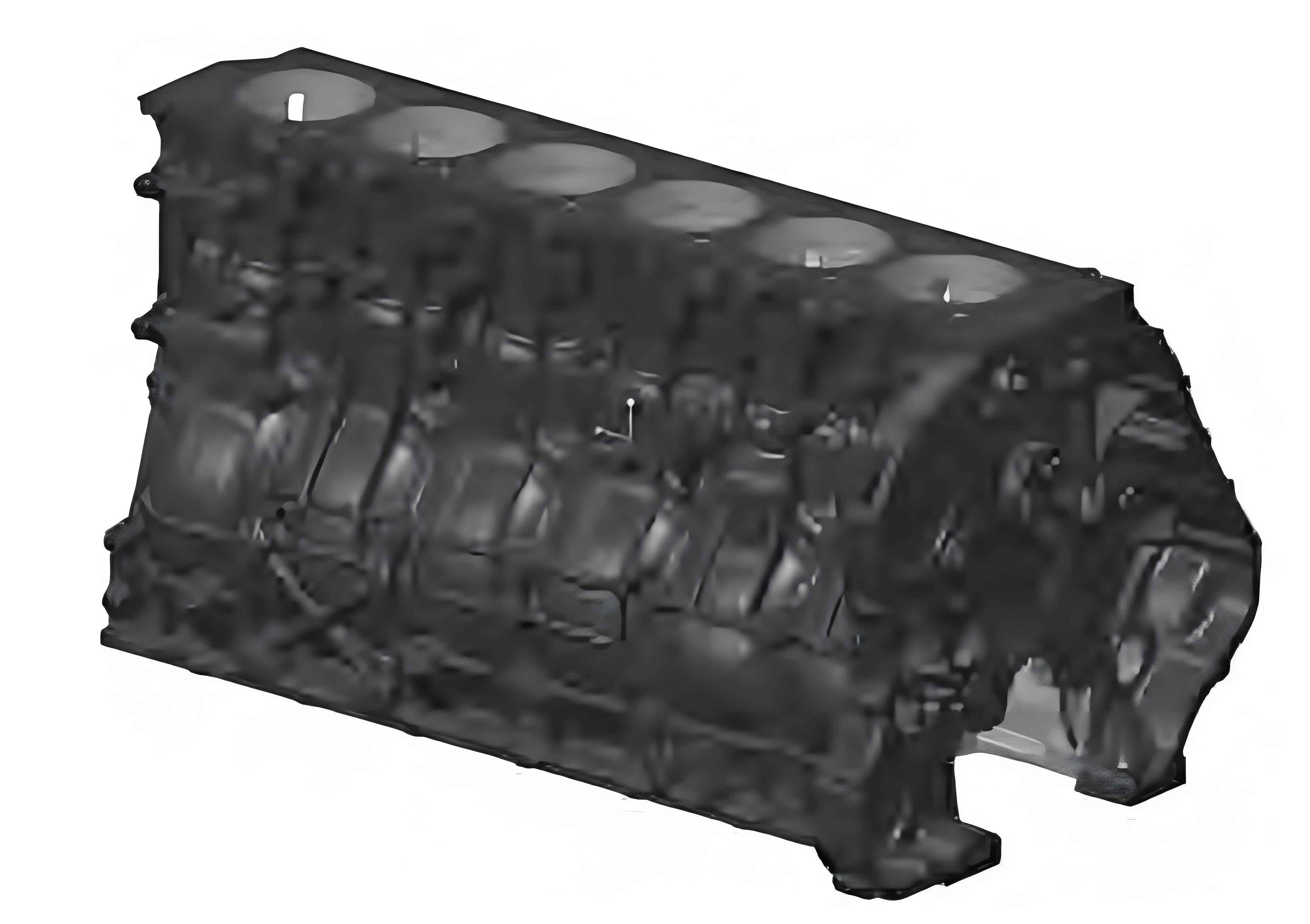
1. Cold Core Box System Design
The engine cylinder block casting process utilizes ZL107 aluminum alloy molds with HT250 frames, achieving dimensional tolerances per ISO 8062 CT8 class. Key design parameters include:
$$ \Delta D = 0.05L^{0.7} $$
Where ΔD = dimensional tolerance (mm), L = characteristic length (mm). For typical engine cylinder block cores (500-800 mm length), this yields tolerance bands of ±0.15-0.25 mm.
| Mold Component | Material | Hardness (HB) | Surface Finish (Ra) |
|---|---|---|---|
| Core Box | ZL107 | 70-80 | 1.6 μm |
| Support Frame | HT250 | 190-220 | 3.2 μm |
2. Core Manufacturing Process
The cold core box process for engine cylinder block components follows this optimized sequence:
- Sand Preparation: SiO₂ (98.5% purity), resin binder (1.0-1.1% phenolic-isocyanate), additives (3-7% iron oxide)
- Core Shooting: Pressure = 0.35-0.55 MPa, Time = 3-8 s
- Amine Curing: Triethylamine concentration = 2-5 vol%, Gas flow = 15-25 L/min
- Post-processing: Alcohol-based coating (0.3-0.5 mm thickness), Drying at 200°C × 40 min
The curing reaction kinetics follow:
$$ \frac{d\alpha}{dt} = A(1-\alpha)^n e^{-E_a/RT} $$
Where α = conversion degree, A = pre-exponential factor (2.3×10⁴ s⁻¹), Ea = activation energy (58 kJ/mol), n = reaction order (1.2).
3. Material Composition Control
For engine cylinder block castings requiring QT400-15 properties, the metallurgical control parameters are:
| Element | Target (%) | Tolerance (±%) |
|---|---|---|
| C | 3.75 | 0.10 |
| Si | 1.65 | 0.15 |
| Mn | 0.25 | 0.03 |
| Mg | 0.045 | 0.005 |
The inoculation efficiency equation for engine cylinder block castings:
$$ N = N_0 e^{-k(T)t} $$
Where N = effective nuclei count, N₀ = initial nuclei (1.2×10⁶/mm³), k(T) = temperature-dependent decay constant.
4. Thermal Management System
The engine cylinder block heat treatment profile combines stress relief and microstructure optimization:
$$ T(t) = \begin{cases}
220^{\circ}\text{C} + 5^{\circ}\text{C/min} \times t & 0 \leq t < 90 \text{ min} \\
220^{\circ}\text{C} & 90 \leq t < 150 \text{ min} \\
220^{\circ}\text{C} – 3^{\circ}\text{C/min} \times (t-150) & 150 \leq t \leq 210 \text{ min}
\end{cases} $$
Cooling water channel design for engine cylinder block cores follows turbulent flow principles:
$$ Nu = 0.023Re^{0.8}Pr^{0.4} $$
Where Nu = Nusselt number, Re = Reynolds number (>10⁴), Pr = Prandtl number (water ≈6.99).
5. Quality Validation
Engine cylinder block castings undergo rigorous testing:
| Test | Standard | Requirement |
|---|---|---|
| Pressure Test | ISO 8539 | 8 bar × 30 min |
| UT Inspection | ASTM E317 | ≤Φ2 mm FBH |
| Metallography | EN 1563 | ≥85% nodularity |
The process achieves 98.2% dimensional compliance for engine cylinder block castings, with core rejection rates <1.5%. Production efficiency reaches 42-48 cores/hour using 40L core shooters, demonstrating significant advantages over traditional hot box methods.