
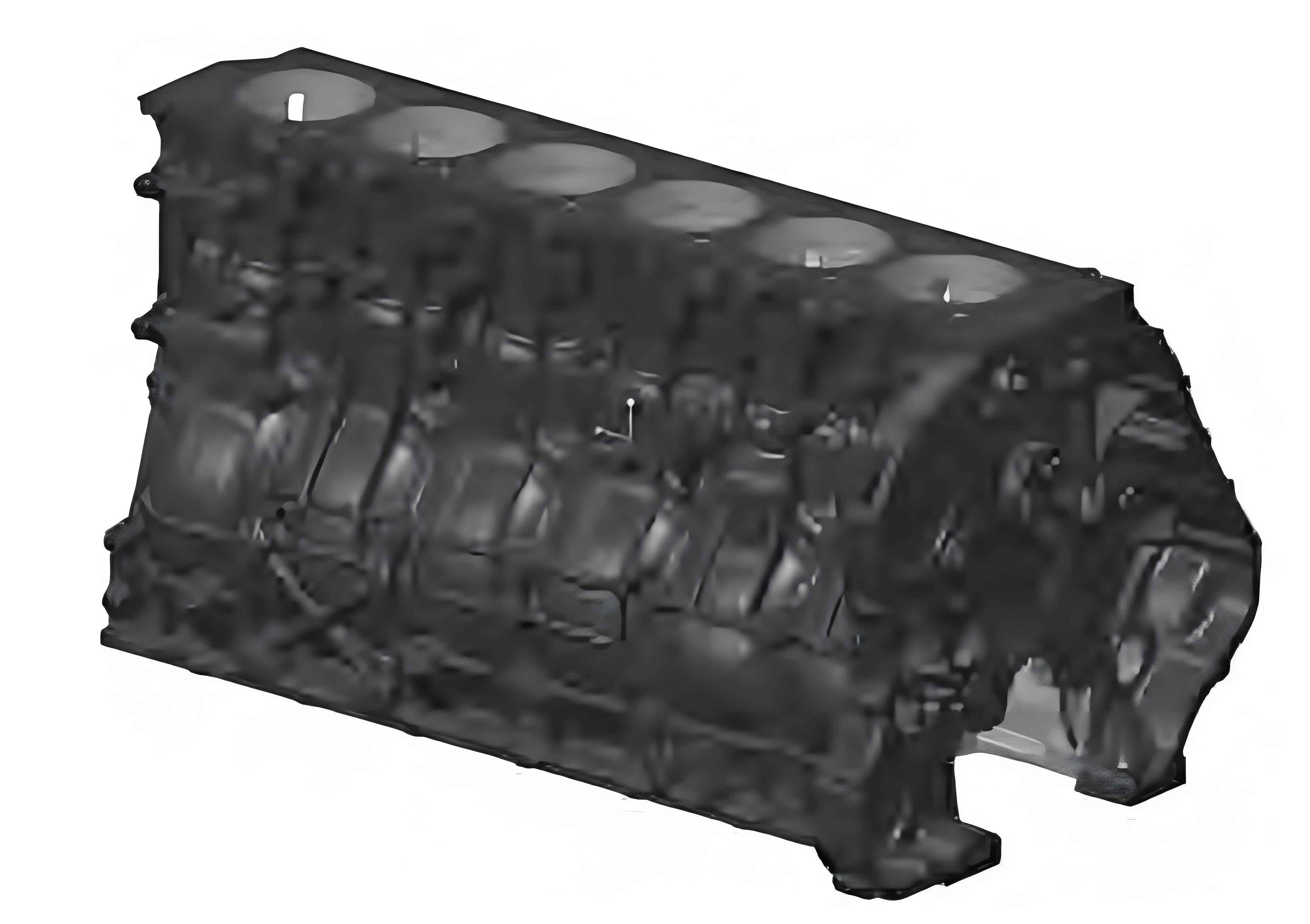
As a critical component of heavy-duty machinery, the engine cylinder block requires meticulous casting processes to ensure structural integrity and performance. This article details a systematic approach to address leakage defects in HT300 diesel engine cylinder blocks through process refinement, material optimization, and advanced simulation techniques.
Material Composition and Metallurgical Requirements
The engine cylinder block specifications demand exceptional mechanical properties due to its complex geometry (1,650 mm × 700 mm × 500 mm) and varying wall thickness (8-75 mm). The chemical composition control strategy for HT300 cast iron is formulated as:
| Element | C | Si | Mn | P | S | Cu | Cr |
|---|---|---|---|---|---|---|---|
| Target | 3.15-3.30 | 1.80-1.90 | 0.70-0.80 | <0.05 | <0.10 | 0.85 | 0.25-0.28 |
The metallurgical equation for carbon equivalent (CE) calculation ensures proper castability:
$$ CE = C + \frac{Si + P}{3} $$
Maintaining CE between 3.8-4.0 prevents chill formation while ensuring adequate fluidity.
Casting Process Design
Our improved process incorporates three key modifications:
| Parameter | Original | Optimized |
|---|---|---|
| Binder Usage (g/cm³) | 1.8-2.2 | 1.2-1.5 |
| Coating Type | Alkaline | Graphite-based |
| Pouring Temp (°C) | 1,370±10 | 1,360±5 |
The gating system design follows Bernoulli’s principle for controlled filling:
$$ v = \sqrt{\frac{2gh}{1 – (A_2/A_1)^2}} $$
Where:
v = flow velocity
g = gravitational acceleration
h = metal head height
A₁/A₂ = cross-sectional area ratio
Defect Analysis and Mitigation
Through SEM-EDS analysis of leakage-prone zones (U-shaped water jacket and tappet areas), we identified critical factors:
| Element | SN1 (at.%) | SN2 (at.%) | SN3 (at.%) |
|---|---|---|---|
| O | 41.2 | 38.7 | 43.1 |
| Al | 12.3 | 9.8 | 14.2 |
| Si | 18.4 | 22.1 | 16.8 |
The gas entrapment probability (Pg) during mold filling is modeled as:
$$ P_g = 1 – e^{(-\frac{t}{\tau})} $$
Where τ represents the gas evacuation time constant, optimized through venting design.
Process Validation and Results
Implementation of modified core assembly techniques and material adjustments yielded significant improvements:
| Batch | Quantity | Leakage Rate | Total Rejection |
|---|---|---|---|
| Pre-optimization | 289 | 42.9% | 40.5% |
| Post-optimization | 101 | 1.98% | 5.23% |
The final microstructure quality meets specifications:
$$ \frac{A_{graphite}}{A_{total}} \geq 80\% $$
$$ \frac{V_{pearlite}}{V_{total}} \geq 95\% $$
Conclusion
Through systematic process optimization combining advanced simulation (MAGMA), material engineering, and precision core-making techniques, we achieved:
- Leakage defect reduction from 42.9% to <2%
- Mechanical property enhancement: σb ≥ 276 MPa, HBW 179-255
- Production yield improvement exceeding 35%
This methodology establishes a robust framework for high-integrity engine cylinder block manufacturing, particularly beneficial for large-displacement diesel applications requiring complex internal geometries and stringent quality standards.