
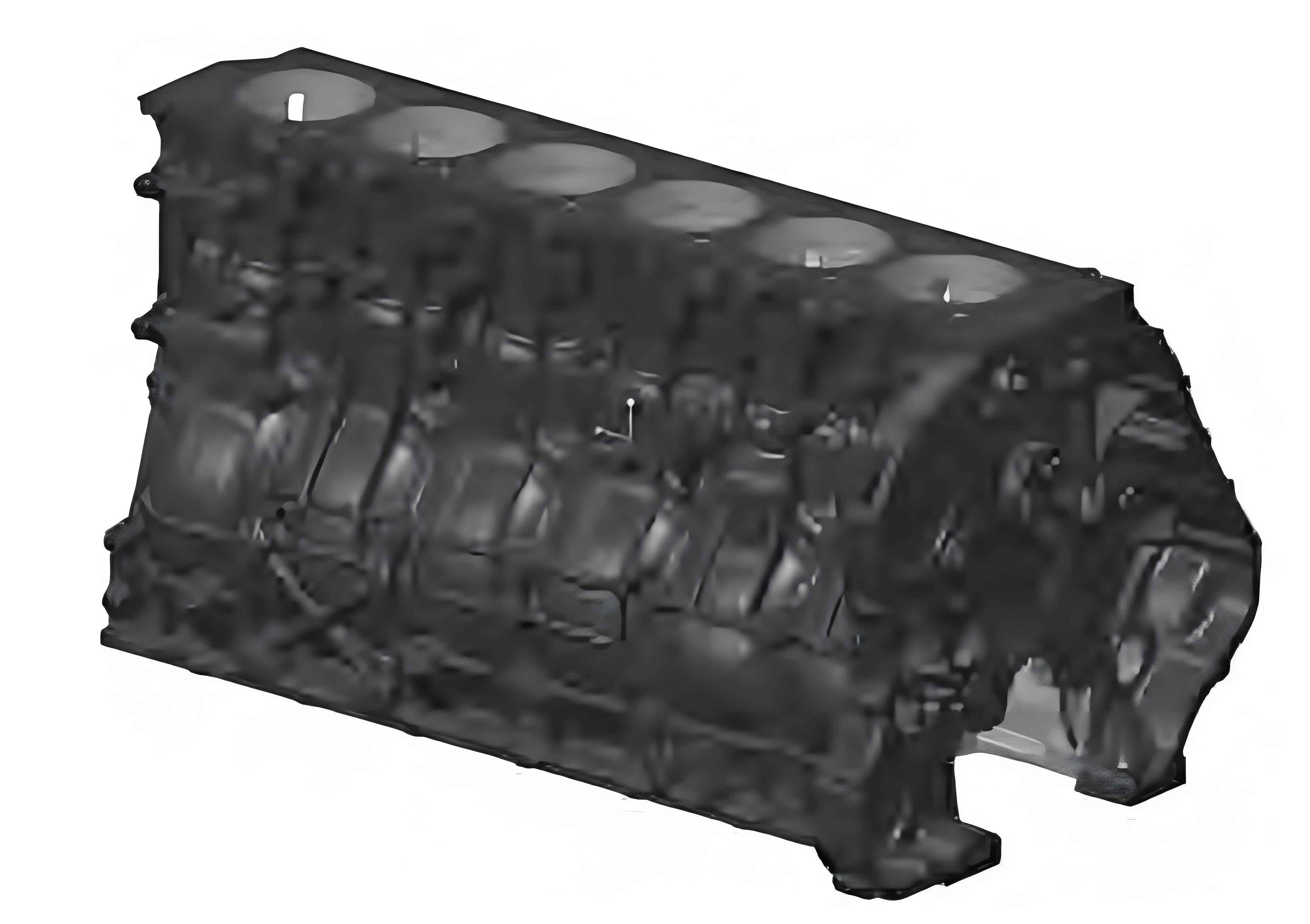
The engine cylinder block serves as the structural foundation of internal combustion engines, requiring exceptional thermal stability and mechanical strength. This paper presents an optimized tilt pouring process for producing complex aluminum alloy cylinder blocks with wall thicknesses as low as 5 mm, demonstrating how advanced casting techniques address manufacturing challenges while maintaining stringent quality standards.
1. Material Composition and Mechanical Requirements
For ZL101A aluminum alloy engine cylinder blocks, the chemical composition and mechanical properties are strictly controlled:
| Element | Composition (%) |
|---|---|
| Si | 6.5-7.5 |
| Mg | 0.25-0.45 |
| Fe | ≤0.20 |
| Cu | ≤0.05 |
| Mn | ≤0.10 |
| Zn | ≤0.10 |
| Ti | 0.08-0.20 |
Post-T6 treatment requirements:
| Property | Value |
|---|---|
| Tensile Strength | >295 MPa |
| Yield Strength | >180 MPa |
| Elongation | >4% |
| Hardness | 90-120 HBW |
2. Solidification Modeling and Gating Design
The Chvorinov’s rule governs solidification time prediction:
$$ t = \left( \frac{V}{A} \right)^2 \cdot \frac{\rho^2 \cdot L^2}{k^2 \cdot (T_m – T_0)^2} $$
Where:
t = Solidification time (s)
V = Volume (m³)
A = Surface area (m²)
ρ = Metal density (kg/m³)
L = Latent heat (J/kg)
k = Thermal conductivity (W/m·K)
Tm = Melting temperature (°C)
T0 = Mold temperature (°C)
Gating system parameters for engine cylinder block casting:
| Parameter | Ratio |
|---|---|
| ∑Agate:∑Arunner:∑Asprue | 1:1.5:0.53 |
| Pouring Temperature | 680-720°C |
| Mold Tilt Speed | 2-3°/s |
3. Process Optimization Strategies
The Reynolds number for molten metal flow:
$$ Re = \frac{\rho v D}{\mu} $$
Where:
Re = Reynolds number
ρ = Density (kg/m³)
v = Flow velocity (m/s)
D = Characteristic diameter (m)
μ = Dynamic viscosity (Pa·s)
Critical process controls for engine cylinder block production:
| Parameter | Control Range |
|---|---|
| Degassing Time | 8-12 min |
| Filter Mesh Size | 10-15 ppi |
| Cooling Rate | 0.5-1.5°C/s |
| Vacuum Level | 50-80 mbar |
4. Defect Prevention Mechanisms
The Niyama criterion for shrinkage prediction:
$$ Ny = \frac{G}{\sqrt{\dot{T}}} $$
Where:
G = Temperature gradient (K/m)
Ȯ = Cooling rate (K/s)
Typical defect control thresholds:
| Defect Type | Prevention Measure | Control Value |
|---|---|---|
| Gas Porosity | Vacuum Level | <60 mbar |
| Shrinkage | Feeding Pressure | 1.2-1.5 bar |
| Inclusions | Filter Efficiency | >90% |
5. Thermal Management System
Fourier’s heat conduction equation for mold cooling:
$$ \frac{\partial T}{\partial t} = \alpha \left( \frac{\partial^2 T}{\partial x^2} + \frac{\partial^2 T}{\partial y^2} + \frac{\partial^2 T}{\partial z^2} \right) $$
Where:
α = Thermal diffusivity (m²/s)
T = Temperature field (K)
t = Time (s)
Cooling channel parameters for engine cylinder block molds:
| Parameter | Value |
|---|---|
| Channel Diameter | 8-12 mm |
| Water Flow Rate | 15-25 L/min |
| Coolant Temperature | 18-25°C |
6. Quality Validation Methods
X-ray inspection standards for engine cylinder blocks:
| Defect Type | Acceptance Level |
|---|---|
| Gas Porosity | ≤ASTM E505 Level 2 |
| Shrinkage | ≤0.5 mm diameter |
| Inclusions | No metallic inclusions |
Through systematic process optimization and rigorous quality control, the developed tilt pouring process achieves a production yield exceeding 95% for aluminum alloy engine cylinder blocks, meeting all performance requirements while maintaining dimensional accuracy within ±0.15 mm. The integration of computational modeling with practical process controls demonstrates effective solutions for manufacturing high-performance engine components with complex geometries.