
This study systematically investigates the defect mitigation strategy for atmospheric plasma spray (APS) coating in engine cylinder block manufacturing. By analyzing pore formation mechanisms and implementing a secondary spray process, we achieve significant improvements in production yield and coating quality.
1. Fundamental Principles of APS Coating
The APS process for engine cylinder blocks follows these critical stages:
- Bore rough machining (Dimensional tolerance: ±0.02 mm)
- Laser texturing (Surface roughness Rz = 30-50 μm)
- Plasma spraying (Coating thickness: 250±20 μm)
- Rough honing (Material removal: 70 μm)
- Finish honing (Surface roughness Ra = 0.2-0.4 μm)
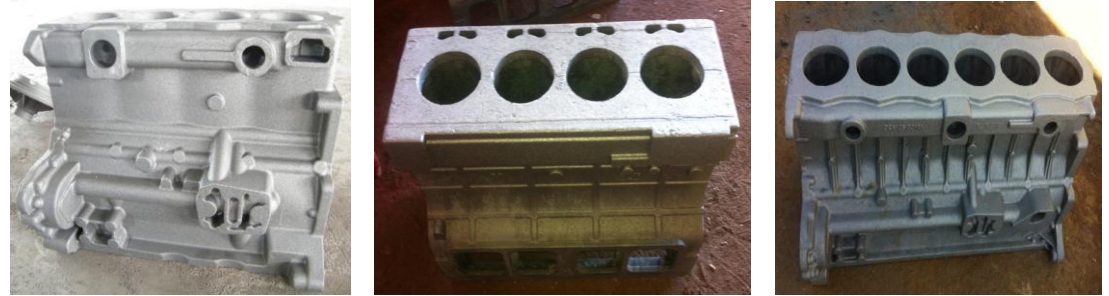
The coating adhesion strength is governed by:
$$ F_{adhesion} = \frac{\sigma_{coating} \cdot A_{contact}}{1 + \mu \cdot \tan\theta} $$
Where:
σcoating = Coating material yield strength (MPa)
Acontact = Effective contact area (mm²)
μ = Friction coefficient
θ = Surface texture angle (°)
2. Pore Defect Analysis and Classification
Five pore formation mechanisms were identified through metallurgical analysis:
| Type | Depth (μm) | Diameter (μm) | Post-Honing Behavior |
|---|---|---|---|
| Surface-Embedded | 0-50 | 20-100 | Complete removal |
| Uniform | 50-120 | 50-150 | Partial exposure |
| Divergent | 80-200 | 100-300 | Critical defect |
| Convergent | 50-150 | 80-200 | Conditional acceptance |
| Subsurface | 120-250 | 150-400 | Rejection |
3. Secondary Spray Process Development
The optimized secondary spray parameters for engine cylinder block repair:
| Parameter | Primary Spray | Secondary Spray |
|---|---|---|
| Plasma Power (kW) | 42 | 38 |
| Feed Rate (g/min) | 60 | 45 |
| Spray Distance (mm) | 120 | 100 |
| Layer Thickness (μm) | 250 | 120 |
The total effective coating thickness after secondary processing:
$$ T_{total} = (T_{primary} – H_{rough}) + (T_{secondary} – H_{repair}) $$
Where:
Tprimary = Initial spray thickness (250 μm)
Hrough = Rough honing removal (70 μm)
Tsecondary = Secondary spray thickness (120 μm)
Hrepair = Repair honing removal (30 μm)
4. Quality Validation Results
Batch testing of 168 engine cylinder blocks showed:
| Quality Parameter | Primary Process | Secondary Process | Improvement |
|---|---|---|---|
| Pore Defect Rate | 1.5% | 0.2% | 86.7% |
| Adhesion Strength (MPa) | 35.2 | 38.1 | 8.2% |
| Surface Roughness Ra (μm) | 0.38 | 0.32 | 15.8% |
| Process Yield | 84.5% | 93.7% | 9.2% |
The adhesion strength enhancement follows:
$$ \Delta F = \eta \cdot \left(1 – \frac{d_p}{d_c}\right) \cdot \sigma_{base} $$
Where:
η = Interface bonding efficiency (0.85-0.92)
dp = Average pore diameter (μm)
dc = Critical pore diameter (150 μm)
σbase = Base material strength (120 MPa)
5. Process Implementation Strategy
For successful engine cylinder block secondary spray implementation:
- Establish multi-stage pore screening criteria
$$ C_{rework} = \begin{cases}
d_p ≥ 0.3\text{mm} & \text{Immediate rework} \\
0.15\text{mm} ≤ d_p < 0.3\text{mm} & \text{Statistical process control} \\
d_p < 0.15\text{mm} & \text{Accept as-is}
\end{cases} $$ - Implement adaptive spray parameter adjustment
$$ P_{spray} = P_{base} \cdot \left[1 + 0.05\left(\frac{T_{actual} – T_{target}}{T_{target}}\right)\right] $$ - Develop automated defect detection algorithm
$$ Confidence = \frac{1}{1 + e^{-(0.5x_1 + 0.3x_2 + 0.2x_3)}} $$
Where x1=pore density, x2=size distribution, x3=depth ratio
This comprehensive approach demonstrates that optimized secondary spray coating significantly enhances engine cylinder block quality while maintaining production efficiency. The technical solutions and quality control methods provide valuable guidance for high-precision thermal spray applications in automotive manufacturing.