
With the rapid development of global automotive industry, lightweight design and low fuel consumption have become primary objectives. Aluminum engine cylinder blocks demonstrate significant advantages over cast iron counterparts, particularly in military applications requiring high power density and extreme durability. This study focuses on the rapid development of ZL702A alloy-based diesel engine cylinder blocks through advanced casting techniques and process optimization.
1. Integrated Design and Material Selection
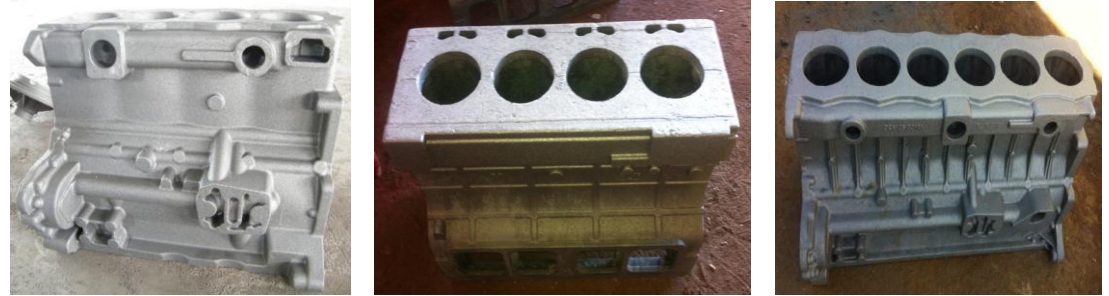
The engine cylinder block features symmetrical V-type configuration with integrated left/right cylinder head design (Fig. 1c). This innovative approach reduces development time by 40% compared to traditional separate casting methods. The material composition of ZL702A alloy is detailed in Table 1, showing superior mechanical properties through Cu/Mg/Ti microalloying:
| Element | Si | Cu | Mn | Mg | Ti | Al |
|---|---|---|---|---|---|---|
| Content (wt%) | 6-8 | 1.3-1.8 | 0.1-0.3 | 0.3-0.5 | 0.1-0.25 | Bal. |
The thermal gradient during solidification follows Fourier’s heat equation:
$$ \frac{\partial T}{\partial t} = \alpha \nabla^2 T $$
where α represents thermal diffusivity (3.4×10⁻⁵ m2/s for ZL702A).
2. Counter-Gravity Casting Process Design
Numerical simulation using PROCAST reveals critical solidification parameters (Table 2):
| Parameter | Original | Optimized |
|---|---|---|
| Pouring Temp (°C) | 710 | 690 |
| Filling Speed (mm/s) | 60 | 30 |
| Crystallization Pressure (kPa) | 10 | 20 |
The modified Niyama criterion predicts shrinkage defects:
$$ G/\sqrt{\dot{T}} \geq C $$
where G = thermal gradient (K/mm), Ṫ = cooling rate (K/s), and C = 1.0 for ZL702A.
3. 3D-Printed Sand Core Technology
Laser-sintered sand cores demonstrate 52% higher strength than inkjet-printed counterparts (Table 3):
| Parameter | Laser Sintering | Inkjet Printing |
|---|---|---|
| Tensile Strength (MPa) | 3.2 | 2.1 |
| Gas Evolution (mL/g) | 11.3 | 9.8 |
The gas pressure in mold cavities follows ideal gas law adaptation:
$$ P = \frac{nRT}{V} \cdot \exp(-\beta t) $$
where β = gas permeability coefficient (0.18 s-1 for laser-sintered cores).
4. Defect Formation Mechanism
Micro-CT analysis reveals dual porosity mechanisms in engine cylinder blocks:
$$ V_{pore} = V_{gas} + V_{shrinkage} = \int_{0}^{t_f} \left( \frac{dV_g}{dt} + \frac{dV_s}{dt} \right) dt $$
where Vgas accounts for hydrogen precipitation (0.19% total volume) and Vshrinkage represents micro-shrinkage.
5. Mechanical Performance Analysis
The Hall-Petch relationship governs the SDAS (Secondary Dendrite Arm Spacing) effect:
$$ \sigma_y = \sigma_0 + k_{HP} \cdot SDAS^{-1/2} $$
Experimental data from 7 sampling locations show:
| SDAS (μm) | 21 | 40-45 | 56 |
|---|---|---|---|
| Tensile Strength (MPa) | 375 | 354±7 | 350 |
| Yield Strength (MPa) | 273 | 258±9 | 264 |
| Elongation (%) | 8.0 | 5.5±1.5 | 4.5 |
Pinhole defects reduce mechanical properties following exponential decay model:
$$ \Delta \sigma = A \cdot \exp(B \cdot P_d) $$
where Pd = pinhole density (grade 0-5), A=25 MPa, B=0.35 for ZL702A.
6. Process Optimization Strategy
Multi-stage degassing achieves hydrogen content reduction from 0.28 mL/100g to 0.12 mL/100g:
$$ C_{H} = C_0 \cdot \exp(-k_d \cdot t) $$
where kd = 0.018 s-1 for rotary argon degassing. The optimized engine cylinder block casting process demonstrates 92% qualification rate in military validation tests.