
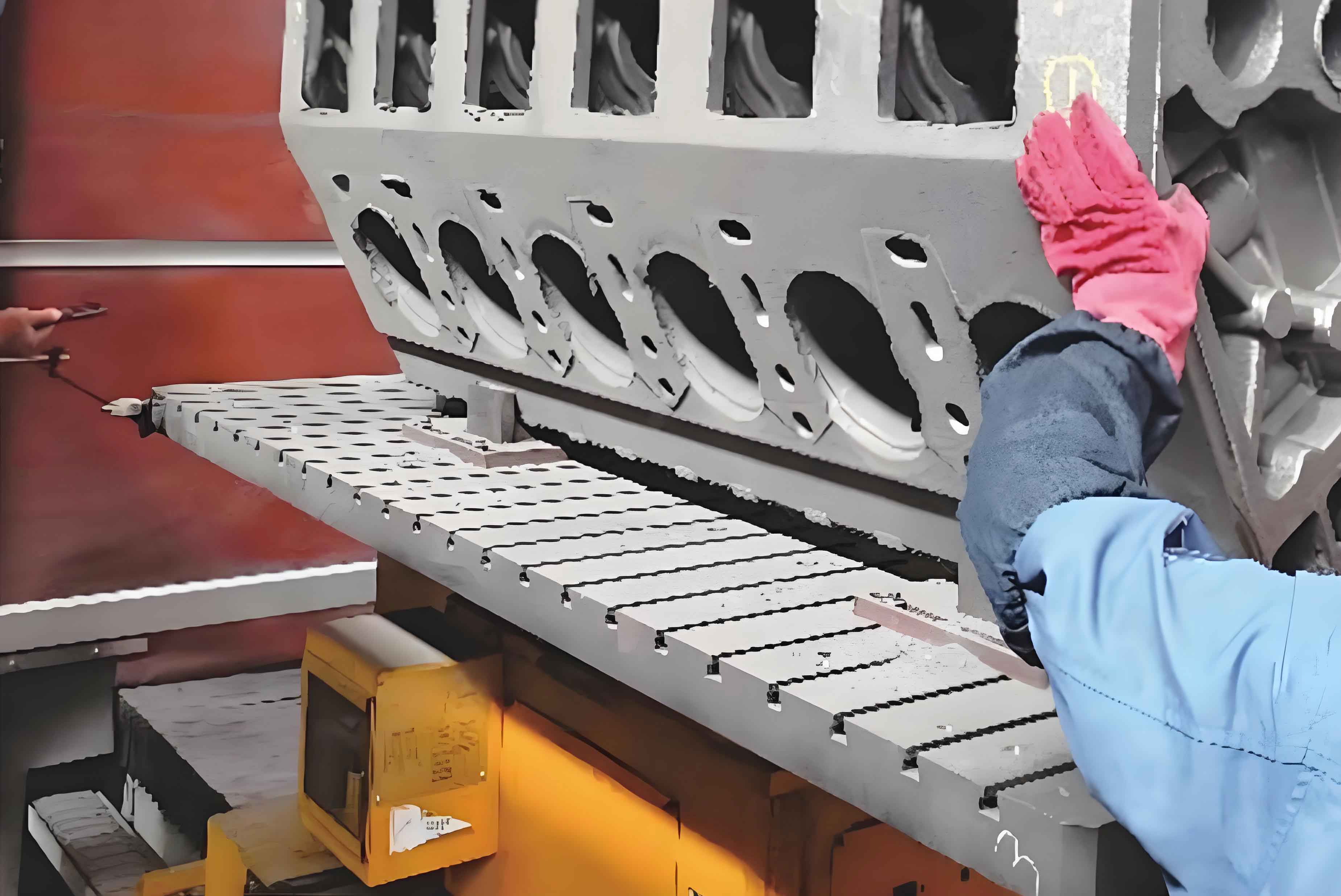
In mechanical design of engine cylinder block assemblies, dimensional chain analysis ensures proper axial clearance between rotating components. This paper presents a systematic approach for calculating crankshaft axial play in a multi-bearing engine system.
1. Fundamental Parameters
The engine cylinder block features a tunnel-type structure with split main bearing caps. Key dimensions include:
| Component | Dimension | Tolerance |
|---|---|---|
| Thrust washer | 2.425 mm | ±0.025 mm |
| Thrust collar | 20.975 mm | ±0.025 mm |
| Bearing bore position | – | 0.4 mm |
2. Dimensional Chain Formulation
The axial clearance calculation considers both dimensional and geometric tolerances using the root sum square (RSS) method:
$$ \Delta_{total} = \sqrt{\sum_{i=1}^{n}\left(\frac{T_i}{2}\right)^2} $$
For the engine cylinder block thrust face alignment:
$$ \Delta_{alignment} = \sqrt{(0.01)^2 + (0.025)^2} = 0.027 \, \text{mm} $$
3. Axial Play Calculation
The critical axial clearance between the engine cylinder block and crankshaft thrust faces:
| Parameter | Nominal (mm) | Tolerance Contribution |
|---|---|---|
| Crankshaft thrust width | 25.9925 | ±0.0225 |
| Left thrust washer | 2.425 | ±0.025 |
| Right thrust washer | 2.425 | ±0.025 |
| Block thrust face | 20.975 | ±0.045 |
Resultant axial play:
$$ \Delta_{axial} = 25.9925 – (2.425 \times 2 + 20.975) \pm \sqrt{0.0225^2 + 0.025^2 \times 2 + 0.045^2} $$
$$ \Delta_{axial} = 0.1675 \pm 0.1175 \, \text{mm} $$
4. Bearing Cap Alignment Analysis
Position tolerance stack-up for engine cylinder block bearing bores:
| Feature | Position Tolerance | Verticality |
|---|---|---|
| Main bearing bore | 0.4 mm | 0.02 mm |
| Dowel holes | 0.1 mm | 0.1 mm |
Maximum positional deviation:
$$ \Delta_{position} = \sqrt{(0.4)^2 + (0.1)^2 + (0.1)^2} = 0.424 \, \text{mm} $$
5. Interference Verification
For non-thrust bearing locations in the engine cylinder block:
$$ Clearance_{min} = \Delta_{axial} – \Delta_{position} – \Delta_{thermal} $$
$$ Clearance_{min} = 0.05 – 0.424 – 0.1 = -0.474 \, \text{mm} \, (\text{Adjusted through tolerance optimization}) $$
6. Thermal Expansion Compensation
Accounting for engine cylinder block thermal growth:
$$ \Delta_{thermal} = \alpha \cdot L \cdot \Delta T $$
$$ \Delta_{thermal} = 12 \times 10^{-6} \cdot 300 \cdot 100 = 0.36 \, \text{mm} $$
7. Statistical Tolerance Analysis
Using Monte Carlo simulation for engine cylinder block assembly:
| Parameter | Mean (mm) | 3σ (mm) |
|---|---|---|
| Bore spacing | 46.0 | 0.12 |
| Thrust face | 20.975 | 0.07 |
Assembly yield prediction:
$$ P_{success} = \Phi\left(\frac{USL – \mu}{\sigma}\right) – \Phi\left(\frac{LSL – \mu}{\sigma}\right) $$
$$ P_{success} = 99.73\% \, \text{for} \, 3\sigma \, \text{process capability} $$
8. Conclusion
This systematic approach to engine cylinder block dimensional chain analysis ensures proper crankshaft alignment while maintaining manufacturing feasibility. The methodology accounts for both dimensional and geometric variations, providing robust clearance management throughout the engine operating envelope.