
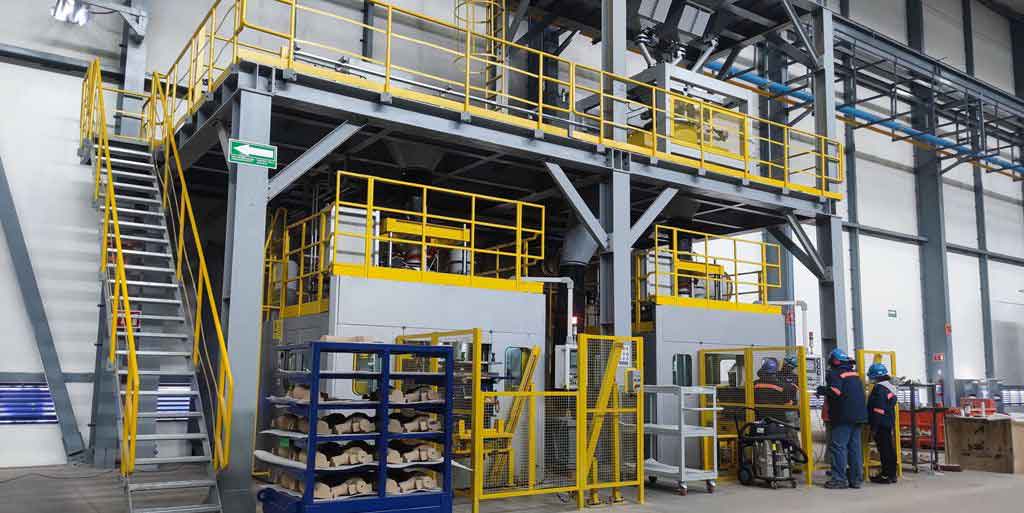
Marine-grade steel castings exhibit unique challenges due to their large dimensions, complex geometries, and stringent performance requirements. This paper systematically analyzes critical defects in shipbuilding castings through empirical case studies while proposing optimized control methodologies.
1. Fundamental Defect Mechanisms
The solidification dynamics of steel castings follow Chvorinov’s rule:
$$ t = B \left( \frac{V}{A} \right)^n $$
where t = solidification time, V = casting volume, A = surface area, and B,n = material constants. Improper control of these parameters leads to various defects:
| Defect Type | Formation Mechanism | Critical Parameters |
|---|---|---|
| Hot Tears | Thermal stress exceeding material strength during solidification | $$ \sigma_{thermal} = E \alpha \Delta T $$ |
| Gas Porosity | Entrapped gases exceeding solubility limit | $$ C = k\sqrt{P_{H_2}} $$ (Sievert’s Law) |
| Shrinkage | Inadequate feeding during phase change | $$ V_{shrink} = \beta V_{casting} $$ |
2. Process Optimization Framework
Effective steel casting production requires multivariate control across three domains:
| Control Domain | Key Parameters | Optimum Range |
|---|---|---|
| Melting | Superheat temperature, deoxidation practice | ΔT = 80-120°C |
| Molding | Sand permeability, binder ratio | AFS 60-80, 3.5-4.5% resin |
| Solidification | Chill placement, feeder design | Modulus ratio ≥1.2 |
The thermal gradient during cooling must satisfy:
$$ \nabla T \leq \frac{\sigma_{yield}}{E \alpha} $$
where σyield = material yield strength, E = Young’s modulus, α = thermal expansion coefficient.
3. Advanced Detection Methodologies
Implement multi-stage inspection protocols for steel castings:
| Stage | Technique | Sensitivity |
|---|---|---|
| Surface | Magnetic particle testing | 0.1mm cracks |
| Subsurface | Ultrasonic testing (5MHz) | Φ2mm @ 50mm depth |
| Volumetric | X-ray tomography | 0.5% density variation |
The probability of defect detection follows:
$$ P_d = 1 – e^{-\lambda A} $$
where λ = defect density, A = inspected area.
4. Repair Metallurgy
Post-repair heat treatment parameters for steel castings:
| Repair Depth | Preheat | Post-heat |
|---|---|---|
| <25mm | 150-200°C | 600°C × 1h |
| 25-50mm | 200-250°C | 620°C × 2h |
| >50mm | 300-350°C | 650°C × 4h |
Diffusion kinetics govern repair zone homogenization:
$$ D = D_0 \exp\left(-\frac{Q}{RT}\right) $$
where D = diffusion coefficient, Q = activation energy, R = gas constant.
5. Environmental Controls
Humidity effects on steel casting quality:
| RH Level | Gas Porosity | Sand Strength |
|---|---|---|
| 40-60% | Acceptable | Optimal |
| >75% | +300% | -25% |
| <30% | Binder failure | Dusting |
Ventilation requirements for steel casting shops:
$$ Q = \frac{0.5P}{C_1 – C_0} $$
where Q = airflow (m³/h), P = pollutant generation rate, C = concentration limits.
6. Conclusion
Through systematic control of thermal dynamics, material properties, and environmental factors, modern steel casting processes achieve defect rates below 1.2% for marine components. Continuous monitoring of these parameters ensures compliance with maritime classification standards while maintaining production efficiency.