
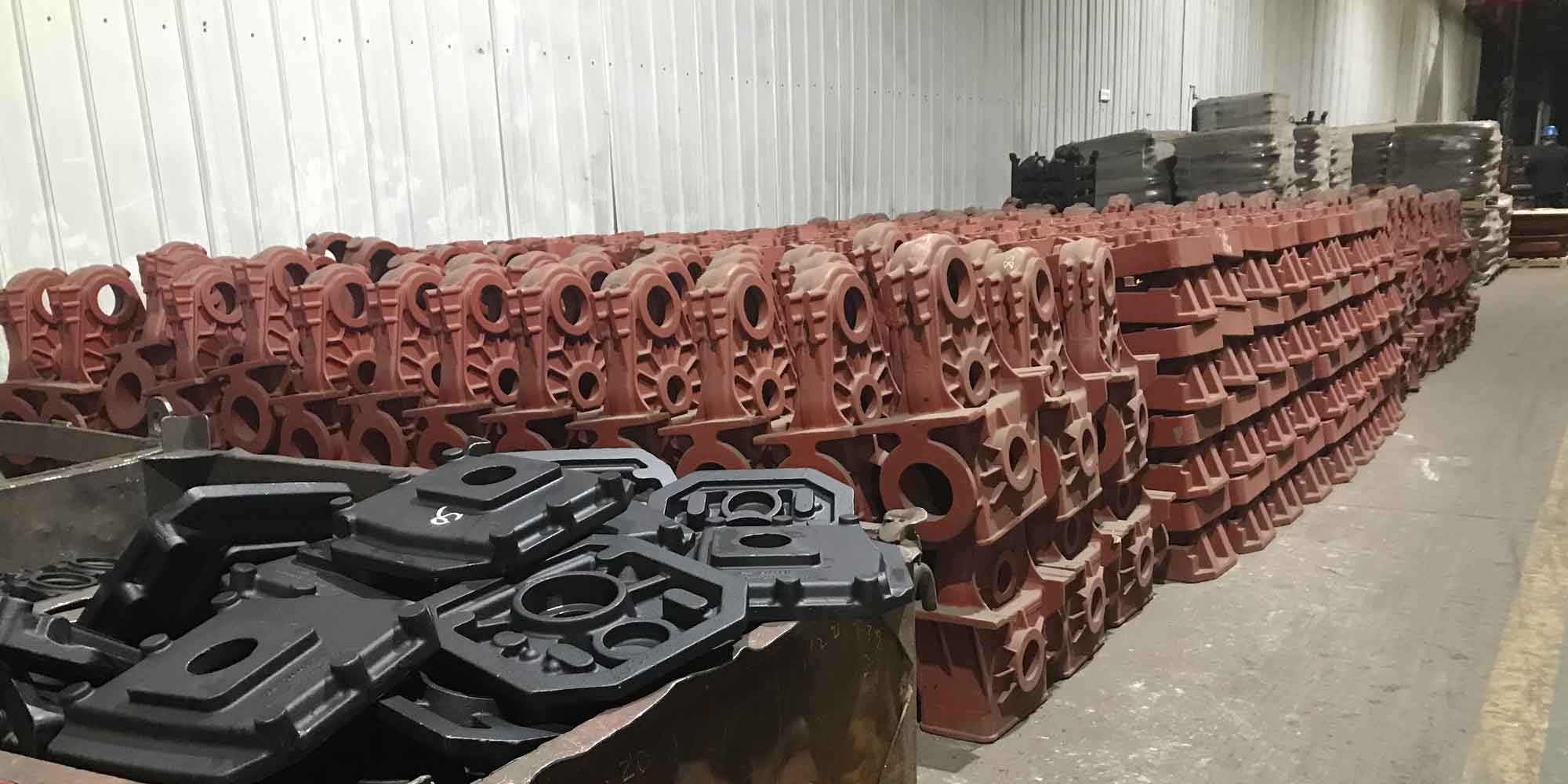
This paper systematically explores the application of coated sand technology in steel casting production through process optimization, material analysis, and economic evaluation. As a state-owned enterprise producing 10,000 tons/year of steel castings for rail transportation equipment, we have achieved significant improvements in surface quality and cost efficiency through coated sand implementation.
1. Process Design & Equipment Configuration
The core equipment includes two Z8957CE vertical parting thermal core shooters operating under these parameters:
$$T_{\text{shooting}} = 260-270\ \degree C$$
$$t_{\text{curing}} = 3-3.5\ \mathrm{min}$$
$$P_{\text{sand-filling}} = 0.5-0.6\ \mathrm{MPa}$$
| Process Stage | Key Parameters |
|---|---|
| Core Shooting | Cycle time ≤5 min/set |
| Coating | Zircon-based alcohol coating (1 layer) |
| Pouring | Tsteel = 1560-1580°C |
2. Material System Optimization
The coated sand formulation for steel casting components follows:
$$W_{\text{total}} = W_{\text{sand}} + W_{\text{resin}} + W_{\text{additive}}$$
$$W_{\text{resin}} = 2.7-2.9\%\ W_{\text{sand}}$$
$$W_{\text{lubricant}} = 0.1-0.5\%\ W_{\text{sand}}$$
| Material | Specification | Parameter |
|---|---|---|
| Silica Sand | AFS 70/100 | SiO2 ≥98% |
| Resin | Phenolic | Softening point 95°C |
| Additive | Hexamine | 0.1-0.6% |
3. Quality Control Mechanisms
Key performance equations for coated sand in steel casting applications:
Bending strength at room temperature:
$$\sigma_b = \frac{3FL}{2bh^2}$$
Thermal deformation resistance:
$$\varepsilon_{\text{thermal}} = \alpha \cdot \Delta T + \frac{\sigma}{E}$$
| Property | Standard | Measurement |
|---|---|---|
| Cold Strength | ISO 10025 | 7.5-7.7 MPa |
| Hot Strength | ASTM C884 | 4.0-4.2 MPa |
| LOI | DIN 51900 | 3.2-3.6% |
4. Process Parameter Sensitivity
Critical factors affecting steel casting quality with coated sand:
$$Q_{\text{gas}} = k \cdot W_{\text{resin}} \cdot T_{\text{pouring}}^{1.5}$$
$$t_{\text{opt}} = \frac{d^2}{4\alpha} \cdot \ln\left(\frac{T_m – T_0}{T_m – T_c}\right)$$
| Factor | Impact | Control Range |
|---|---|---|
| Resin Content | ↑1% → Strength ↑15% | 2.7-3.2% |
| Curing Temp | Δ10°C → Cycle Δ25% | 240-260°C |
| Sand Fineness | AFS ↑10 → Surface Ra↓2μm | 70-100 |
5. Economic Analysis
Cost comparison between conventional and coated sand processes for steel casting:
$$C_{\text{total}} = C_{\text{material}} + C_{\text{energy}} + C_{\text{labor}}$$
$$\eta_{\text{reclamation}} = \frac{W_{\text{reused}}}{W_{\text{total}}} \times 100\%$$
| Metric | Water Glass Sand | Coated Sand |
|---|---|---|
| Binder Cost | $12.5/ton | $28.7/ton |
| Reclamation Rate | 62% | 89% |
| Defect Rate | 3.2% | 1.1% |
Through systematic optimization of coated sand parameters for steel casting production, we achieved 23% reduction in post-processing costs and 15% improvement in dimensional accuracy. Future developments will focus on low-resin formulations (≤2.5%) and AI-driven process control systems.