
This study presents a comprehensive approach to designing and optimizing the steel casting process for a ZG45 anvil base, a critical component in forging equipment. By integrating numerical simulation, foam pattern fabrication, and sand mold preparation techniques, the research addresses challenges related to shrinkage, cracks, and efficiency in traditional casting methods.
Technical Requirements and Material Characteristics
The ZG45 steel casting requires strict control of chemical composition to ensure mechanical performance under heavy impact loads. Table 1 summarizes the chemical requirements:
| Element | C | Mn | Si | P | S | Cr | Mo | Ni |
|---|---|---|---|---|---|---|---|---|
| Content (%) | 0.42–0.50 | 0.50–0.80 | 0.17–0.37 | ≤0.035 | ≤0.035 | 0–0.25 | 0–0.25 | 0–0.30 |
The modulus (M) calculation for riser design follows Chvorinov’s rule:
$$ M = \frac{V}{A} $$
where V is volume (mm³) and A is surface area (mm²). For the anvil base geometry (1,000 mm × 720 mm × 300 mm), the calculated modulus was 62 mm, necessitating risers with M ≥ 75.4 mm.
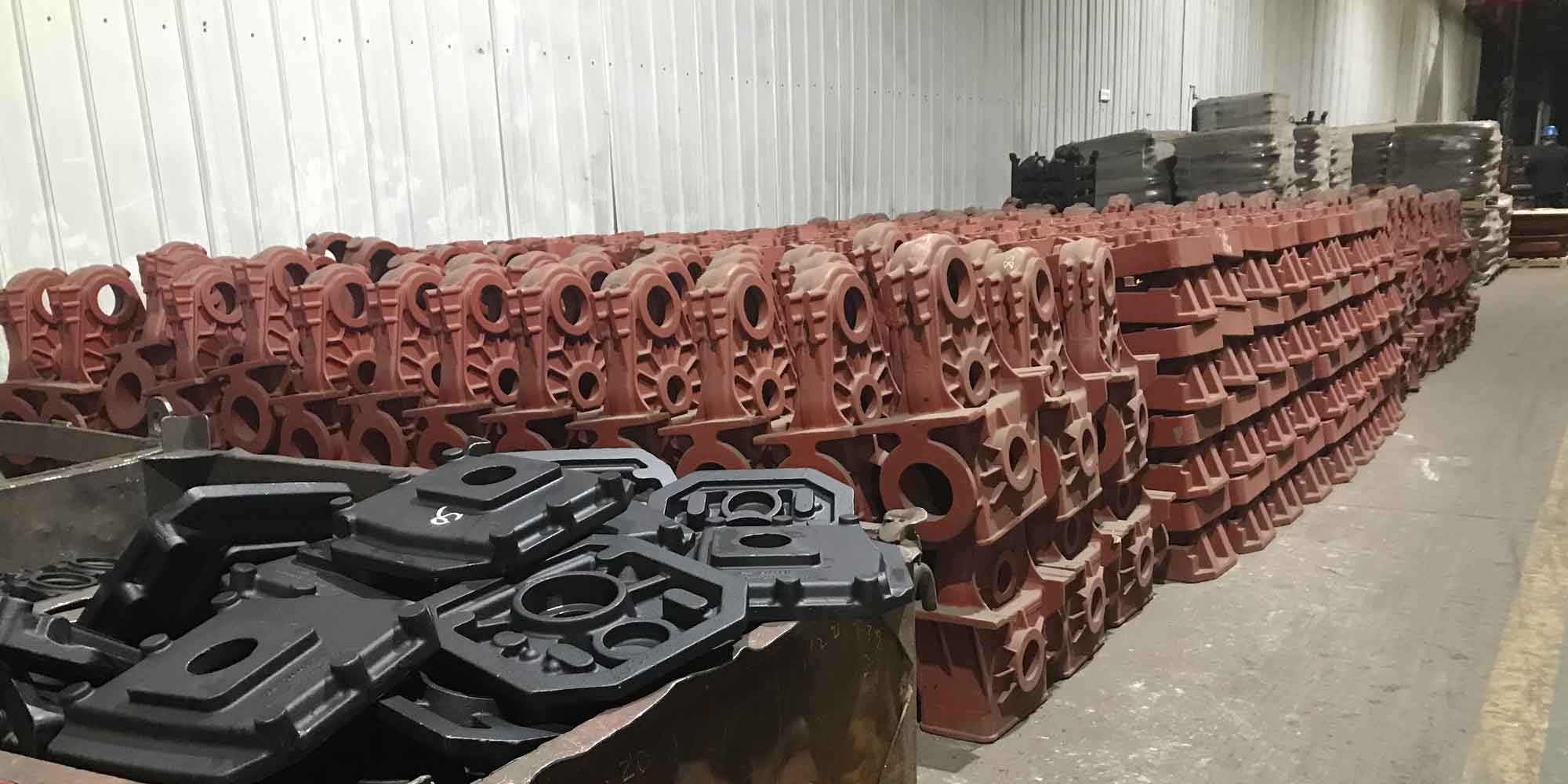
Process Design Methodology
The vertical parting design was selected over horizontal parting through thermal analysis using ProCAST software. The governing heat transfer equation for solidification modeling:
$$ \frac{\partial T}{\partial t} = \alpha \nabla^2 T + \frac{L}{C_p} \frac{\partial f_s}{\partial t} $$
where α is thermal diffusivity (m²/s), L latent heat (J/kg), and fs solid fraction.
Key process parameters:
| Parameter | Value |
|---|---|
| Pouring Temperature | 1,565°C |
| Mold Initial Temperature | 20°C |
| Pouring Rate | 35 kg/s |
Numerical Simulation and Defect Prediction
Initial process simulation revealed critical shrinkage defects in upper regions (Figure 4). The Niyama criterion identified risk zones:
$$ N_y = \frac{G}{\sqrt{\dot{T}}} $$
where G is temperature gradient (°C/mm) and Ṫ cooling rate (°C/s). Regions with Ny < 1 (°C·s)0.5/mm were prone to microporosity.
Process Optimization Strategy
The revised design implemented:
- Dual risers (FT400-S350) with modified placement
- Optimized chill layout using heat transfer equations:
$$ Q = kA\frac{\Delta T}{d} $$
where Q is heat flux (W), k thermal conductivity (W/m·K), and d chill thickness (mm) - Gating system redesign with velocity control:
$$ v = \sqrt{2gh + \frac{p_{\text{atm}} – p_{\text{mold}}}{\rho}} $$
| Parameter | Initial | Optimized |
|---|---|---|
| Riser Quantity | 1 | 2 |
| Yield (%) | 58.3 | 61.8 |
| Solidification Time (h) | 4.2 | 3.8 |
Production Validation and Quality Control
Post-optimization casting achieved HB210–235 hardness with complete elimination of shrinkage defects. Residual stress analysis confirmed:
$$ \sigma_{\text{res}} = E\alpha \Delta T \left(1 – \frac{1}{1 + \frac{h^2}{3r^2}}\right) $$
where E is Young’s modulus (GPa), α thermal expansion coefficient (1/°C), and h/r geometric ratios.
Economic and Technical Benefits
The steel casting approach demonstrated:
- 30% reduction in development time compared to wood pattern methods
- 15% improvement in material utilization
- Zero heat treatment-induced cracking
This methodology provides a robust framework for heavy steel castings requiring high impact resistance and dimensional stability. The integration of numerical simulation with rapid pattern fabrication significantly enhances process reliability while maintaining cost-effectiveness for single-piece production.