
In the steel casting manufacturing industry, flash removal plays a critical role in ensuring surface quality and dimensional accuracy. This paper presents an intelligent grinding system combining 3D vision detection with industrial robotics to address the limitations of manual polishing. The proposed methodology includes point cloud processing for pose estimation, defect segmentation, and optimized trajectory generation, significantly improving automation levels in steel casting post-processing.
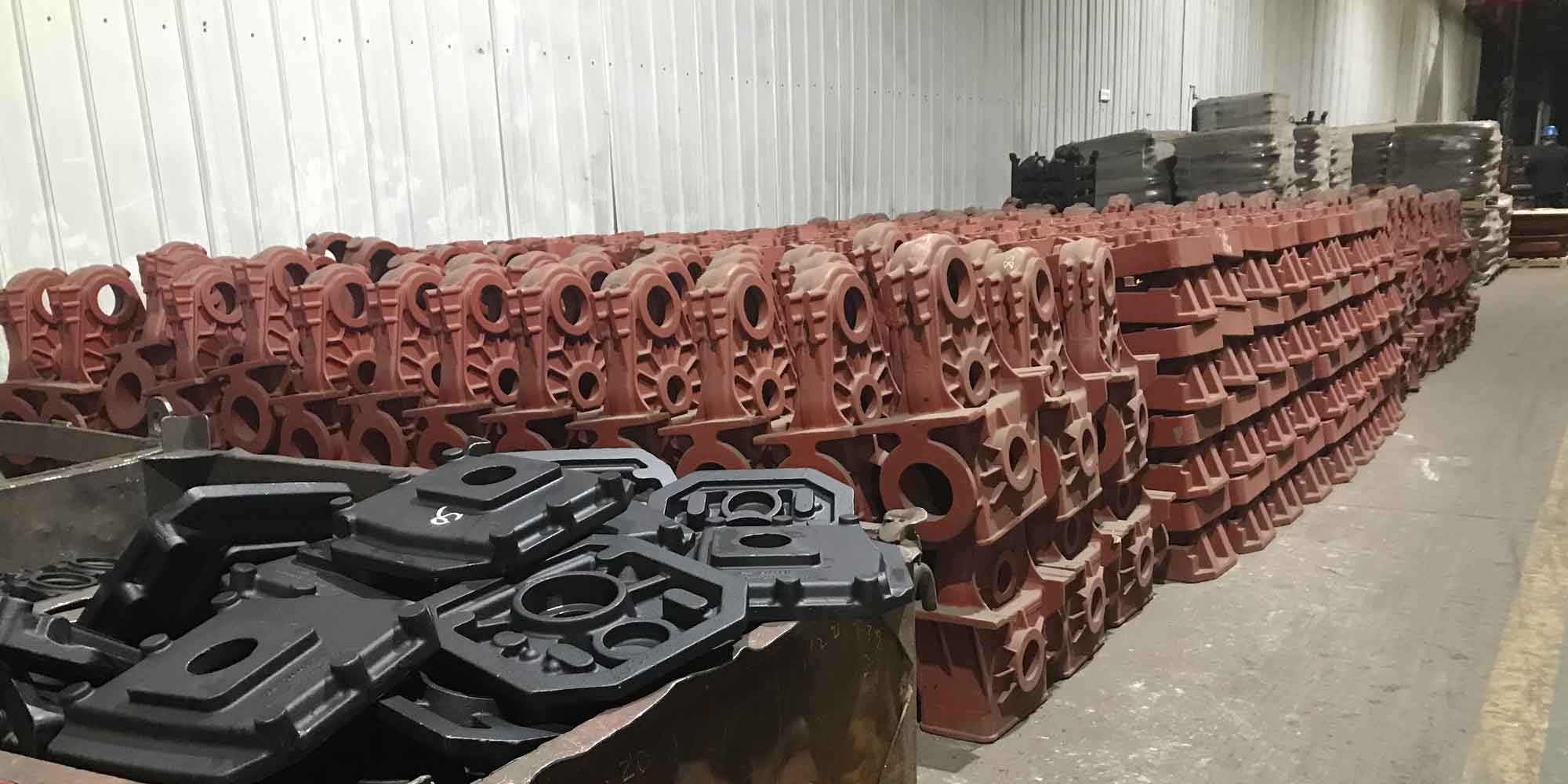
1. Coordinate Transformation in Grinding System
The spatial relationship between robotic manipulator and steel casting is established through coordinate transformation matrices:
$$T_B^E = \begin{bmatrix}
R & t \\
0 & 1
\end{bmatrix}$$
Where $R$ represents rotation matrix and $t$ denotes translation vector. For steel casting pose estimation, we calculate transformation between scanner coordinate system {M} and workpiece coordinate system {C}:
$$T_C^M = (T_B^M)^{-1} \cdot T_B^C$$
2. Point Cloud Registration Algorithm
An improved registration method combining PCA alignment and normal vector constraints achieves superior performance:
| Method | RMSE (mm) | Time (s) |
|---|---|---|
| SAC-IA+NDT | 3.15×10⁻² | 3.28 |
| 4PCS+ICP | 2.23×10⁻² | 2.53 |
| Proposed | 0.53×10⁻³ | 0.86 |
The registration error metric is defined as:
$$E_{reg} = \frac{1}{N}\sum_{i=1}^{N} \|p_i – T\cdot q_i\|^2$$
where $p_i$ and $q_i$ represent corresponding points in source and target point clouds of steel castings.
3. Flange Feature Extraction
Alpha-shapes algorithm effectively identifies flash boundaries on steel castings:
$$\alpha = \arg\max_{r}\left\{\bigcap_{i=1}^{n} B(p_i,r) \cap P = \emptyset\right\}$$
where $B(p_i,r)$ denotes a sphere with radius $r$ centered at point $p_i$. The optimized voxel downsampling preserves edge features:
$$p_{voxel} = \arg\min_{p_j \in V} \|p_j – \bar{p}\|$$
where $\bar{p}$ is voxel centroid and $V$ contains all points within the voxel.
4. Quintic Spline Trajectory Generation
The robotic grinding path is generated using non-uniform B-spline interpolation:
$$C(u) = \sum_{i=0}^{n} N_{i,5}(u)P_i$$
where $N_{i,5}$ represents 5th-degree basis functions and $P_i$ are control points. The knot vector $U$ for steel casting path points $\{q_k\}$ is calculated as:
$$u_{k+5} = u_{k+4} + \frac{\|q_{k+1} – q_k\|}{\sum_{i=1}^{m} \|q_i – q_{i-1}\|}$$
| Method | Max Error (mm) | Smoothness (m/s³) |
|---|---|---|
| Polynomial | 1.67 | 0.85 |
| Cubic Spline | 0.87 | 0.42 |
| Quintic B-spline | 0.43 | 0.12 |
5. Robotic Motion Control
The inverse kinematics solution for 6-DOF manipulator handling steel castings is formulated as:
$$\theta = J^+ ( \dot{X} – \dot{J}\theta ) + (I – J^+J)z$$
where $J^+$ represents Moore-Penrose pseudo-inverse of Jacobian matrix. The joint velocity profile follows S-curve acceleration:
$$a(t) = \begin{cases}
\frac{2A}{T^2}t, & 0 \leq t < \frac{T}{2} \\
A – \frac{2A}{T^2}(t – \frac{T}{2}), & \frac{T}{2} \leq t \leq T
\end{cases}$$
6. Experimental Validation
The developed steel casting processing system demonstrates:
$$Positioning\ Accuracy: 0.12\pm0.03mm$$
$$Path\ Following\ Error: <0.5mm$$
$$Cycle\ Time: 85s\ per\ casting$$
Implementation results confirm the effectiveness of proposed methods in automated steel casting finishing applications, significantly improving production efficiency and surface quality compared to manual operations.