
This study investigates defect formation mechanisms and process optimization for a compressor support ring steel casting (ZG13Cr9Mo2Co1NiVNbNB alloy) using numerical simulation. Through systematic analysis of filling patterns, solidification behavior, and shrinkage defects, an optimized casting scheme with improved quality control was developed.
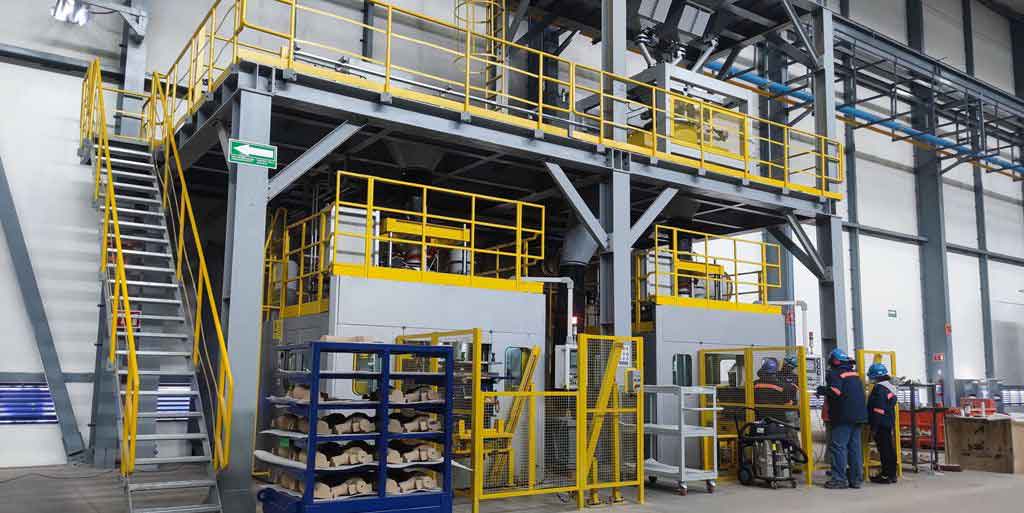
1. Casting Process Design
The steel casting process employed bottom gating system with three feeding risers and chill placements. Key process parameters were determined through modulus calculations:
$$ M = \frac{V}{S} $$
Where $M$ represents modulus (cm), $V$ volume (cm³), and $S$ cooling surface area (cm²). The optimized riser dimensions followed:
$$ M_{\text{riser}} = 1.2M_{\text{casting}} $$
| Element | C | Cr | Mo | Co | V |
|---|---|---|---|---|---|
| Content (%) | 0.11-0.14 | 9.00-9.60 | 1.40-1.60 | 0.90-1.10 | 0.18-0.23 |
2. Numerical Simulation Methodology
The governing equations for steel casting simulation include:
Continuity equation:
$$ \frac{\partial \rho}{\partial t} + \nabla (\rho \mathbf{V}) = 0 $$
Momentum conservation:
$$ \rho \left( \frac{\partial \mathbf{V}}{\partial t} + \mathbf{V} \cdot \nabla \mathbf{V} \right) = -\nabla P + \mu \nabla^2 \mathbf{V} + \rho \mathbf{g} $$
Energy conservation:
$$ \rho c_p \frac{\partial T}{\partial t} = \nabla (k \nabla T) + Q_{\text{latent}} $$
The Niyama criterion predicted shrinkage porosity:
$$ \frac{G}{\sqrt{R}} < C_{\text{Niyama}} $$
Where $G$ denotes temperature gradient (°C/mm), $R$ cooling rate (°C/s), and $C_{\text{Niyama}}$ the critical value (0.8-1.1).
3. Process Optimization Strategy
Orthogonal testing revealed key parameter influences on defect formation:
| Factor | Level 1 | Level 2 | Level 3 | Range |
|---|---|---|---|---|
| Pouring Temp (°C) | 1585 | 1575 | 1565 | 13.96 |
| Flow Rate (kg/s) | 100 | 90 | 105 | 8.56 |
| Mold Temp (°C) | 20 | 25 | 30 | 0.57 |
The optimal parameters for steel casting were determined as:
$$ T_{\text{pour}} = 1575\,^\circ\text{C},\ \dot{m} = 100\,\text{kg/s},\ T_{\text{mold}} = 20\,^\circ\text{C} $$
4. Defect Control Mechanisms
Implementing exothermic risers and strategic chill placement achieved directional solidification:
$$ \frac{dT}{dz} = 2.8\text{–}3.2\,^\circ\text{C/cm} $$
Key improvements included:
- Shrinkage porosity reduced from 16% to 8.4%
- Riser efficiency increased by 40-50%
- Microstructure uniformity enhanced (ASTM grain size 3-5)
5. Industrial Validation
Non-destructive testing confirmed the simulation accuracy:
| Method | Sensitivity | Defect Detection |
|---|---|---|
| UT | Φ2mm FBH | 0% |
| MT | 0.1mm surface | 0% |
| PT | 0.05mm depth | 0% |
The developed steel casting process demonstrates significant improvements in defect control and mechanical performance, providing technical guidance for heavy-section cast components in power generation systems.
“`html
Optimization of Steel Casting Process for Compressor Support Ring Based on ProCAST Simulation
This study investigates defect formation mechanisms and process optimization for a compressor support ring steel casting (ZG13Cr9Mo2Co1NiVNbNB alloy) using numerical simulation. Through systematic analysis of filling patterns, solidification behavior, and shrinkage defects, an optimized casting scheme with improved quality control was developed.
1. Casting Process Design
The steel casting process employed bottom gating system with three feeding risers and chill placements. Key process parameters were determined through modulus calculations:
$$ M = \frac{V}{S} $$
Where $M$ represents modulus (cm), $V$ volume (cm³), and $S$ cooling surface area (cm²). The optimized riser dimensions followed:
$$ M_{\text{riser}} = 1.2M_{\text{casting}} $$
| Element | C | Cr | Mo | Co | V |
|---|---|---|---|---|---|
| Content (%) | 0.11-0.14 | 9.00-9.60 | 1.40-1.60 | 0.90-1.10 | 0.18-0.23 |
2. Numerical Simulation Methodology
The governing equations for steel casting simulation include:
Continuity equation:
$$ \frac{\partial \rho}{\partial t} + \nabla (\rho \mathbf{V}) = 0 $$
Momentum conservation:
$$ \rho \left( \frac{\partial \mathbf{V}}{\partial t} + \mathbf{V} \cdot \nabla \mathbf{V} \right) = -\nabla P + \mu \nabla^2 \mathbf{V} + \rho \mathbf{g} $$
Energy conservation:
$$ \rho c_p \frac{\partial T}{\partial t} = \nabla (k \nabla T) + Q_{\text{latent}} $$
The Niyama criterion predicted shrinkage porosity:
$$ \frac{G}{\sqrt{R}} < C_{\text{Niyama}} $$
Where $G$ denotes temperature gradient (°C/mm), $R$ cooling rate (°C/s), and $C_{\text{Niyama}}$ the critical value (0.8-1.1).
3. Process Optimization Strategy
Orthogonal testing revealed key parameter influences on defect formation:
| Factor | Level 1 | Level 2 | Level 3 | Range |
|---|---|---|---|---|
| Pouring Temp (°C) | 1585 | 1575 | 1565 | 13.96 |
| Flow Rate (kg/s) | 100 | 90 | 105 | 8.56 |
| Mold Temp (°C) | 20 | 25 | 30 | 0.57 |
The optimal parameters for steel casting were determined as:
$$ T_{\text{pour}} = 1575\,^\circ\text{C},\ \dot{m} = 100\,\text{kg/s},\ T_{\text{mold}} = 20\,^\circ\text{C} $$
4. Defect Control Mechanisms
Implementing exothermic risers and strategic chill placement achieved directional solidification:
$$ \frac{dT}{dz} = 2.8\text{–}3.2\,^\circ\text{C/cm} $$
Key improvements included:
- Shrinkage porosity reduced from 16% to 8.4%
- Riser efficiency increased by 40-50%
- Microstructure uniformity enhanced (ASTM grain size 3-5)
5. Industrial Validation
Non-destructive testing confirmed the simulation accuracy:
| Method | Sensitivity | Defect Detection |
|---|---|---|
| UT | Φ2mm FBH | 0% |
| MT | 0.1mm surface | 0% |
| PT | 0.05mm depth | 0% |
The developed steel casting process demonstrates significant improvements in defect control and mechanical performance, providing technical guidance for heavy-section cast components in power generation systems.
“`