
Precision investment casting remains a cornerstone of modern manufacturing, enabling the production of complex near-net-shape components with exceptional dimensional accuracy (surface roughness Ra ≤ 3.2 μm). This paper systematically analyzes critical process parameters and presents optimized solutions for small-to-medium enterprises transitioning toward advanced manufacturing paradigms.
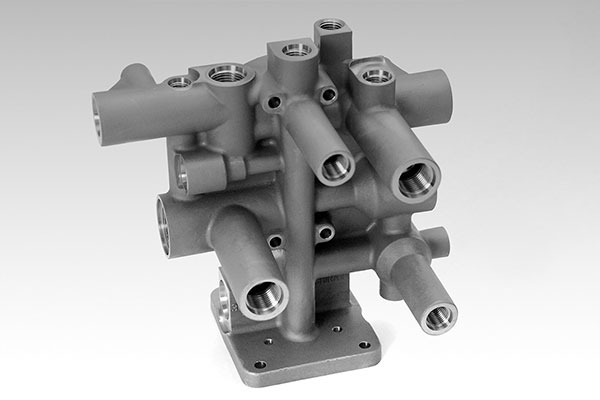
1. Core Process Parameters in Precision Investment Casting
The quality equation for precision investment casting can be expressed as:
$$ Q = f(P_m, S_c, F_t, M_q) $$
Where:
– \( P_m \): Pattern material properties
– \( S_c \): Shell ceramic characteristics
– \( F_t \): Firing temperature profile
– \( M_q \): Melt quality index
| Process Stage | Key Parameters | Optimal Range |
|---|---|---|
| Pattern Making | Wax viscosity (mPa·s) | 850-950 @ 75°C |
| Shell Building | Slurry density (g/cm³) | 1.75-1.85 |
| Dewaxing | Steam pressure (MPa) | 0.45-0.55 |
| Firing | Thermal ramp rate (°C/min) | 3-5 (below 600°C) |
2. Advanced Shell System Design
Modern shell systems for precision investment casting employ multilayer architectures:
$$ \text{Shell Strength} = \sum_{i=1}^{n} \left( \frac{E_i \cdot t_i}{1 – \nu_i^2} \right) $$
Where \( E_i \), \( t_i \), and \( \nu_i \) represent Young’s modulus, thickness, and Poisson’s ratio of each layer respectively.
| Layer | Material | Thickness (mm) | CTE (10⁻⁶/K) |
|---|---|---|---|
| Primary | Zircon | 0.15-0.25 | 4.5 |
| Secondary | Mullite | 0.3-0.4 | 5.2 |
| Backup | Alumina | 0.5-0.7 | 8.1 |
3. Melt Quality Control
The hydrogen solubility in molten alloys follows Sievert’s Law:
$$ [H] = K_H \sqrt{P_{H_2}} $$
Where \( K_H \) represents the temperature-dependent solubility constant. For precision investment casting of stainless steel:
$$ K_H = 0.65 \exp\left(-\frac{2850}{T}\right) $$
| Alloy | Target [H] (ppm) | Max [O] (ppm) | N₂ Control |
|---|---|---|---|
| 316L | ≤1.2 | ≤25 | Argon shrouding |
| Inconel 718 | ≤0.8 | ≤15 | Vacuum melting |
4. Thermal Management Strategies
The critical cooling rate to prevent deleterious phase formation:
$$ \frac{dT}{dt} \geq \frac{T_l – T_s}{\tau_c} $$
Where \( T_l \) = liquidus temperature, \( T_s \) = solidus temperature, \( \tau_c \) = critical time constant.
| Alloy | Optimal Cooling Rate (°C/min) | Method |
|---|---|---|
| Carbon Steel | 25-40 | Controlled air cooling |
| Ti-6Al-4V | 50-75 | Gas quenching |
5. Quality Assurance Metrics
The process capability index for precision investment casting:
$$ C_{pk} = \min\left(\frac{USL – \mu}{3\sigma}, \frac{\mu – LSL}{3\sigma}\right) $$
Typical achieved values for aerospace components:
| Feature | Tolerance (mm) | Cₚₖ |
|---|---|---|
| Thin walls | ±0.15 | 1.33 |
| Bore diameters | ±0.08 | 1.67 |
6. Energy Optimization Models
The thermal efficiency of modern furnaces:
$$ \eta = \frac{Q_{useful}}{Q_{input}} \times 100\% $$
Advanced recuperative systems achieve η ≥ 65% compared to conventional η ≈ 35%.
| Process | Energy Consumption (kWh/kg) | CO₂ Emission (kg/kg) |
|---|---|---|
| Conventional | 2.8 | 1.2 |
| Optimized | 1.6 | 0.7 |
Through systematic optimization of these parameters, precision investment casting achieves dimensional accuracy improvements up to 40% while reducing energy consumption by 30-45%. The integration of real-time process monitoring and adaptive control systems further enhances the consistency and reliability of high-performance cast components.