
The coupler is a critical component in railway systems, responsible for transmitting longitudinal forces between locomotives and carriages. Precision investment casting, known for its ability to produce complex geometries with high dimensional accuracy, is widely adopted for manufacturing E-grade steel couplers. This study integrates material characterization, finite element analysis (FEA), and fatigue simulation to evaluate the performance of a precision investment casting coupler under operational loads.
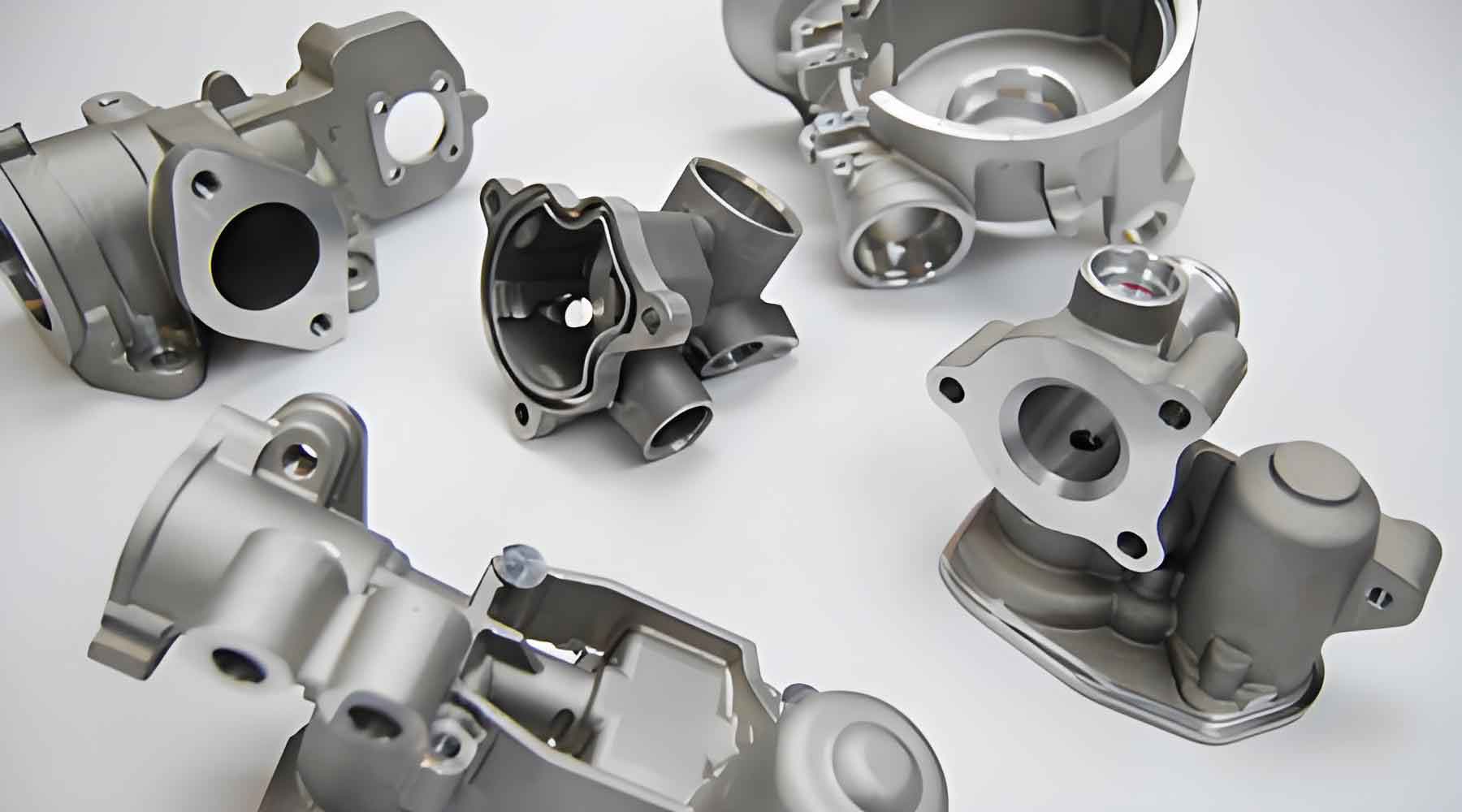
Material Characterization of Precision Investment Cast E-Grade Steel
The coupler material, ZG25MnCrNiMo, was analyzed in both as-cast and heat-treated conditions. Heat treatment included normalizing (910°C), quenching, and tempering (590°C for 2 hours). Key mechanical properties are summarized below:
| Property | As-Cast | Heat-Treated | Industry Standard (TB/T 2942-2015) |
|---|---|---|---|
| Tensile Strength (MPa) | 550–675 | 900–1,450 | ≥830 |
| Yield Strength (MPa) | — | 920 | ≥690 |
| Elongation (%) | 1.5–2.7 | 14.5 | ≥14 |
| Hardness (HBW) | 235–241 | 315–320 | 241–311 |
Microstructural analysis revealed that precision investment casting produced a homogeneous distribution of fine-grained tempered martensite after heat treatment, contributing to enhanced fatigue resistance. The Manson-Coffin equation for strain-life fatigue prediction was derived as:
$$
\frac{\Delta \varepsilon}{2} = \frac{1,051}{210,000}(2N_f)^{-0.05927} + 13.2987(2N_f)^{-1.03023}
$$
Finite Element Modeling and Boundary Conditions
A 3D FEA model of the coupler was developed in ANSYS Workbench, incorporating 1.92 million tetrahedral elements with localized mesh refinement (0.5 mm) at stress-concentration zones. Boundary conditions simulated three operational scenarios:
- Steady-State Tension: 600 kN (simulating cruising)
- Dynamic Tension: 800 kN (simulating acceleration)
- Compression: 1,000 kN (simulating emergency braking)
Stress Distribution and Deformation Analysis
FEA results demonstrated that precision investment casting effectively minimized stress concentrations in critical regions. Maximum stresses and deformations are compared below:
| Load Case | Max Stress (MPa) | Max Deformation (mm) | Critical Location |
|---|---|---|---|
| Steady-State Tension | 362.0 | 2.41 | Hook Throat |
| Dynamic Tension | 482.7 | 3.21 | Hook Base |
| Compression | 603.4 | 4.01 | Coupling Interface |
The safety factor (SF) was calculated using:
$$
SF = \frac{\sigma_y}{\sigma_{max}}
$$
where $\sigma_y$ = 920 MPa (yield strength) and $\sigma_{max}$ = 603.4 MPa, yielding SF = 1.53 under worst-case compression.
Fatigue Life Prediction Using Load Spectra
Two load spectra were analyzed in nCode DesignLife:
- DaQin Line Spectrum: Modified heavy-haul freight profile (15,000 km cycle)
- Chongqing Metro Spectrum: Simplified sinusoidal profile (800 kN amplitude)
The fatigue life ($N_f$) was calculated via the Palmgren-Miner rule:
$$
D = \sum \frac{n_i}{N_{f,i}} \leq 1
$$
Key results are summarized below:
| Load Spectrum | Minimum Cycles to Failure | Predicted Service Life |
|---|---|---|
| DaQin Line | 1.05 × 10⁵ | 12.8 years |
| Chongqing Metro | 5.10 × 10⁷ | 31.5 years |
Parametric Study of Load Amplitude Effects
A stress-life (S-N) curve was generated to assess overload impacts on precision investment casting couplers:
$$
\frac{\Delta \sigma}{2} = 1,051(2N_f)^{-0.05927}
$$
| Load Amplitude (kN) | Max Stress (MPa) | Fatigue Life (Cycles) |
|---|---|---|
| 1,440 | 868.6 | 2.6 × 10⁴ |
| 800 | 482.7 | 1.05 × 10⁵ |
| 600 | 361.9 | 5.10 × 10⁷ |
Conclusions
Precision investment casting enables the production of high-integrity E-grade steel couplers with optimized stress distribution. Key findings include:
- Heat treatment increased tensile strength by 64% and elongation by 590% compared to as-cast material
- Maximum operational stresses remained below 60% of yield strength
- Predicted service life exceeded 30 years under urban metro conditions
This methodology provides a robust framework for evaluating precision investment casting components in railway applications, combining material science with advanced simulation techniques.