
High-temperature and high-pressure valve body castings demand specialized manufacturing processes distinct from standard valves. The complexity arises from extreme operational environments requiring exceptional material integrity, dimensional precision, and resistance to thermal stress and corrosion. Key phases include stringent technical specifications, advanced casting methodologies, controlled smelting, and rigorous non-destructive testing—all critical for ensuring the reliability of valve body casting.
Manufacturing Technical Requirements
Technical specifications govern material composition, mechanical properties, and structural integrity. For CF8C-grade valve body casting, elemental composition must adhere to strict limits:
| Element | C | Si | Cr | Ni | Nb |
|---|---|---|---|---|---|
| Wt.% Range | ≤0.08 | ≤2.00 | 18.0–21.0 | 9.0–12.0 | 8×C–1.00 |
Mechanical performance thresholds:
| Property | Tensile Strength (MPa) | Yield Strength (MPa) |
|---|---|---|
| Minimum Value | 485 | 205 |
Metallographic examination per ASTM E381 restricts inclusions: sulfides and aluminates ≤1.0 grade. Banded microstructures require uniformity, with segregation dimensions constrained by:
$$ \delta_{\text{segregation}} \leq \kappa_{\text{max}} $$
where $\kappa_{\text{max}}$ denotes maximum allowable segregation size. Intergranular corrosion testing follows ASTM A262, simulating sensitized conditions to validate corrosion resistance.
Casting Process Design
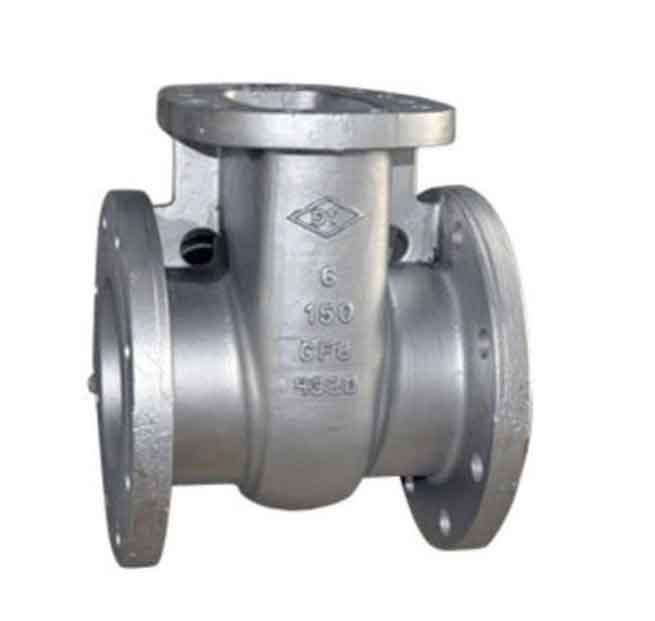
Valve body casting geometry typically features three coaxial circular conduits intersecting at orthogonal planes. Key process parameters include:
- Shrinkage Compensation: Differential scaling applied: internal cavity (2%), external features (1.5%)
- Parting Plane: Defined at conduit centroid convergence to minimize core usage and parting-line defects
Gating systems employ bottom-pouring to mitigate turbulence and oxidation. Critical equations govern fluid dynamics:
Mass flow rate $\dot{m}$ during pouring:
$$ \dot{m} = C_d \cdot A_{\text{nozzle}} \cdot \sqrt{2 \rho g h} $$
where $C_d$ = discharge coefficient, $A_{\text{nozzle}}$ = nozzle area, $\rho$ = molten metal density, $h$ = pour height.
Pouring time $t_{\text{pour}}$ optimization:
$$ t_{\text{pour}} = \frac{W_{\text{metal}}}{\dot{m}} \leq t_{\text{critical}} $$
Chrome ore sand (0.03–0.05 m thickness) insulates critical sections, while cold-set furan resin-bonded silica sand ($d_{\text{grain}}$ = 0.08–0.10 m) forms mold cores.
Smelting Process Optimization
Electric arc furnace (EAF) refining using high-alloy steel returns minimizes deleterious elements:
| Phase | Key Control Parameters |
|---|---|
| Melting | Slag removal at ≥1600°C; oxygen decarburization under thin slag |
| Oxidation | O₂ pressure $P_{\text{O₂}}$, time $t_{\text{blow}}$: $P_{\text{O₂}} \propto \frac{1}{t_{\text{blow}}}$ |
| Reduction | FeCr addition; final deoxidation; teeming temperature ≤1560°C |
Constraints on impurities:
$$ [S], [P] \leq 0.025\% $$
Post-smelt chemistry validation ensures Nb/C ratio >8 to stabilize carbides and enhance intergranular corrosion resistance in the valve body casting.
Non-Destructive Evaluation
Radiographic (RT) and liquid penetrant testing (PT) detect internal/external flaws per ASTM standards:
| Method | Acceptance Criteria |
|---|---|
| RT | Gas porosity ≤2 grade; shrinkage ≤2 grade |
| PT | Linear indications ≤2 mm; clustered indications ≤4 in 0.01 m² |
Flaw geometry constraints:
$$ L_{\text{linear}} \leq 2 \text{ mm}; \quad N_{\text{cluster}} \leq 4/\text{0.01 m}^2 $$
Process Integration and Defect Mitigation
Synchronizing casting, smelting, and heat treatment prevents defects like hot tears or microporosity. Residual stress $\sigma_{\text{residual}}$ in valve body casting is minimized through controlled cooling:
$$ \sigma_{\text{residual}} \propto \left( \frac{dT}{dt} \right)^{-1} $$
where $dT/dt$ = cooling rate. Post-casting hot isostatic pressing (HIP) at 1180°C/100 MPa further eliminates internal voids, enhancing fatigue life.
Conclusion
Manufacturing high-integrity valve body casting necessitates systemic control across metallurgy, process design, and quality verification. Precise alloy management, optimized gating, impurity suppression, and rigorous NDE collectively ensure dimensional stability and performance under extreme thermomechanical loads. Continuous refinement of these protocols remains essential for advancing valve reliability in critical service environments.