
Cast forming remains the predominant method for manufacturing complex components. While China leads globally in casting output, transitioning from quantity to quality requires overcoming persistent challenges with defects, particularly blow hole defects. At our production facility, we encountered recurring blow hole defects in HT250 engine blocks – critical components measuring 335 mm × 258 mm × 322 mm with wall thickness variations of 3.5-30 mm. Using green sand static pressure molding, coated sand hot box core-making, and induction furnace melting with in-stream inoculation, we observed approximately 3.51% scrap rates from blow hole defects concentrated at the rear flange’s isolated protrusion – the highest point during horizontal pouring.
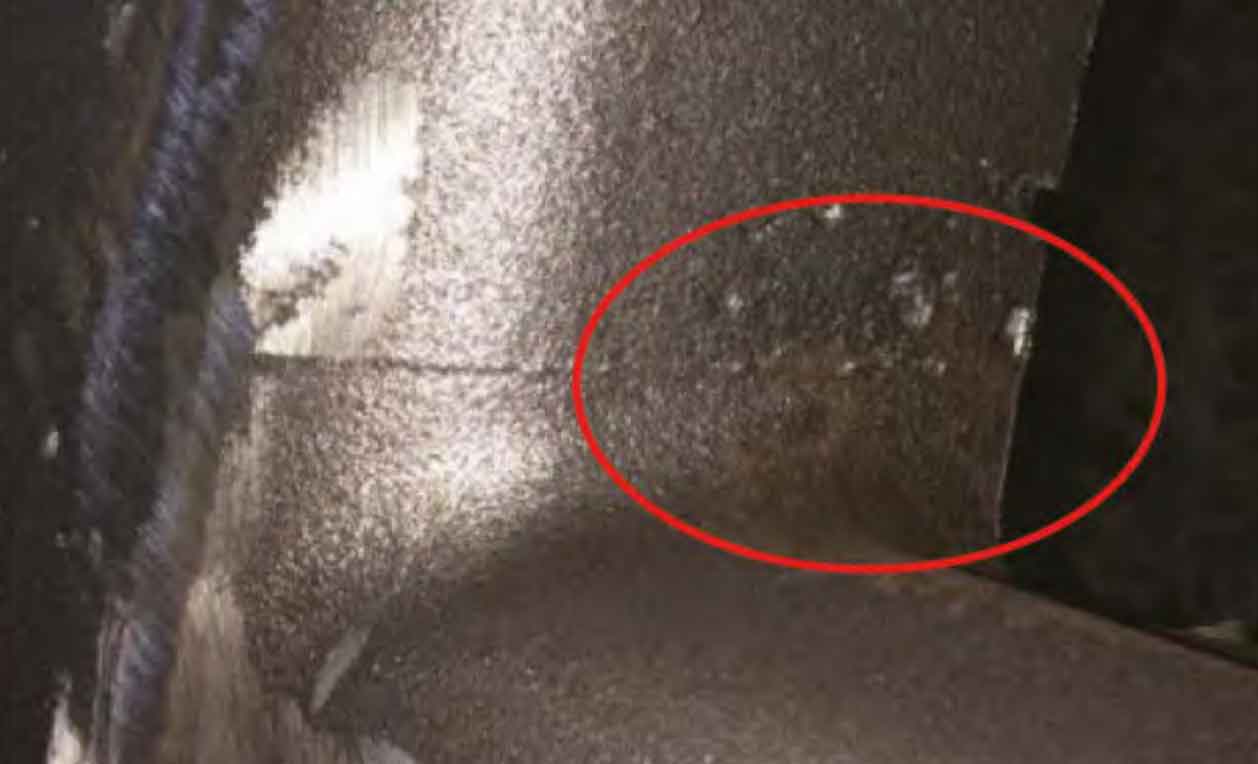
Energy-dispersive spectroscopy confirmed the blow hole defect nature through elevated oxygen content (17-28%) compared to the base metal (3.25%), indicating gas entrapment. Blow hole defects form when dissolved gases (H₂, N₂, O₂) nucleate during solidification. Solubility dynamics govern this process, as described by Sievert’s Law:
$$C = k\sqrt{P}$$
where $C$ is gas concentration, $k$ is material-specific constant, and $P$ is partial pressure. The temperature dependence follows Arrhenius behavior:
$$\frac{dC}{dT} = -\frac{\Delta H}{RT^2}C$$
where $\Delta H$ is dissolution enthalpy, $R$ is gas constant, and $T$ is temperature. This explains gas expulsion during cooling. Our analysis identified three critical factors enabling blow hole defect formation at the flange:
| Factor | Mechanism | Impact |
|---|---|---|
| Thermal Isolation | High thermal mass (22.5×35mm) in thin-wall structure (4mm) | Delayed solidification creates gas accumulation zone |
| Oxide Barrier Formation | Surface solidification before gas expulsion | Traps evolving gases beneath surface |
| Inadequate Venting | Original 12cm³ side-venting overflow | Insufficient thermal capacity and suboptimal vent path |
We developed three overflow modification strategies without altering pouring systems or temperature (1420°C), targeting blow hole defect mitigation through thermal management:
Strategy 1: Increased Overflow Volume (50cm³)
Volume expansion enhances thermal capacity through heat retention:
$$Q = mc_p\Delta T$$
where $Q$ is thermal energy, $m$ is overflow mass, $c_p$ is specific heat. Larger mass extends solidification time.
Strategy 2: Top-Venting Overflow
Vertical venting exploits buoyant gas migration through Stokes’ Law:
$$v_t = \frac{2r^2(\rho_f – \rho_g)g}{9\eta}$$
where $v_t$ is terminal velocity, $r$ is bubble radius, $\rho$ denotes densities, $g$ is gravity, $\eta$ is viscosity.
Strategy 3: Combined Approach
Integrated 50cm³ top-venting overflow maximizes thermal and venting efficiency.
Solidification simulations quantified temperature profiles at the blow hole defect risk zone:
| Overflow Configuration | Peak Temperature (°C) | Time to Liquidus (s) | Solidification Delay (%) |
|---|---|---|---|
| Original (12cm³ side-vent) | 1333 | 18.9 | 0 |
| Strategy 1: Volume increase | 1336 | 19.5 | 3.2 |
| Strategy 2: Top-venting | 1340 | 20.1 | 6.3 |
| Strategy 3: Combined | 1341 | 20.9 | 10.6 |
Thermal analysis confirmed Strategy 3’s superiority, maintaining higher temperatures longer at the critical location. Experimental validation across 4,460 castings demonstrated dramatic blow hole defect reduction:
| Implementation Phase | Casting Volume | Blow Hole Defect Occurrence | Defect Rate (%) |
|---|---|---|---|
| Baseline | 1,480 | 52 | 3.51 |
| Strategy 1 (Volume only) | 420 | 11 | 2.62 |
| Strategy 2 (Venting only) | 580 | 7 | 1.21 |
| Strategy 3 (Combined) | 3,460 | 7 | 0.20 |
The synergistic solution reduced blow hole defects by 94% through three integrated mechanisms:
1. Enhanced Buoyant Venting: Top-positioned vents provide direct escape paths for gases moving toward pressure minima:
$$\nabla P = -\rho \mathbf{g}$$
2. Extended Thermal Buffering: Increased overflow mass extends the critical temperature window above liquidus (1236°C) by 10.6%, delaying surface solidification.
3. Impurity Segregation: Larger overflow volume effectively traps oxide inclusions and cold metal containing concentrated blow hole defect precursors.
This approach demonstrates that strategic overflow optimization provides a powerful solution to blow hole defects in complex castings when fundamental process parameters cannot be modified. The methodology proves particularly effective for isolated heavy sections where thermal management governs gas expulsion efficiency. Future work will explore overflow geometry optimization through computational fluid dynamics to further suppress blow hole defect formation.