
As the European Foundry Association (CAEF), we closely monitor the pulse of our sector. Recent data reveals that the Foundry Industry Sentiment Index (FISI) declined for the second consecutive month in April 2023, falling by 0.5 percentage points to 103.3. This dip initially signals concern, yet deeper analysis uncovers nuanced trends. Our members—representing 4,400 castings manufacturers across Europe—reported improved current business conditions compared to March, contrasting sharply with heightened pessimism regarding the next six months. This divergence marks a reversal from recent months when the gap between negative expectations and positive current assessments had been narrowing.
The resilience in current conditions stems largely from processing backlogs, expressed mathematically as:
$$ \text{Current Business Strength} = \frac{\text{Backlog Orders}}{\text{Production Capacity}} \times \text{Efficiency Coefficient} $$
However, without sustained new orders, this buffer depletes, leading to anticipated deterioration. Simultaneously, the European Commission’s Business Climate Index (BCI) for manufacturing fell by 0.14 points to 0.54 in April. Declines in sales price expectations, production forecasts, and order book assessments drove this downturn. The relationship between FISI and BCI is captured by:
$$ \text{BCI} = \alpha + \beta_1(\text{FISI}_{\text{current}}) + \beta_2(\text{FISI}_{\text{future}}) + \epsilon $$
where declining future sentiment (\(\beta_2\)) exerts stronger downward pressure.
| Index | April 2023 Value | Monthly Change | Key Drivers |
|---|---|---|---|
| FISI | 103.3 | -0.5 | Backlog utilization (+), Future orders (-) |
| BCI | 0.54 | -0.14 | Production expectations (-), Order levels (-) |
For castings manufacturers, order volatility remains critical. The order-to-inventory ratio predicts near-term stability:
$$ \text{Stability Index} = \frac{\text{New Orders}_{\text{30d}}}{\text{Finished Goods Inventory}} $$
Ratios below 1.0 signal impending production cuts. Currently, 68% of castings manufacturers report ratios between 0.8-1.0, indicating fragility.
| Segment | Order-to-Inventory Ratio | Production Outlook (Next 6mo) |
|---|---|---|
| Automotive | 0.92 | Moderate contraction |
| General Engineering | 0.87 | Stable |
| Construction | 0.78 | Significant contraction |
| Electrical Engineering | 1.05 | Expansion |
Innovation partnerships illustrate strategic adaptations. ZF’s collaboration with Tevva on regenerative braking systems exemplifies how castings manufacturers enable electrification. Tevva’s 7.5t BEV trucks—using cast components for brake durability—leverage:
$$ \text{Regenerative Efficiency} = \frac{\text{Kinetic Energy}_{\text{recovered}}}{\text{Total Braking Energy}} \times 100\% $$
This innovation reduces mechanical wear by 40%, extending component lifespan. Such advancements help castings manufacturers penetrate emerging markets, including EV and hydrogen commercial vehicles projected to grow at 14% CAGR through 2030.
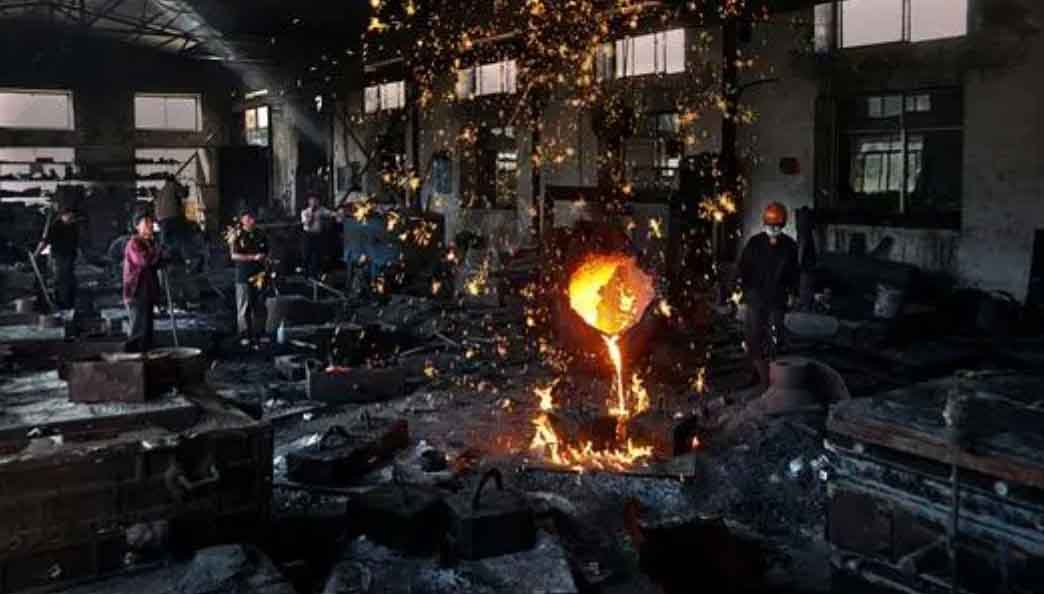
Structural challenges persist. Energy costs constitute 30-35% of production expenses for European castings manufacturers, compared to 18-22% globally. We model cost competitiveness as:
$$ \text{Competitiveness Score} = \frac{\text{Technical Expertise} \times \text{Quality Index}}{\text{Energy Cost} \times \text{Regulatory Burden}} $$
European foundries average 0.75 versus 1.2 for Asian rivals. Bridging this gap requires:
- Automation investments reducing labor costs by 25%
- Low-carbon melting technologies cutting energy use by 15-20%
- Closed-loop material recycling raising yield rates above 95%
Workforce dynamics also impact resilience. With 20,000 annual hires, castings manufacturers face a skills gap. Training ROI is quantified as:
$$ \text{ROI}_{\text{training}} = \frac{\Delta\text{Productivity} \times \text{Revenue} – \text{Training Cost}}{\text{Training Cost}} \times 100\% $$
Current median ROI stands at 140%, justifying expanded programs.
Looking ahead, FISI trajectory depends on inventory normalization:
$$ \text{Inventory Cycle} = \frac{\text{Average Days of Inventory}}{\text{New Order Lead Time}} $$
Cycles exceeding 1.2 precede sentiment declines. Presently at 1.18, this metric warrants vigilance. For castings manufacturers, diversification remains paramount—especially in aerospace and medical sectors, where premium tolerances command 20-30% price premiums. As CAEF, we project moderated 2023 growth of 1.8-2.4%, contingent on energy stability and supply chain realignment. Continuous innovation will define the next era of European foundry excellence.