
As a critical diesel engine component, bearing caps secure and support crankshafts while enduring cyclic alternating loads during operation. Our development of a large-scale bearing cap (700 mm × 450 mm × 150 mm, 190 kg) initially faced shrinkage porosity and slag inclusion defects despite conventional casting process design. This article details our systematic approach to defect resolution through comprehensive casting process optimization.
Initial Casting Process Limitations
The original casting process employed conventional methodologies: bolt holes were machined post-casting, insulating risers covered thick sections, chill plates were positioned beneath risers, and two vertically oriented ceramic filters managed slag. This configuration yielded three critical limitations:
| Process Element | Defect Correlation | Yield Impact |
|---|---|---|
| Machined bolt holes | Increased thermal volume → shrinkage porosity | Requires excess material |
| Vertical ceramic filters | Limited initial filtration → slag inclusions | Increased scrap rate |
| Riser-chill configuration | Insufficient solidification control → porosity near bolt holes | 56% yield |
Defect analysis confirmed subsurface shrinkage porosity (Figure 4) and surface slag inclusions dominated by oxides (Figure 3). Energy-dispersive spectroscopy quantified inclusion composition:
$$\text{Inclusion Composition} = \begin{cases} \text{O: 49.17\%} \\ \text{Si: 11.03\%} \\ \text{Ca: 11.26\%} \\ \text{Fe: 6.52\%} \\ \text{Zr: 10.82\%} \end{cases}$$
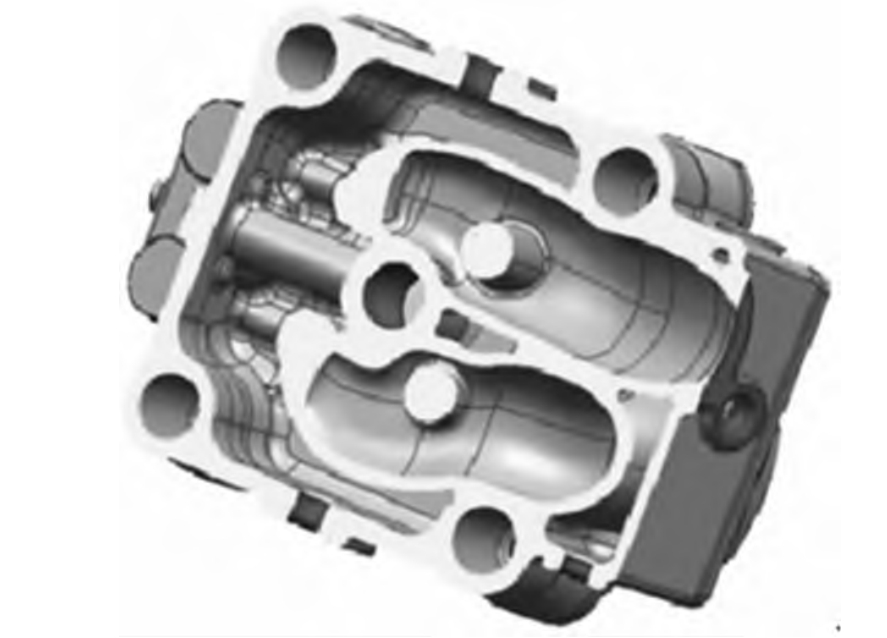
Integrated Process Modifications
Three synergistic improvements transformed the casting process:
1. Filtration System Redesign: Horizontal filter orientation created bottom-to-top metal flow, extending residence time for enhanced slag capture. The modified fluid dynamics increased filtration efficiency according to:
$$\eta_f = 1 – e^{-\frac{k \cdot A \cdot L}{Q}}$$
where \(\eta_f\) = filtration efficiency, \(k\) = filter medium constant, \(A\) = surface area, \(L\) = flow path length, and \(Q\) = flow rate.
2. Thermal Management Reconstruction: Cast-in bolt holes reduced thermal mass by 28%, while contoured chills replaced risers for targeted solidification control. Chill placement followed solidification modulus rules:
$$M_c = \frac{V}{A} \leq 1.2 \cdot M_{chill}$$
where \(M_c\) = casting modulus, \(V\) = volume, \(A\) = surface area, and \(M_{chill}\) = chill modulus.
3. Sand Core Reinforcement: Steel-reinforced sand cores ensured dimensional stability in bolt hole cavities. Core gas permeability maintained at 80-100 (GFN) prevented gas-related defects.
Validation and Performance Metrics
MAGMA simulation confirmed defect reduction (Figures 6-7), with shrinkage porosity displaced >76mm from critical zones. Physical validation included:
| Validation Method | Process Parameter | Improvement |
|---|---|---|
| Metallurgical analysis | Slag inclusion frequency | 0 defects in 20 samples |
| Sectioning inspection | Shrinkage-free zone | 76mm from bolt holes |
| Production monitoring | Casting yield | 56% → 82% |
Technical Implementation Framework
Successful casting process execution required coordinated parameter control:
$$\text{Process Stability} = \prod_{i=1}^{n} \left( \frac{T_{\text{pour}} {T_{\text{eutectic}}} \cdot C_{\text{Mg}} \cdot \tau_{\text{mold}} \right)$$
where \(T_{\text{pour}}\) = pouring temperature (1380-1420°C), \(T_{\text{eutectic}}\) = eutectic temperature (1150°C), \(C_{\text{Mg}}\) = magnesium residual (0.03-0.05%), and \(\tau_{\text{mold}}\) = mold restraint time (>120 min).
Industrial Significance
This optimized casting process demonstrates that synergistic adjustments to filtration orientation, thermal geometry, and reinforcement strategies can resolve complex defects in thick-section ductile iron castings. The methodology increased yield by 46% while ensuring critical zone integrity, establishing a replicable framework for heavy-section components requiring defect-free zones around machined features.