
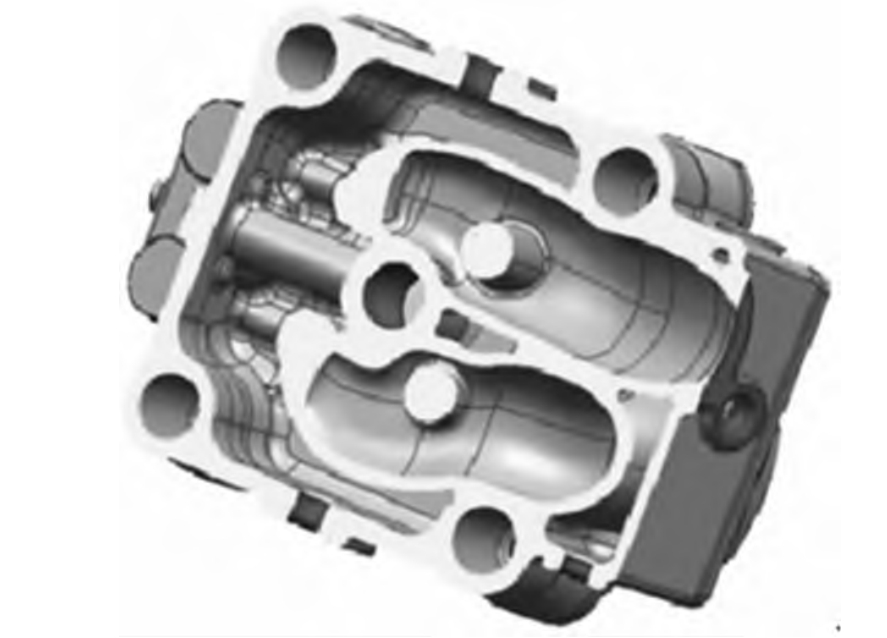
Expanding methionine production capacity from 50,000 to 100,000 tons annually presented significant environmental challenges due to the high toxicity of wastewater and biochemical waste. The high-temperature, high-pressure centrifugal zirconium pump emerged as critical equipment, handling a corrosive multiphase flow (230°C, 900 Lb pressure) containing toxic compounds like sodium chloride, phosphates, formaldehyde, and diglycol. The extreme conditions demanded exceptional corrosion resistance, leading to the selection of zirconium (Zr702C) with an annual corrosion rate below 0.05 mm. The casting process faced three primary challenges: managing zirconium’s high reactivity, preventing gas defects in thick sections, and achieving dimensional accuracy in complex geometries.
Material Properties and Structural Requirements
Zirconium’s corrosion resistance stems from its stable oxide layer formation, governed by:
$$ \frac{d\delta}{dt} = k \cdot e^{-\frac{Q}{RT}} $$
where δ is oxide layer thickness, k is the rate constant, Q is activation energy, R is gas constant, and T is temperature. The pump structure featured uneven wall thicknesses (42-100mm) and seven critical defect-prone zones identified through thermal analysis:
$$ \nabla^2 T = \frac{1}{\alpha} \frac{\partial T}{\partial t} $$
where α is thermal diffusivity. Key specifications included:
- ASTM-B752 standards compliance
- RT Level 2 per ASTM E446/E186
- CT8 dimensional tolerance
- Mandatory hot isostatic pressing (HIP)
| Parameter | Value | Standard |
|---|---|---|
| Maximum Wall Thickness | 100 mm | Section 7 |
| Gas Porosity Allowance | <1.5 mm | ASTM E446 Class B |
| Surface Roughness | Ra 12.5 μm | ASTM B752 |
Graphite Mold Design and Gating Optimization
High-purity graphite (density ≥1.58 g/cm³) was selected for mold construction due to its thermal stability and machinability. The parting scheme incorporated multiple cores and venting channels to address zirconium’s high gas solubility. The gating system employed a bottom-feeding design with controlled choke ratios to ensure sequential filling:
$$ Q = A \cdot v = \frac{\pi d^2}{4} \cdot \sqrt{2gh} $$
where Q is flow rate, A is cross-section area, v is velocity, d is diameter, g is gravity, and h is metal head. Two gating configurations were tested:
| Parameter | Design 1 | Design 2 |
|---|---|---|
| Choke Area Ratio (Schoke:Sgate) | 1:1.96 | 1:2.56 |
| Runner Diameter | 4×70 mm | 4×80 mm |
| Filling Time | 9.2 s | 7.8 s |
| Surface Defects | Severe cold shuts | Minimal |
Design 2’s optimized ratio prevented premature top-gate activation, reducing gas entrapment. Venting design followed:
$$ V_v = 0.05 \cdot V_m \cdot \left(1 + \frac{T_g}{273}\right) $$
where Vv is vent volume, Vm is mold volume, and Tg is gas temperature.
Vacuum Consumable Electrode Process Parameters
The 800kg vacuum furnace underwent critical upgrades to handle zirconium’s high melting point (1855°C). Hydraulic and electrical modifications enabled consistent 850kg pours:
| Parameter | Pre-Upgrade | Post-Upgrade |
|---|---|---|
| Melt Current | 32 kA | 35 kA |
| Tilt Time | 18±3s | 13±1s |
| Cooling Water Temp | 68°C | 48°C |
| Maximum Melt Duration | 22 min | 38 min |
Power consumption followed:
$$ P = I \cdot V \cdot \cos\phi = 35,000 \cdot 40 \cdot 0.93 = 1,302 \text{ kW} $$
Thermal Management and Defect Control
Mold preheating at 375°C for 4+ hours minimized thermal shock. The solidification time for thick sections (100mm) was calculated as:
$$ t_s = \frac{K \cdot V^2}{A^2} $$
where K is mold constant (0.8 min/cm² for graphite), V is volume, and A is surface area. HIP processing at 900°C/100MPa for 120 minutes healed internal porosity through diffusion:
$$ \frac{dr}{dt} = \frac{D\gamma\Omega}{kT} \cdot \frac{1}{r} $$
where r is pore radius, D is diffusivity, γ is surface energy, Ω is atomic volume, k is Boltzmann constant, and T is temperature.
Process Validation and Quality Metrics
Final casting process achieved:
- X-ray compliance: 100% ASTM E446 Class B
- Dimensional accuracy: CT8 per ISO 8062
- Mechanical properties: UTS=550MPa, YS=380MPa
- Gas porosity reduction: 92% vs. initial trials
The optimized casting process demonstrates that controlled sequential filling with properly vented graphite molds enables production of complex zirconium pressure components. The methodology provides a framework for high-integrity zirconium casting processes where conventional methods fail.