
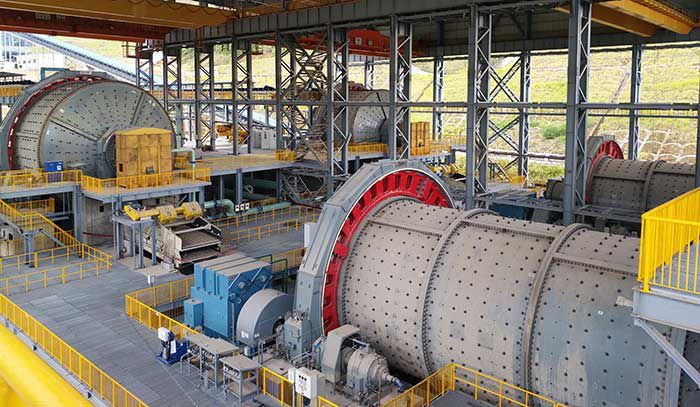
Ball mills experience micro-deformation during prolonged operation, making isolated component repairs challenging. Traditional realignment requires adjusting both the cylinder and main motor, significantly increasing downtime and costs. This article details a method for installing and adjusting the pinion shaft of an MQS4866 ball mill without moving these components, reducing maintenance time by 40-60% while ensuring operational stability.
Pinion Shaft Removal and Repair
Initiate by shutting down the ball mill, de-energizing systems, and stopping lubrication pumps. Sequentially disconnect the air clutch, unbolt bearing housing connections, and detach lubrication lines. Lift the pinion shaft using certified rigging rated for 150% of the component’s weight (typically 8-12 tons for MQS4866 models). Support the shaft on hardwood blocks during inspection. Common repairs include:
- Gear tooth refurbishment via grinding for deviations exceeding 0.5mm
- Bearing replacement if wear exceeds $$ \Delta d = \frac{0.001 \times D}{2} $$ where \( D \) = bearing bore diameter (mm)
- Shaft straightening using hydraulic presses when runout >0.15mm/m
Foundation Preparation
After extraction, evaluate anchor bolts and grout integrity. Replace damaged bolts with Cr40 steel equivalents, heat-treated to 45-50 HRC hardness. For compromised grout, remove 30-50mm depth and repour with epoxy-modified cement achieving ≥75MPa compressive strength. Align leveling components using these parameters:
| Component | Tolerance | Measurement Method |
|---|---|---|
| Baseplate Horizontal Alignment | <0.10mm/m | Precision level |
| Shim Group Thickness | ≤5 shims per group | Laser interferometer |
| Shim Overhang | 10-50mm | Calibrated ruler |
| Contact Gaps | <0.10mm | Feeler gauge |
Position wedge pairs at 300-600mm intervals near anchor bolts, welded post-alignment to prevent displacement. Verify contact using 0.05mm feeler gauges with insertion depth <⅓ of shim length.
Pinion Installation and Alignment
Lift the pinion assembly using dual hoists with synchronized controls. Position the pinion within 1.5-2mm of the bull gear’s theoretical mesh point. Initial alignment focuses on three critical parameters:
| Parameter | Drive End | Non-Drive End | Acceptance Limit |
|---|---|---|---|
| Radial Runout (mm) | 2.70 max | 1.95 max | 0.70 |
| Axial Runout (mm) | 1.95 max | 0.94 max | 0.80 |
| Backlash (mm) | 3.27 | 2.55 | 1.88±0.30 |
| Tip Clearance (mm) | 10.50 | 9.80 | 5.50 |
Radial correction involves inserting stainless steel shims beneath bearing housings. Calculate shim thickness using:
$$ \delta_r = \frac{R_{max} – R_{min}}{2} $$
where \( R_{max} \) and \( R_{min} \) are maximum/minimum radial deviations from eight circumferential points. For measured 2.70mm radial deviation, install 0.96-1.24mm shims at 45° intervals. Axial adjustment follows similar methodology, prioritizing backlash conformity over tip clearance for helical gears.
Mesh Optimization
After mechanical alignment, verify gear engagement through rotational calibration:
- Rotate bull gear via auxiliary drive at 0.5-1rpm
- Measure backlash at 30° intervals using certified gap gauges
- Adjust pinion position until backlash variance <0.15mm across all points
Final verification requires:
$$ G_b = \frac{\sum_{i=1}^{n} b_i}{n} = 2.12\text{mm} \quad (\text{Target: } 1.88 \pm 0.30\text{mm}) $$
Post-adjustment measurements confirm compliance:
| Parameter | Value | Standard |
|---|---|---|
| Radial Runout | 0.68mm | <0.70mm |
| Backlash Uniformity | ±0.11mm | <0.30mm |
| Mesh Contact Pattern | 75% tooth width | >70% |
Secondary Grouting and Commissioning
Pour non-shrink grout with minimum 65MPa compressive strength after final alignment. Maintain 25°C curing temperature for 72 hours. Commissioning involves sequential testing:
- Lubrication System: Achieve oil pressure ≥16MPa before rotation
- No-Load Test: Run 3 hours with bearing temperature rise <35°C
- Load Test: Gradually increase to full capacity over 24 hours
Critical monitoring parameters include:
$$ T_{bearing} \leq 70^\circ \text{C}, \quad V_{vibration} \leq 2.8 \text{mm/s RMS} $$
Operational Stability Measures
Sustain ball mill performance through:
- Staggered Starts: Engage slow-turn system for >15 minutes after 8+ hour downtime
- Lubrication Management: Maintain ISO VG320 oil at 40±2°C with 25µm filtration
- Torque Verification: Check anchor bolts quarterly at 2,500±50 N·m
Implementing these protocols extends gear service life by 15,000-20,000 operational hours and reduces vibration-related failures by 60%.
Conclusion
This methodology enables precise pinion realignment in ball mills without cylinder disassembly. Key innovations include dynamic shimming algorithms and mesh optimization via rotational calibration. The technique reduces downtime to 5-7 days versus 14+ days for conventional methods, maintaining production continuity while achieving:
$$ \eta = \frac{t_{standard} – t_{new}}{t_{standard}} \times 100\% = 58-63\% \text{ Time Savings} $$
Ball mill operators can implement this approach for MQS/GMQ series equipment with torque ratings of 400-800 kN·m, adapting shim calculations and backlash tolerances to specific gear modules.