
Wet-process phosphoric acid (WPA) production relies heavily on grinding efficiency, where the ball mill serves as a critical component. At our facility, severe leakage through liner bolts in an overflow-type ball mill caused operational disruptions: continuous operation rates plummeted below 70%, small gears required replacement every 3–6 months, and maintenance costs soared due to slurry ingress into gear housings. Each 8-hour shift necessitated a 2-hour stoppage for cleanup and repairs, destabilizing process parameters. This paper details our root-cause analysis and successful countermeasures.
1. Root Causes of Liner Bolt Leakage
Initial leakage stemmed from inadequate liner material selection. Rubber liners degraded within a year, causing misalignment and bolt fractures. Switching to high-manganese steel liners (each secured by two M30×180 bolts) extended service life but introduced new failures. Key factors included:
- Excessive Liner Mass: 500 kg liners exerted dynamic loads exceeding bolt fatigue limits during grinding media impacts.
- Structural Vulnerability: Bolt fixation without radial support allowed displacement under stress.
- Uncontrolled Gaps: Cumulative dimensional tolerances created 8–25 mm inter-liner gaps, enabling slurry penetration.
The resultant forces on bolts can be modeled as:
$$ F_{\text{impact}} = m_{\text{ball}} \cdot \frac{dv}{dt} + k \cdot \delta $$
where \( m_{\text{ball}} \) is grinding media mass, \( dv/dt \) is impact acceleration, \( k \) is liner stiffness, and \( \delta \) is displacement.
2. Technical Improvements
2.1 Liner Structural Optimization
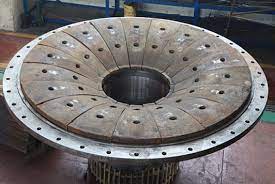
We replaced monolithic liners with interlocked wave-profile segments. Four segments form a radial unit, clamped by two M30×120 bolts through end-lifter bars. This reduced bolt count from 320 to 80, minimizing leakage points while distributing loads. The redesign lowered individual bolt stress by 60%:
$$ \sigma_{\text{new}} = \frac{F_{\text{total}}}{n_{\text{bolts}}} \cdot C_{\text{dist}} $$
where \( C_{\text{dist}} \) ≈ 0.4 is the load-distribution coefficient.
2.2 Bolt Sealing System Upgrade
The original external rubber-seal design lacked lateral stability. We welded sealing seats onto the mill shell, creating a confined compression cavity. Bolts now thread into these seats, with EPDM gaskets providing radial sealing under nut torque \( T \):
$$ P_{\text{seal}} = \frac{T}{K \cdot d} $$
where \( K \) = 0.2 (friction coefficient) and \( d \) = bolt diameter.
2.3 Gap Elimination Strategies
Axial Gap Control: Lifter bars accommodate dimensional variations, ensuring near-zero radial gaps. Shell Protection: A 10-mm rubber layer between shell and liners prevents erosion while compensating for shell thinning. Grinding Media Filling: Reintroducing crushed sub-70-mm balls into the ball mill fills axial gaps, forming a self-locking liner matrix.
3. Performance Metrics
Post-retrofit data confirms dramatic improvements:
| Parameter | Pre-Retrofit | Post-Retrofit | Change |
|---|---|---|---|
| Ball mill Operation Rate (%) | 68.2 | 92.4 | +35.5% |
| Maintenance Frequency | 3 shifts/day | 5 times/year | -98% |
| Small Gear Lifetime (months) | 3–6 | 30 | +400% |
| Annual Maintenance Cost (RMB) | 350,000 | 50,000 | –300,000 |
4. Economic and Operational Impact
Eliminating liner bolt leakage transformed ball mill reliability. Key outcomes include:
- Annualized savings of ~¥300,000 from reduced part replacements and labor.
- Enhanced process stability with uninterrupted runs exceeding 30 days.
- Extended liner service life to >24 months.
The retrofit demonstrates that holistic redesign—addressing material, geometry, and operational factors—resolves chronic leakage in abrasive environments.