
Medium-speed coal mills are critical auxiliary equipment in coal-fired power plant boiler systems. Their function is to crush and pulverize coal chunks into fine powder while simultaneously drying the coal. During operation, these components endure significant impact, compression, and grinding forces. This leads to severe damage in the roller sleeves and lining plates, causing insufficient mill output and reduced operational efficiency. Consequently, enhancing the wear resistance of roller sleeves and lining plates is paramount for meeting long-term production demands and improving overall plant productivity.
Numerous researchers have investigated advanced wear-resistant materials for mill roller sleeves and lining plates. Comparative analyses reveal that advanced metal-matrix ceramic materials offer wear resistance exceeding 2.7 times that of traditional high-chromium alloys. Studies on ZTA (Zirconia Toughened Alumina) particle-reinforced high-chromium cast iron composites demonstrate a 4.85-fold improvement in wear performance. Engineering modifications based on coal mill operating principles have achieved enhanced operational stability, translating to annual cost savings of approximately ¥800,000. When ZTA ceramic particles and Fe-Ti preform binders are utilized, the resulting composites exhibit three times the wear resistance of standard high-chromium cast iron. Cast infiltration techniques further confirm that ZTA-reinforced composites achieve wear performance 2.41 times greater than their base materials. These findings underscore the evolution in wear-resistant material technology, pointing toward ceramic solutions as the future direction.
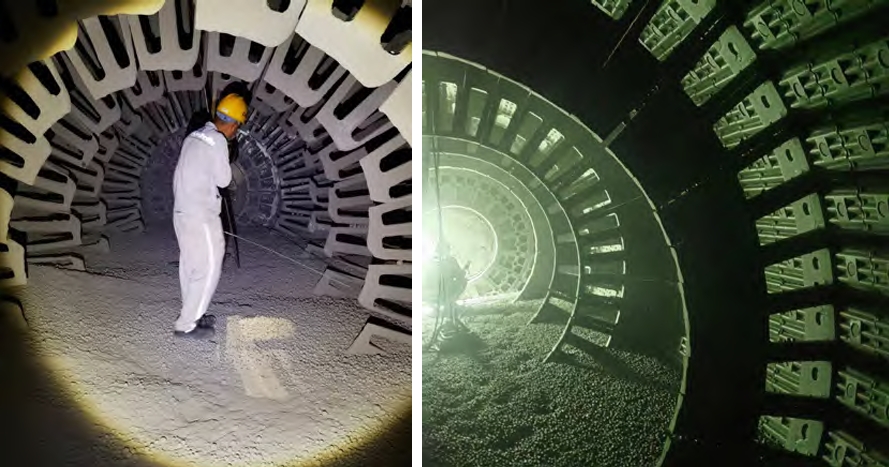
To address the chronic issue of insufficient mill output caused by lining plate and roller sleeve wear, an MPS235 medium-speed coal mill underwent a transformative retrofit using advanced ceramic materials. The primary objectives were to boost wear resistance and enhance the economic efficiency of the power station.
Plant and Equipment Configuration
The power station features two ultra-supercritical boilers designed for sliding pressure operation. Key technical parameters are summarized below:
| Parameter | Unit | Design Value |
|---|---|---|
| Maximum Continuous Evaporation Rate | t/h | 2090 |
| Guaranteed Boiler Efficiency (BRL) | % | 93.3 |
| Calculated Boiler Efficiency (BMCR) | % | 93.53 |
| Actual Coal Consumption (BMCR) | t/h | 307.81 (Design Coal) 332.53 (Check Coal) |
| Theoretical Dry Air Requirement | Nm³/kg | 4.686 – 4.994 |
The unit operates under the following annual load profile:
| Load Level | Annual Operating Hours | Annual Utilization Hours |
|---|---|---|
| 100% Rated Output | 4350 | 4350 |
| 75% Rated Output | 700 | 525 |
| 50% Rated Output | 2250 | 1125 |
| Total | 7300 | 6000 |
Mill Specifications and Wear Challenges
The pulverizing system employs MPS235 medium-speed coal mills. Key operational parameters are:
- Model: MPS235
- Maximum Output: 78.22 t/h
- Calculated Output (BMCR): 64.70 t/h
- Grinding Roller Loading: Hydraulic Variable Loading
- Mill Speed: 29.07 rpm
- Input Power: 520 kW
Coal enters through a central feed chute onto the grinding surface between the rollers and the grinding table. Motor-driven rotation subjects coal to compressive and grinding forces. Centrifugal force propels pulverized coal to the air ring for drying before classification. Qualified fine coal proceeds to burners, while coarse particles recirculate. The critical wear components – the roller sleeves and the grinding table lining plate – endure tremendous stress. Prolonged operation induces thermal stress, vibration, abrasion, and deviations from design coal properties. This manifests as plastic deformation, fatigue cracks, localized collapse, reduced efficiency, safety risks, and frequent maintenance downtime. Traditional high-chromium alloy welded lining plates typically wear 50-60mm within 6000 hours, necessitating premature replacement and escalating operational costs.
Ceramic Retrofit Solution
Advanced ceramic materials offer a revolutionary solution. Their superior wear resistance significantly extends service life:
- Wear after 3000h: < 10mm
- Wear after 10,000h: 20-30mm
- Wear after 15,000h: 40-50mm
- Projected Service Life: > 20,000 hours
The wear rate $$(W_r)$$ for the new ceramic lining plate can be empirically modeled as a function of operating time $$(t)$$ and coal abrasiveness index $$(HGI)$$:
$$W_r = k \cdot t^{0.7} \cdot HGI^{1.2}$$
where $$k$$ is a material-specific constant significantly lower for ceramics than for high-chromium alloys. This directly translates to a slower decline in mill output $$(Q_m)$$ over time:
$$\frac{dQ_m}{dt} \propto -W_r$$
The retrofit involved replacing the conventional high-chromium alloy roller sleeves and grinding table lining plate with engineered ceramic composites.
Performance Validation Testing
Rigorous performance acceptance tests were conducted post-retrofit using two distinct coal types. Fuel characteristics were:
| Parameter | Unit | Liyuanhe Coal | Beixinyao Coal |
|---|---|---|---|
| Total Moisture (Mt) | % | 4.7 | 4.4 |
| Inherent Moisture (Mad) | % | 0.93 | 1.51 |
| Ash Content (Ad) | % | 45.48 | 44.03 |
| Volatile Matter (Vdaf) | % | 39.71 | 42.78 |
| Gross Calorific Value (Qgr,ad) | MJ/kg | 17.01 | 17.07 |
| Hardgrove Grindability Index (HGI) | – | 66 | 74 |
Testing involved measuring coal feed rate, power consumption, coal fineness (R90 and R200), and mill output under stable, manually controlled conditions at rated load for one hour per test.
Results with Liyuanhe Coal
- Average Unit Load: 510 MW
- Classifier Frequency: 30 Hz
- Mill Output (C Mill): 65.00 t/h
- Average Coal Fineness: R90 = 17.87%, R200 = 1.27%
Results with Beixinyao Coal
- Average Unit Load: 540 MW
- Classifier Frequency: 35 Hz
- Mill Output (C Mill): 64.82 t/h
- Average Coal Fineness: R90 = 15.13%, R200 = 0.73%
Economic and Operational Benefits
The retrofit delivered substantial improvements:
- Enhanced Wear Resistance & Extended Lifespan: The ceramic lining plate and roller sleeves drastically reduced wear rates. Projected service life exceeds 20,000 hours, representing a 3-4 fold increase over traditional materials. The slower wear rate directly mitigates the decline in mill output $$(dQ_m/dt)$$ over time.
- Stable Mill Output: Consistent output near the BMCR calculated value (64.70 t/h) was achieved with both coal types (65.00 t/h and 64.82 t/h), demonstrating the retrofit’s effectiveness under varying fuel conditions.
- Reduced Maintenance Costs: The extended lifespan of the ceramic lining plate significantly reduces the frequency of replacements and associated downtime. Annual savings, previously estimated around ¥800,000 for similar modifications, are anticipated. The Return on Investment (ROI) can be expressed as:
$$ROI = \frac{(C_{traditional} – C_{ceramic}) + S_{downtime}}{I_{retrofit}} \times 100\%$$
where $$C_{traditional}$$ and $$C_{ceramic}$$ are the lifecycle costs of traditional vs. ceramic components, $$S_{downtime}$$ represents savings from reduced outage time, and $$I_{retrofit}$$ is the initial investment cost. - Improved Plant Efficiency and Economics: Sustained high mill output, reduced maintenance frequency, and lower component replacement costs collectively enhance overall plant operational efficiency and profitability.
The adoption of advanced ceramic materials for coal mill roller sleeves and grinding table lining plates represents a significant technological advancement for the coal power industry. This retrofit strategy effectively combats wear-induced output loss, delivering superior durability, operational stability, and compelling economic returns. The performance validation confirms the ceramic lining plate’s capability to handle diverse coal types while maintaining design output specifications over extended periods.