
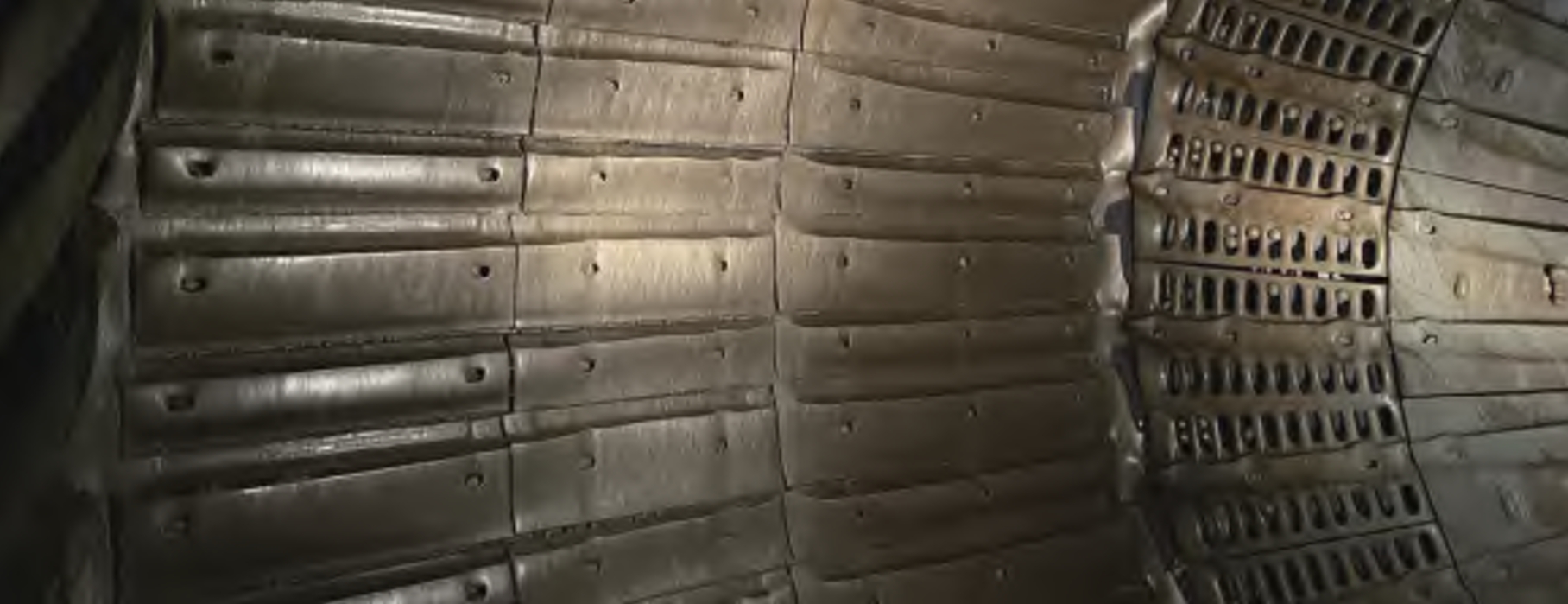
We investigate the wear distribution characteristics of cone crusher lining plates through theoretical modeling, experimental validation, and discrete element simulation. Lining plates experience severe abrasive wear due to direct contact with ore materials during crushing operations. Their wear directly impacts crusher performance, product quality, and operational costs. Based on motion analysis of ore particles within the crushing chamber, we establish a layered crushing cavity model where each layer undergoes independent compressive wear events. The wear mechanisms are categorized as:
Compressive wear: Occurs during particle compression without macroscopic sliding:
$$Δω_N^1 = K_2 \sqrt{d_N P_N}$$
where $d_N$ is the average particle size in layer $N$, $P_N$ is compressive pressure, and $K_2$ is the wear resistance coefficient.
Cutting wear: Results from tangential sliding between particles and lining plates:
$$Δω_N^2 = K_1 \int_0^{t_2} P v dt$$
where $v$ is relative sliding velocity, $t_2$ is contact duration, and $K_1$ is the cutting wear coefficient.
Compressive pressure is determined through compression experiments, revealing the relationship:
$$P = \exp(7.56\epsilon + 0.43\sigma + 0.021)$$
where $\epsilon$ is the compression ratio and $\sigma$ is the particle size distribution coefficient. Particle size evolution is modeled using selection and breakage functions:
| Function | Expression |
|---|---|
| Selection function | $s_i = 0.5998\epsilon_n – 0.52987\epsilon_n^2 + 0.0012d_i^{0.34}$ |
| Breakage function | $b_{ab} = k\left(\frac{d_a}{d_b}\right)^e + (1-k)F\left(\frac{d_a}{d_b}\right)^f$ |
The effective compression ratio varies with crusher parameters:
| RPM | Layers | Max $ε_{\text{eff}}$ |
|---|---|---|
| 350 | 8 | 0.561 |
| 400 | 10 | 0.480 |
| 450 | 13 | 0.431 |
| 500 | 16 | 0.369 |
| 550 | 20 | 0.337 |
Discrete element simulations using EDEM implement the Tavares breakage model and Archard wear model. Key parameters include:
| Parameter | Value |
|---|---|
| Ore density | 2830 kg/m³ |
| Ore-lining static friction | 0.26 |
| $K_1$ (cutting) | 4.37×10⁻¹³ |
| Lining plate hardness | 535 HBW |
Parameter influence on lining plate wear rate shows distinct trends:
Main shaft RPM:
– Compressive wear rate decreases 37% from 350 to 550 RPM
– Most uniform wear distribution at 450 RPM (IQR = 0.15×10⁻⁵ mm/s)
– Cutting wear rate decreases 42% with RPM increase
Feed particle size:
– 45mm feed causes 2.8× higher compressive wear than 25mm
– Wear distribution uniformity increases as particle size decreases
Precession angle:
– Compressive wear at 2.4° is 3.1× higher than at 1.6°
– Cutting wear increases exponentially beyond 2.0°
– Smaller angles improve wear distribution uniformity
The maximum lining plate wear consistently occurs near the parallel zone entrance (200-225mm cavity depth) due to:
1. Peak compressive pressure (60-70 MPa)
2. Maximum effective compression ratios (0.45-0.60)
3. Critical transition from coarse to fine particle crushing
These findings provide theoretical guidance for optimizing lining plate materials and crusher chamber geometry. The layered wear prediction model reduces thickness measurement errors to <8% compared to ultrasonic field measurements, enabling proactive maintenance planning.