
For an extended period, our molybdenum concentrator experienced critical challenges with semi-autogenous mill shell lining plates, including premature wear and structural failures. The target service life of 5 million tonnes per set was consistently unmet, averaging only 4.6 million tonnes. Additionally, frequent cracking necessitated unplanned shutdowns, escalating operational costs and safety risks. This comprehensive study details our methodology for optimizing lining plate design through multidimensional analysis and computational modeling.
Performance Analysis of Original Lining Plates
We identified two primary failure modes: accelerated wear in the central cylinder section compared to feed/discharge ends, and unpredictable fracture incidents. Metallurgical analysis revealed uniform hardness distribution (380-405 HB) but suboptimal impact resistance. Laboratory testing quantified average impact energy absorption at 48.27 J, indicating material limitations under cyclic loading. Microstructural examination showed tempered sorbite with pearlite inclusions, contributing to brittle fracture tendencies under impact stresses.
| Test Type | Location 1 | Location 2 | Location 3 | Location 4 | Location 5 | Average |
|---|---|---|---|---|---|---|
| Hardness (HB) | 403 | 405 | 405 | 392 | 387 | 398.4 |
| Impact Energy (J) | 55.99 | 35.08 | 56.27 | 53.52 | 40.48 | 48.27 |
Computational Modeling and Design Optimization
Discrete Element Method (DEM) simulations informed our redesign strategy, modeling charge motion at 10.1 rpm with 21% ore and 13% grinding media filling. Key trajectory parameters were calculated:
$$ \theta_{\text{lift}} = 60.3^\circ, \quad \theta_{\text{impact}} = 53.7^\circ, \quad d_{\text{max}} = 4.42\text{m} $$
where $\theta_{\text{lift}}$ represents the lifter detachment angle and $d_{\text{max}}$ the maximum ball impact distance from central axis. The wear differential between central and end sections followed the thickness reduction equation:
$$ \Delta h_c – \Delta h_e = k \cdot \tau \cdot (P_c – P_e) $$
where $k$ is the ore abrasiveness coefficient, $\tau$ is operational time, and $P$ denotes localized pressure.
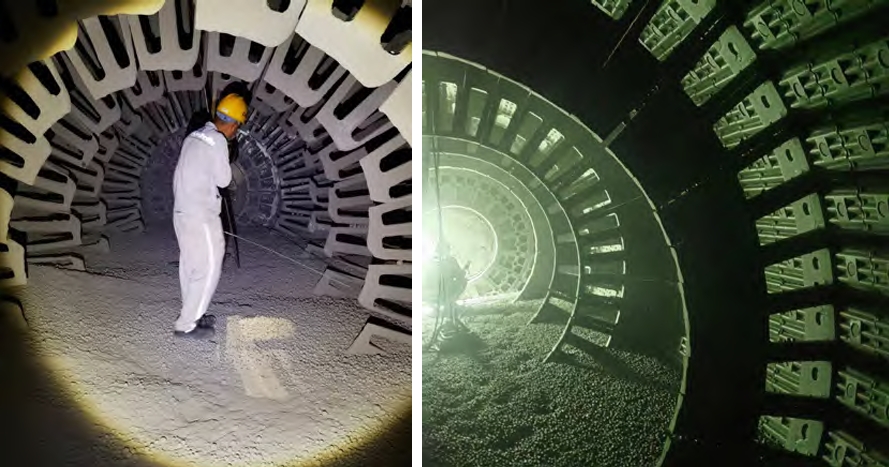
Optimization included three key modifications: (1) Differential lifter heights (central section +15% vs. ends) ensuring uniform wear, (2) Enhanced curvature reducing peak stress concentrations by 40%, (3) Embedded lugs eliminating external stress risers. Material upgrades featured proprietary chromium-molybdenum alloy with modified heat treatment, achieving 510-540 HB hardness and 85+ J impact resistance.
Performance Validation and Wear Analysis
Post-implementation monitoring confirmed significant improvements. After processing 4.86 million tonnes, 3D scanning revealed uniform wear progression. The thickness-to-throughput relationship was fitted using exponential decay models:
$$ h_f = h_0 \cdot e^{-kQ} $$
$$ h_m = h_0 \cdot e^{-kQ} + c $$
where $h$ denotes residual thickness, $Q$ is cumulative throughput (million tonnes), and $k$, $c$ are material constants.
| Component | Location | Residual Thickness (mm) | Wear Rate (mm/million t) |
|---|---|---|---|
| High Lifter | Feed End | 137 | 52.1 |
| Central | 137 | 58.2 | |
| Discharge End | 155 | 54.5 | |
| Base Plate | Feed End | 68 | 2.5 |
| Central | 68 | 4.5 | |
| Discharge End | 60 | 6.2 |
Operational Impact and Lifecycle Projection
The optimized lining plate eliminated fracture incidents completely while extending service life. Throughput-to-thickness regression projected total lifecycle capacity:
| Parameter | Original Design | Optimized Design | Improvement |
|---|---|---|---|
| Average Throughput (million t/set) | 4.60 | 5.60 | +21.7% |
| Fracture Incidence (plates/set) | 7-20 | 0 | 100% reduction |
| Unscheduled Stoppages (events/set) | 3-5 | 0 | 100% reduction |
| Replacement Frequency (annual) | 3.8 | 3.0 | -21% |
Lifecycle modeling projected 560,000+ tonne capacity at 80mm lifter wear limit. Conservative operational thresholds maintain power stability while achieving 530,000+ tonne service life. The wear uniformity index improved from 0.38 to 0.86 (1.0 = perfect uniformity), calculated as:
$$ U = 1 – \frac{\sigma}{\mu} $$
where $\sigma$ is standard deviation of wear rates across sections, and $\mu$ is mean wear rate.
Economic and Reliability Implications
The optimized lining plate delivers significant benefits: 14 additional operational days per set, 15% reduced media consumption, and elimination of safety hazards from plate fragmentation. Power stability throughout the wear cycle maintained grinding efficiency within ±2% variation. The differential wear profile optimization successfully addressed the central-section acceleration phenomenon, with wear differentials reduced from >35% to <8%.
Our implementation demonstrates that comprehensive lining plate optimization requires integrated solutions: DEM-guided geometry refinement, metallurgical enhancement, and continuous performance monitoring. The approach achieved complete fracture elimination while extending service life beyond operational targets, establishing a replicable framework for similar applications. Future developments will focus on smart lining plates with embedded wear sensors for predictive maintenance integration.