
This article details an innovative process developed for removing the large retaining nut securing the dynamic cone lining plates on Kawasaki KG15522 gyratory crushers, specifically addressing challenges encountered during refurbishment at the Husab Uranium Mine in Namibia. Traditional methods, involving direct nut loosening, radial nut cutting, or torch ring cutting, posed significant risks of damaging critical components like the threaded sleeve, main shaft journal, and the expensive nut itself, leading to high spare parts costs and complex, lengthy repairs.
1 Project Overview
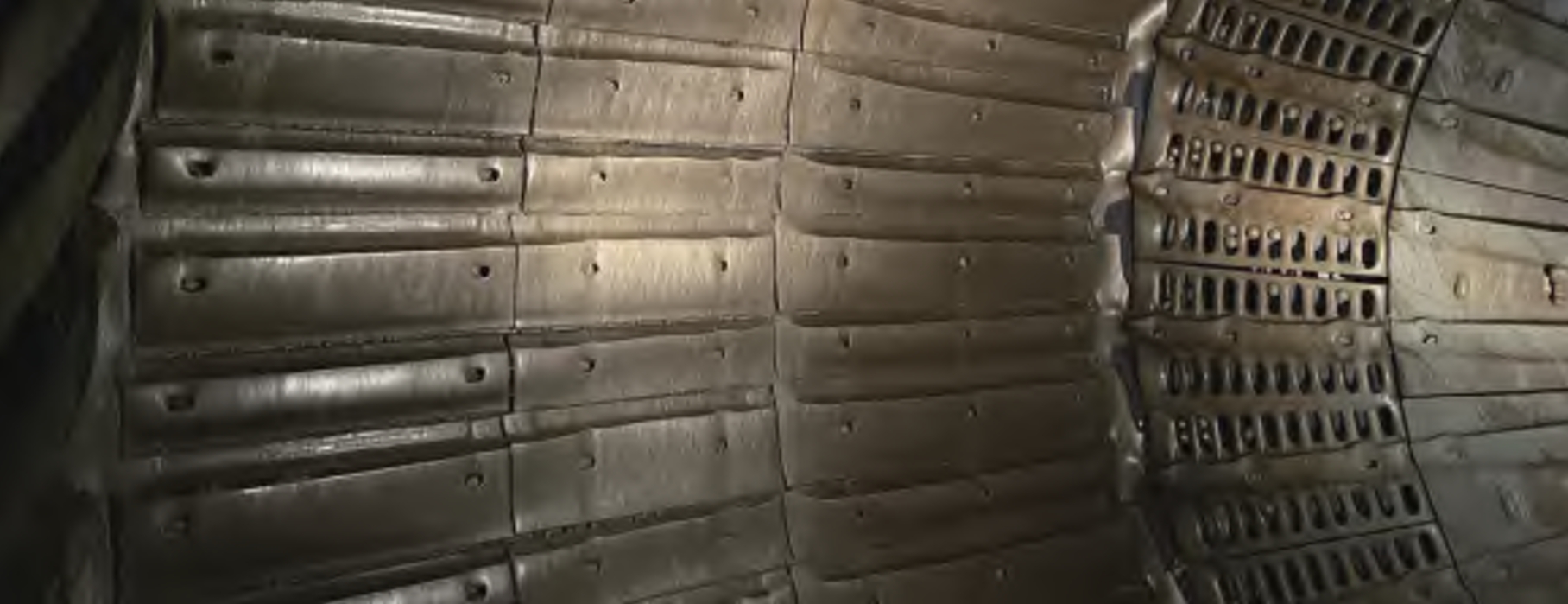
The primary crushing stage at the Husab Uranium Mine relies on Kawasaki KG15522 gyratory crushers. The dynamic cone assembly is the core working component. Its central shaft is protected by upper and lower conical lining plates, consumable parts requiring frequent replacement. These lining plates are secured by a large top nut pressing onto a torch ring, which in turn clamps the lining plates against the main shaft. Epoxy resin fills the space between the lining plates and the shaft. Removing this large nut is the critical first step for lining plate replacement.
2 Comparative Analysis of Removal Processes
Historically, four main processes were employed for nut removal, each with significant drawbacks:
| Process | Description | Key Risks & Drawbacks | Impact on Lining Plate & Components |
|---|---|---|---|
| Process ①: Direct Loosening | Welding levers to nut; striking with hammer. | High risk of thread galling/damage due to excessive force and trapped debris. Difficult control. | Risk of damaging threaded sleeve threads, complicating future lining plate changes. |
| Process ②: Radial Nut Cutting | Cutting diametrically through the nut using oxy-fuel. | Destroys nut (cost ~399,643 NAD). High risk of cutting into/thermally damaging the threaded sleeve and potentially the shaft journal below. Subsequent nut installation prone to jamming on damaged threads. | Destroys nut and often torch ring (~200,000 NAD). High risk of irreparably damaging the threaded sleeve (~400,000 NAD) critical for lining plate retention. |
| Process ③: Torch Ring Cutting | Rotational cutting of the torch ring beneath the nut. | Requires high welder skill. High risk of cutting through the thin ring (~5mm gap) and damaging the threaded sleeve and, critically, the main shaft journal (stress concentration zone). Destroys torch ring. | Destroys torch ring. Thermal damage to threaded sleeve and shaft journal compromises shaft integrity and future lining plate security. |
| Process ④: Upper Lining Plate Cutting (Proposed) | Rotational cutting of the upper lining plate below the nut/torch ring assembly. | Requires precise location but offers high tolerance. Destroys the upper lining plate (consumable). | Sacrifices the worn upper lining plate only. Protects nut, torch ring, threaded sleeve, and shaft journal. |
3 Development and Application of Process ④: Rotational Cutting of the Upper Lining Plate
Leveraging the geometry of the upper lining plate – conical, tapering thicker towards the top – a safe cutting zone was identified. The optimal cut location is approximately 150mm below the top surface of the upper lining plate. At this point:
- The lining plate thickness is reduced (approximately 75mm).
- A thick layer of epoxy resin (>70mm) exists between the lining plate and the main shaft.
- The location is significantly distant from the threaded sleeve/nut interface and the sensitive shaft journal area.
The cutting operation involves a controlled rotational oxy-fuel cut around the circumference of the upper lining plate at the 150mm depth. Crucially, piercing the lining plate exposes the underlying epoxy resin, which produces dense black smoke upon heating, providing a clear visual indicator to the welder that penetration is achieved. This thick resin layer acts as an effective thermal barrier, protecting the main shaft.
The fundamental advantage lies in isolating the destructive cutting process to the consumable upper lining plate itself, away from all precision, high-cost components. Once the lining plate is severed, the compressive epoxy allows the clamping force exerted by the large nut to dissipate. The nut can then be unscrewed easily with minimal force, inspected, cleaned, and reused. The torch ring, located above the cut zone and protected from heat and direct cutting, also remains undamaged and reusable.
4 Technical Advantages and Cost Savings
The strategic choice of cutting the lining plate offers distinct mechanical and economic benefits:
- Elimination of High-Risk Damage: By cutting the lining plate, the critical threaded interface and the shaft journal are completely shielded from thermal stress and mechanical trauma. This preserves the integrity of the shaft and the threads, drastically reducing the risk of catastrophic failure like shaft fracture (historically linked to journal damage) or thread galling during reassembly. The reliability equation for the shaft, considering stress concentration factors, highlights the importance of avoiding journal damage:
$$\sigma_{\text{max}} = K_t \cdot \sigma_{\text{nom}}$$
Where $\sigma_{\text{max}}$ is the maximum stress at the journal (critical for fatigue life), $K_t$ is the stress concentration factor (significantly increased by surface defects), and $\sigma_{\text{nom}}$ is the nominal stress. Process ④ minimizes $K_t$ by preventing journal damage. - Reduced Repair Complexity: Avoiding damage to the threaded sleeve or nut eliminates the need for complex, time-consuming, and often imperfect thread repair procedures, which previously required extensive manpower and crane time.
- Significant Spare Parts Cost Reduction: Reusing the large nut (~399,643 NAD) and the torch ring (~200,000 NAD) represents substantial savings per refurbishment cycle. Annually, this translates to over 1,200,000 NAD in direct savings at Husab Mine. The avoidance of potential damage to the threaded sleeve (~400,000 NAD) or the main shaft itself (costing over 1,284,115 NAD if severely damaged) provides further massive cost avoidance.
- Operational Simplicity and Safety: The thick epoxy layer provides a large tolerance buffer for welders, making the cut safer and easier to control than the precision required for torch ring cutting. The visual smoke indicator enhances process control. The table below summarizes key cutting parameters:
| Parameter | Value/Range | Notes |
|---|---|---|
| Cut Location (Below Top Surface) | 150 mm | Optimized based on lining plate taper & resin thickness. |
| Upper Lining Plate Thickness at Cut | ~75 mm | Reduced thickness facilitates cutting. |
| Epoxy Resin Thickness at Cut | >70 mm | Acts as thermal barrier and penetration indicator. |
| Distance to Threaded Sleeve | >150 mm (Radial & Axial) | Protects threads from heat. |
| Distance to Shaft Journal | >200 mm (Axial) | Protects critical stress area. |
| Primary Equipment | Oxy-Fuel Cutting Torch | Standard site equipment. |
The heat input ($Q$) during cutting and its effect on the underlying shaft can be estimated, demonstrating the safety margin provided by the resin layer:
$$Q = \eta \cdot P \cdot t$$
Where $\eta$ is process efficiency, $P$ is power input, and $t$ is arc time. The temperature rise $\Delta T$ in the shaft is governed by:
$$\Delta T \approx \frac{Q}{c \cdot \rho \cdot V}$$
Where $c$ is specific heat, $\rho$ is density, and $V$ is the affected volume. The thick resin layer significantly increases the effective $V$ and acts as a heat sink, minimizing $\Delta T$ in the shaft.
5 Conclusion
The rotational cutting of the upper lining plate (Process ④) represents a significant advancement in the maintenance methodology for gyratory crusher dynamic cone assemblies. By strategically sacrificing the consumable lining plate component itself, this process effectively eliminates the primary risks associated with traditional nut removal techniques – namely, damage to the high-value large nut, torch ring, threaded sleeve, and critically, the main shaft journal. The process significantly lowers technical complexity, enhances operational safety for maintenance personnel, and drastically reduces spare parts consumption and associated costs. Successfully implemented multiple times at the Husab Uranium Mine, this lining plate-focused cutting technique offers a reliable and economically superior solution for dynamic cone refurbishment, providing a valuable reference for similar gyratory crusher operations globally.