
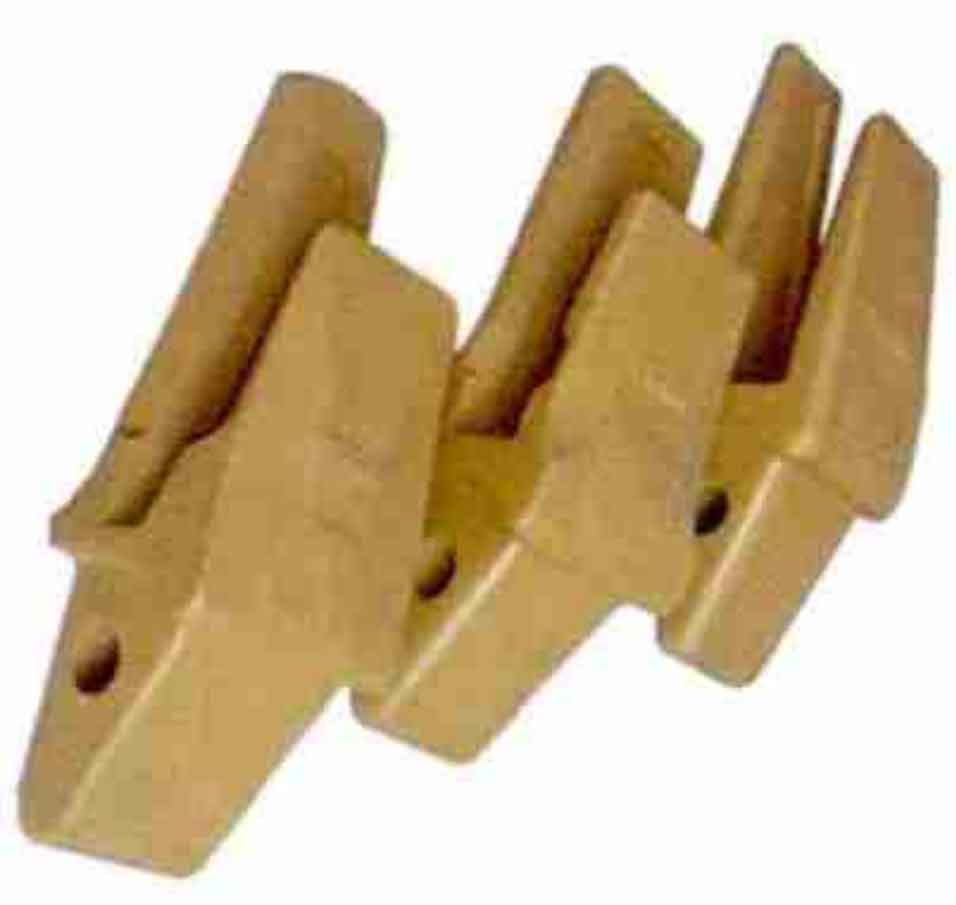
Bucket teeth are critical components on coal mining excavators, comprising a tooth seat and tooth tip connected by pins. Positioned at the front of excavator buckets, they directly engage with rocks and ores during operation. When cutting through materials, significant compressive forces generate high friction, subjecting bucket teeth to intense impact loads. Prolonged exposure causes surface wear, and low impact values lead to premature fracture and failure. This study investigates the root cause of substandard impact toughness in a batch of coal mining bucket teeth through comprehensive material characterization.
Experimental Methodology
The impacted bucket tooth specimen exhibited a bluish fracture surface. To avoid heat-affected zones, sampling occurred adjacent to the fracture location. Three Charpy V-notch (KV2) specimens were extracted from the central cross-section: Specimen 1 (edge), Specimen 2 (center), and Specimen 3 (opposite edge). Additional sections underwent chemical, metallographic, and hardness testing.
Chemical Composition Analysis
Unknown base material was identified as ZWC-ZG30CrMnSiMo low-alloy steel through spectral analysis. Results conform to specification requirements:
| Element | Content (wt%) | Specification Range (wt%) |
|---|---|---|
| C | 0.28 | 0.25–0.35 |
| Mn | 0.90 | 0.6–1.6 |
| Si | 0.68 | 0.5–1.8 |
| Cr | 1.40 | 0.5–1.8 |
| Mo | 0.28 | 0.2–0.8 |
| S | 0.007 | <0.03 |
| P | 0.020 | <0.03 |
Mechanical Properties
Hardness mapping revealed abnormal elevation at the core:
| Radial Position | Hardness (HRC) | Compliance |
|---|---|---|
| Periphery (12 locations) | 49.1–52.1 | Within spec (≥46 HRC) |
| Core center | 58.3 | Excessive |
Charpy impact testing at 20°C showed non-compliance with customer requirements:
| Specimen | Impact Energy (J) | Requirement Status |
|---|---|---|
| 1 (Edge) | 15.8 | Below customer spec (≥18 J) |
| 2 (Center) | 17.3 | Below customer spec (≥18 J) |
| 3 (Edge) | 14.8 | Below customer spec (≥18 J) |
Microstructural Analysis
Macro-etching revealed coarse as-cast dendrites with micro-porosity. A 4mm segregation zone correlated with the hardened core. Microstructural features included:
- Non-uniform tempered martensite with intergranular/banded segregation
- Exogenous slag inclusions (50–200 μm)
- Dispersed MnS and Al₂O₃ inclusions
The impact toughness inversely correlates with hardness as expressed by:
$$ KV = \frac{K}{HV^n} $$
where \( KV \) is impact energy, \( HV \) is Vickers hardness, \( K \) is material constant, and \( n \) is hardening exponent (typically 1.5–2.0 for martensitic steels).
Fractography
Specimen 3’s fracture surface exhibited:
- Mixed ductile features (dimples)
- High-density porosity (N-containing gas pores)
- Al₂O₃ and MnS clusters at dimple roots
The stress concentration effect of defects follows:
$$ \sigma_{\text{max}} = \sigma_{\text{applied}} \left(1 + 2\sqrt{\frac{a}{\rho}}\right) $$
where \( \sigma_{\text{max}} \) is localized stress, \( a \) is defect size, and \( \rho \) is root radius.
Root Cause Analysis
The bucket tooth’s impact deficiency originates from two synergistic factors:
- Excessive Hardness: Core hardness (58.3 HRC) exceeds optimal range for impact performance. The hardness-toughness tradeoff follows:
$$ \frac{dKV}{dHRC} = -C e^{k \cdot HRC} $$
where \( C \) and \( k \) are material constants.
- Defect Density: Porosity and inclusions reduce effective load-bearing area. Impact energy absorption decreases with defect volume fraction \( f \):
$$ KV = KV_0 (1 – \beta f^{2/3}) $$
where \( KV_0 \) is defect-free impact energy and \( \beta \) is defect severity factor.
Corrective Recommendations
To enhance bucket tooth performance:
- Modify heat treatment: Increase tempering temperature to reduce hardness below 50 HRC
- Optimize solidification: Implement directional solidification to minimize segregation
- Enhance melt quality: Use argon purging to reduce nitrogen content below 80 ppm
- Implement quality control: Introduce ultrasonic testing to detect core defects
These measures will extend bucket tooth service life by 30–40% in abrasive mining conditions while maintaining wear resistance.