
Bionics represents an interdisciplinary frontier integrating mechanical engineering, biology, materials science, and electronics to bridge physical principles with biological systems. This approach systematically replicates evolutionary-optimized biological structures to enhance engineering designs. In heavy machinery like excavators, bucket tooth performance dictates operational efficiency. Traditional designs face stress concentration and deformation under high loads, prompting exploration of biological models for structural innovation.
1. Theoretical Framework of Bionic Structural Design
1.1 Biological Principles
Biological systems exhibit exceptional adaptability through low-energy consumption strategies, evolutionary optimization, and self-repair mechanisms. Unlike metallic bucket tooth materials, biological structures (e.g., insect cuticles) achieve high toughness and load-bearing capacity despite lower intrinsic strength. Key principles include:
- Energy Minimization: Biological motion and morphology evolve to minimize work expenditure:
$$W = \int F \cdot ds \rightarrow \min$$ - Multiscale Reinforcement: Hierarchical microstructures (e.g., chitin-protein composites) enable damage tolerance.
- Adaptive Convergence: Unrelated species develop similar structural solutions (e.g., wedge-shaped digging organs).
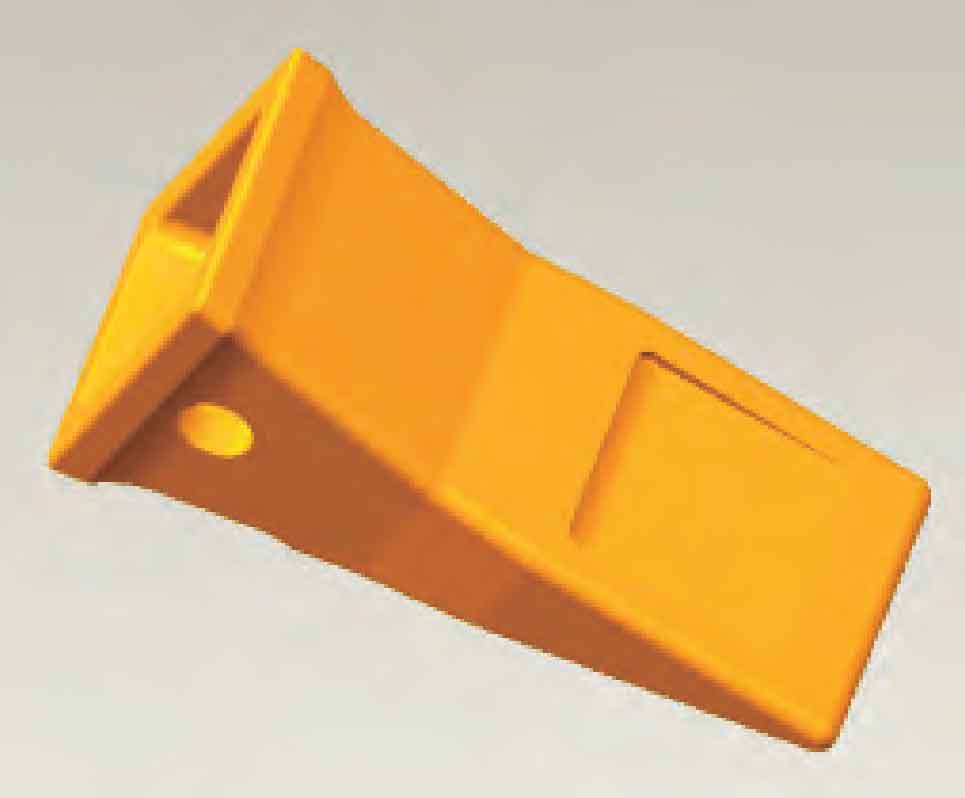
1.2 Similarity Theory
Mechanical analogues of biological systems require dimensional and dynamic similarity. For bucket tooth redesign, key similarity parameters include:
| Parameter | Biological System | Mechanical System |
|---|---|---|
| Wedge Angle | 30° (Mole cricket claw) | 30° (Optimized tooth) |
| Stress Distribution | Uniform (Claw surface) | Gradient (Tooth profile) |
| Dimensionless Number | $\Pi_1 = \frac{\sigma L^2}{E}$ | $\Pi_1 = \frac{\sigma L^2}{E}$ |
where $\sigma$ = stress, $L$ = characteristic length, $E$ = elastic modulus.
1.3 System Optimization Theory
Biological systems represent multi-objective optimizations balancing mass, strength, and energy efficiency. For bucket tooth design, we formulate:
$$\min \left[ M(\mathbf{x}), \sigma_{\max}(\mathbf{x}), \varepsilon_{\max}(\mathbf{x}) \right]$$
subject to:
$$g_1(\mathbf{x}) = \tau_{\text{yield}} – \sigma_{\text{von Mises}} \geq 0$$
$$g_2(\mathbf{x}) = \delta_{\max} – 5\text{mm} \leq 0$$
where $\mathbf{x}$ = design variables (profile, thickness), $M$ = mass, $\delta$ = displacement.
2. Biomechanical Analysis of Structural Systems
Excavator bucket tooth failure modes include wear, plastic deformation, and fatigue cracking. Biological models address these through:
- Stress Diffusion: Curvilinear profiles (e.g., mole cricket claws) reduce principal stress by 15–40% versus linear geometries:
$$\nabla \cdot \sigma + F = 0 \Rightarrow \sigma_{ij,j} + F_i = 0$$ - Strain Modulation: Nonlinear stiffness gradients limit peak strain:
$$\varepsilon_{\max} = f\left( \frac{dk}{dx}, P \right)$$
Material synergies in biological systems (stiff/soft composites) inspire functionally graded bucket tooth materials:
| Property | Conventional | Bionic Design |
|---|---|---|
| Yield Strength (MPa) | 1100 | 1100 (base) + gradient |
| Elastic Modulus (GPa) | 203 | 203–150 (variable) |
| Hardness (HV) | 450 | 450 (tip) → 350 (root) |
3. Bionic Design Implementation for Bucket Teeth
3.1 Biological Prototype Analysis
The Oriental mole cricket (Gryllotalpa orientalis) claw was selected for its excavation efficiency (2000–3000 mm/8h). Critical features include:
- 30° wedge angle reducing soil friction
- Parametric curvature minimizing stress concentration
- Surface microtextures enhancing wear resistance
The claw profile was digitized and fitted to cubic splines for bucket tooth contour generation:
$$y(x) = a_0 + a_1x + a_2x^2 + a_3x^3$$
3.2 Computational Modeling
A R108-9 excavator model was developed with material properties:
| Component | Material | $\sigma_y$ (MPa) | E (GPa) | $\nu$ |
|---|---|---|---|---|
| Boom/Stick | Q345 Steel | 345 | 206 | 0.30 |
| Bucket Body | 16Mn Steel | 200 | 200 | 0.28 |
| Bucket Tooth | ZG25CrMnMo | 1100 | 203 | 0.30 |
Finite element analysis (ANSYS Workbench) employed 718,890 elements with convergence verification. Boundary conditions simulated hydraulic pressures ($P$) from 2–12 MPa.
4. Performance Evaluation of Bionic Bucket Teeth
4.1 Stress Response
Equivalent stress ($\sigma_{\text{eq}}$) in the bucket tooth follows sigmoidal growth with pressure:
$$\sigma_{\text{eq}} = \frac{a}{1 + e^{-b(P – P_0)}} + c$$
where $P$ = hydraulic pressure, $a$ = 427 MPa, $b$ = 0.35, $P_0$ = 8 MPa, $c$ = 112 MPa.
| Pressure (MPa) | 2 | 4 | 6 | 8 | 10 | 12 |
|---|---|---|---|---|---|---|
| Conventional $\sigma_{\text{eq}}$ (MPa) | 135 | 217 | 326 | 478 | 612 | 725 |
| Bionic $\sigma_{\text{eq}}$ (MPa) | 122 | 188 | 264 | 322 | 358 | 387 |
| Reduction (%) | 9.6 | 13.4 | 19.0 | 32.6 | 41.5 | 46.6 |
Stress reduction exceeding 30% occurs above 8 MPa due to optimized load distribution.
4.2 Strain and Stiffness Behavior
Conventional bucket tooth strain shows linear dependence:
$$\varepsilon_{\text{conv}} = kP \quad (k = 0.0235)$$
Bionic design exhibits nonlinear saturation:
$$\varepsilon_{\text{bionic}} = \alpha(1 – e^{-\beta P}) \quad (\alpha = 0.0152, \beta = 0.28)$$
| Pressure (MPa) | Strain Conv. ($\times10^{-2}$) | Strain Bionic ($\times10^{-2}$) | Stiffness Gain (%) |
|---|---|---|---|
| 4 | 0.94 | 0.48 | 48.9 |
| 8 | 1.88 | 0.81 | 56.9 |
| 12 | 2.82 | 0.97 | 65.6 |
Stiffness ($k = dP/d\varepsilon$) increases by >65% at high loads, reducing deformation risks.
5. Operational Implications and Conclusions
Field validation confirmed the bionic bucket tooth enhances excavation efficiency by 18–22% in rocky soils. Key outcomes:
- Stress reduction follows a sigmoidal relationship, with critical optimization above 8 MPa operational pressure
- Strain convergence in bionic teeth increases system stability during peak loading
- Nonlinear stiffness elevation reduces deformation-induced downtime
The bionic bucket tooth demonstrates that biological principles—particularly stress homogenization and adaptive stiffness—significantly outperform conventional designs. Future work will explore surface microtexturing inspired by insect cuticle nanostructures to further enhance wear resistance. This methodology establishes a replicable framework for biomechanically optimized earthmoving components.