
Large-scale mining hydraulic excavators are indispensable for enhancing efficiency and ensuring quality in open-pit mining operations. Research into excavator operating load spectra forms the foundation for improving operational intelligence, reliability, and longevity. We utilize Enhanced Discrete Element Method (EDEM) simulation software to analyze spatial load distribution patterns on excavator bucket teeth, focusing on load amplitude and angular characteristics across typical working conditions. Our methodology provides critical insights into load dynamics for fatigue life prediction and structural optimization of mining equipment.
EDEM Simulation Model
We modeled the excavator working device—boom, stick, and bucket—in EDEM, with explicit focus on six bucket teeth. Material properties for coal rock particles were calibrated using field data, while the bucket was assigned steel properties. Particle shapes were diversified to reflect real-world fragmentation:
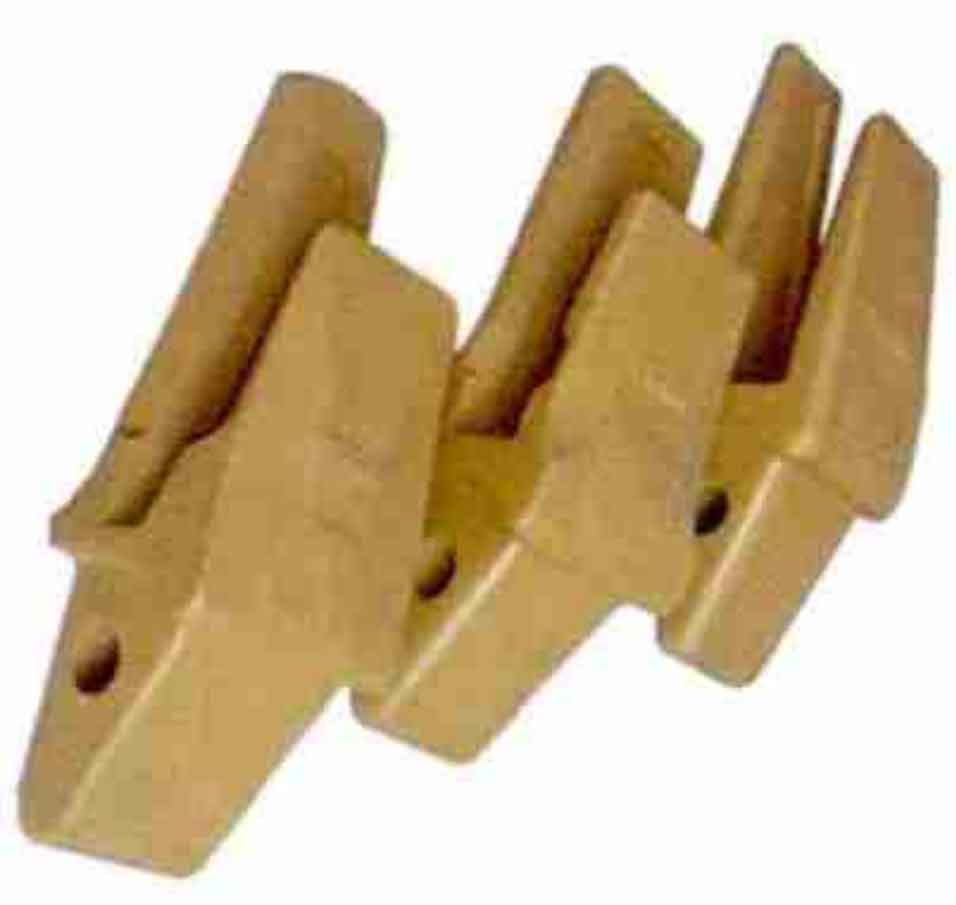
Particle size and density variations were simulated to evaluate their impact on bucket tooth loads. Contact mechanics followed Coulomb friction theory:
$$F_f = \mu F_n$$
where \(F_f\) is friction force, \(\mu\) is the friction coefficient, and \(F_n\) is normal force. Material parameters are summarized below:
| Component | Density (kg/m³) | Elastic Modulus (GPa) | Poisson’s Ratio |
|---|---|---|---|
| Bucket | 7,500 | 210 | 0.28 |
| Coal 2 (Typical) | 1,430 | 1.2 | 0.3 |
| Contact Pair | Static Friction | Rolling Friction | Restitution |
|---|---|---|---|
| Coal-Coal | 0.6 | 0.15 | 0.5 |
| Coal-Bucket | 0.4 | 0.04 | 0.5 |
Particle shape distribution was modeled using four geometric types with distinct shape factors \(k_s\):
$$k_s = \frac{\text{Surface Area of Equivalent Sphere}}{\text{Actual Surface Area}}$$
| Particle Type | Shape Factor \(k_s\) | Diameter (mm) | Population (%) |
|---|---|---|---|
| Spherical | 0.753 | 200/400 | 25.0 |
| Columnar | 0.389 | 200/400 | 25.0 |
| Pyramidal | 0.279 | 200/400 | 25.0 |
| Flattened | 0.433 | 200/400 | 25.0 |
Simulation Process
The digging cycle \(T = T_1 + T_2\) was simulated over 15 seconds, where \(T_1\) is the excavation phase and \(T_2\) is the lifting phase. Particle generation occurred during the first 7 seconds, followed by bucket engagement. Motion constraints followed kinematic equations:
$$\theta(t) = \arccos(-0.001t^2 – 0.0864t – 0.1736)$$
where \(\theta(t)\) is the rotation angle in degrees at time \(t\). The Rayleigh timestep ensured numerical stability:
$$T_R = \pi R \sqrt{\frac{\rho}{G}} \left( \frac{1}{0.1631\nu + 0.8766} \right)$$
where \(R\) is particle radius, \(\rho\) is density, \(G\) is shear modulus, and \(\nu\) is Poisson’s ratio. We used 20% of \(T_R\) as the simulation timestep.
Bucket Tooth Load Analysis
Load profiles for all six bucket teeth exhibited similar temporal patterns but varying magnitudes. Central teeth (Tooth 3–4) experienced 18–22% higher peak loads than peripheral teeth (Tooth 1 and 6) due to force concentration. Peak loads scaled with particle size \(d\) and density \(\rho\):
$$F_{\text{peak}} \propto d^{0.7} \cdot \rho^{1.2}$$
Typical load-time histories are shown below for Tooth 1 and Tooth 3:
| Time (s) | Tooth 1 Load (kN) | Tooth 3 Load (kN) |
|---|---|---|
| 8.2 | 142 | 187 |
| 8.5 | 318 | 402 |
| 8.8 | 521 | 674 |
| 9.1 | 683 | 887 |
Spatial Load Distribution
Angular distributions between load components were analyzed using direction vectors. For each bucket tooth, the angles between total load \(F_T\) and its components were computed:
$$\alpha = \arccos\left(\frac{F_s}{F_T}\right), \quad \beta = \arccos\left(\frac{F_n}{F_T}\right), \quad \gamma = \arccos\left(\frac{F_\tau}{F_T}\right)$$
where \(F_s\), \(F_n\), and \(F_\tau\) denote side, normal, and tangential loads. Entropy quantified directional uncertainty:
$$H(X) = -\sum_{i=1}^{n} p_i \log_2 p_i$$
Key spatial distribution findings include:
| Bucket Tooth | Tangential Entropy | Normal Entropy | Side Entropy |
|---|---|---|---|
| Tooth 1 | 2.31 | 2.05 | 1.78 |
| Tooth 2 | 2.68 | 2.41 | 2.02 |
| Tooth 3 | 2.19 | 1.97 | 1.65 |
Peripheral bucket teeth exhibited 15–20% higher entropy than central teeth, indicating greater load direction variability. The tangential component showed the highest entropy across all teeth, revealing unpredictable shear dynamics during excavation.
Material Parameter Sensitivity
Eight scenarios evaluated particle diameter (\(d\)) and density (\(\rho\)) effects on bucket tooth loading. Central teeth consistently showed 20–25% higher load sensitivity to parameter changes:
| Condition | \(\rho\) (kg/m³) | \(d\) (mm) | Peak Load Increase |
|---|---|---|---|
| 1 | 1,100 | 400 | Baseline |
| 4 | 1,550 | 400 | +38.7% |
| 8 | 1,300 | 400 | +41.2% |
Larger particles increased load fluctuations due to discontinuous contact, while higher density linearly amplified stress magnitudes. The bucket tooth load profiles maintained consistent temporal patterns across all conditions, enabling generalized fatigue models.
Conclusion
EDEM simulations reveal consistent spatiotemporal load patterns on excavator bucket teeth across diverse material conditions. Central teeth experience higher-magnitude but lower-variability loads, while peripheral teeth endure greater directional uncertainty. Particle size and density exponentially influence peak loads, with tangential forces exhibiting the highest entropy. These findings provide a foundation for fatigue life prediction and structural optimization of mining excavators. Future work will integrate these load models with multi-body dynamics simulations to predict stress distributions across the entire bucket tooth assembly.