
Production Technology of Hot Rolled Round Steel for Forging Bucket Teeth
Bucket teeth are critical components in earthmoving machinery like excavators and bulldozers, serving as high-wear parts. With growing environmental awareness and the global push toward low-carbon manufacturing, forged bucket teeth are progressively replacing cast variants due to superior performance and sustainability. Since 2013, our facility at Shandong Iron and Steel Co., Ltd. has pioneered the development of specialized hot-rolled round steel for forging bucket teeth, capturing significant market share with an annual output exceeding 10,000 tons.
Forging Process and Performance Requirements
The manufacturing sequence for forged bucket teeth includes: billet cutting → heating → die forging → primary/secondary punching → flash trimming → pin-hole piercing → stamping → heat treatment. Forging refines grain structure through plastic deformation, enhancing mechanical properties. Post-forging heat treatment (quenching + tempering) ensures optimal hardness-toughness balance, critical for bucket tooth longevity.
Bucket teeth predominantly fail through wear (90–95% of cases) or fracture/deformation (5–10%). Two key wear mechanisms operate:
- Under high-impact conditions (e.g., rock excavation), sharp abrasive particles plow grooves into the bucket tooth surface. The Archard wear model quantifies this: $$W = K \frac{L_n}{H}$$ where \(W\) is wear volume, \(K\) is the wear coefficient, \(L_n\) is normal load, and \(H\) is material hardness.
- Fatigue Spalling Mechanism: In low-impact scenarios (e.g., handling soil), cyclic stress induces subsurface cracks that propagate, causing material spalling. Here, wear resistance correlates with fracture toughness \(K_{IC}\): $$W \propto \frac{1}{K_{IC}^2}$$
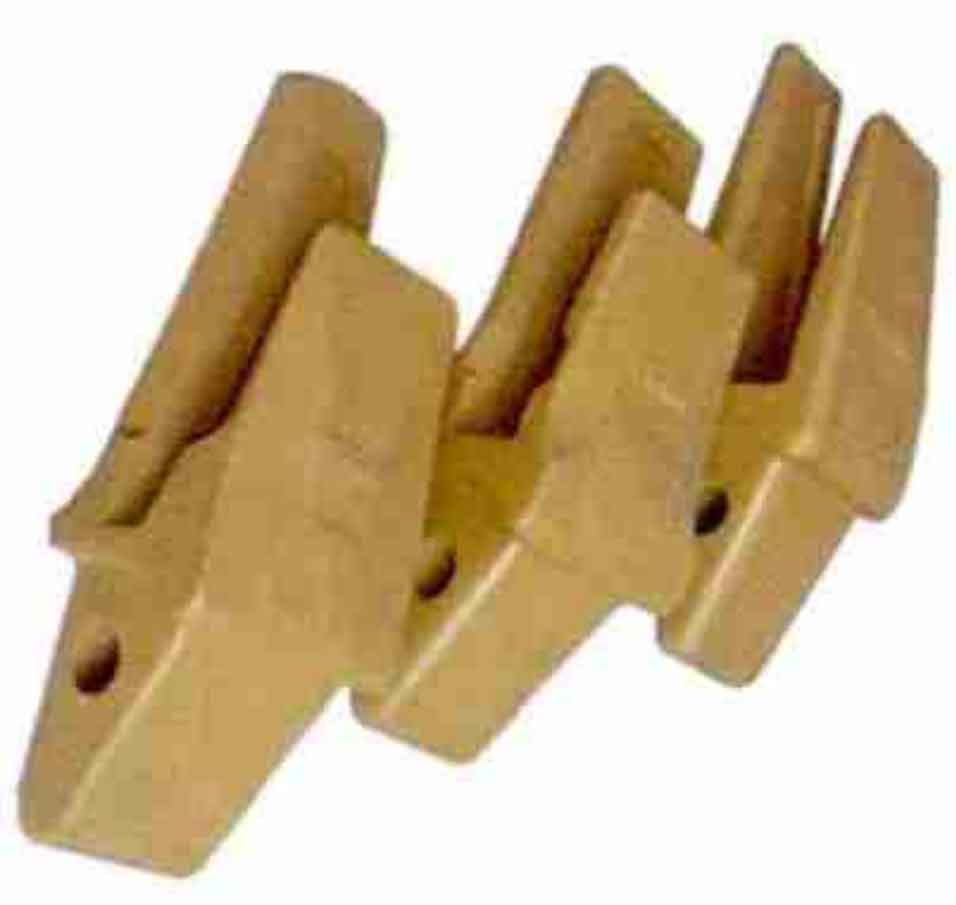
Performance requirements for bucket teeth include:
- Base hardness ≥46 HRC for wear resistance
- Impact toughness ≥20 J to prevent fracture
- Full hardenability to ensure uniform martensitic microstructure
- Austenite grain size ≤ASTM 5 for strength-toughness synergy
Material Design and Production Technology
Alloy systems are tailored to operational demands, balancing cost and performance:
| Series | C | Si | Mn | Cr | Mo | V/Ti/Nb |
|---|---|---|---|---|---|---|
| Si-Mn | 0.27–0.40 | 0.60–1.60 | 0.80–1.50 | – | – | – |
| Si-Mn-Cr | 0.27–0.40 | 0.60–1.60 | 0.80–1.50 | 1.10–2.00 | – | – |
| Si-Mn-Cr-Mo | 0.27–0.40 | 0.60–1.60 | 0.80–1.50 | 1.10–2.00 | 0.10–0.20 | V:0.05–0.15 Ti:0.05–0.10 Nb:0.02–0.07 |
Element functions:
- C (0.27–0.40%): Balances martensite morphology; ensures hardness-toughness equilibrium via mixed lath/plate martensite.
- Si (0.60–1.60%): Solid-solution strengthening; cost-effective hardness booster. Excess Si reduces toughness and promotes decarbonization.
- Mn/Cr/Mo: Enhance hardenability. Mn (0.80–1.50%) and Cr (1.10–2.00%) are essential; Mo (0.10–0.20%) added for severe-service bucket teeth.
- V/Ti/Nb: Form carbides/nitrides, refining grains and improving toughness. Added singly or combined.
Critical quality metrics:
| Inclusion Type | Severity (max) | |
|---|---|---|
| Thin Series | Thick Series | |
| A (Sulfides) | 2.5 | 2.0 |
| B (Aluminates) | 2.0 | 1.5 |
| C (Silicates) | 1.5 | 1.0 |
| D (Globular Oxides) | 1.5 | 1.0 |
| DS (Single-type) | 2.0 | |
Additional specifications:
- Macrostructure: General/center porosity ≤2.0; segregation ≤2.0
- Austenite grain size: ≥ASTM 6
- Delivery hardness: ≤280 HBW (facilitates cutting)
Process Control Innovations
The production route comprises: EAF → LF → VD → continuous casting → rolling → annealing (for high-alloy grades).
Cleanliness Control: Foamy slag practice in EAF ensures vigorous decarburization (\([\text{C}]_{\text{initial}}\) ≥0.15%, T ≤1600°C) for dephosphorization. Desired endpoints: [C]=0.10–0.12%, [P]≤0.012%. Post-tapping, aluminum (1.0 kg/t) deoxidizes molten steel, reducing dissolved oxygen below 20 ppm. LF refining maintains slag basicity (\(R = \frac{\% \text{CaO}}{\% \text{SiO}_2}\)) >3.0 via CaC addition; aluminum wire feeding further reduces [O] and [S] (≤0.010%). VD treatment (≥15 min vacuum) achieves [O]≤15 ppm. Protective casting prevents reoxidation.
Heating Optimization: High-Cr/Mo steels exhibit severe dendritic segregation. Slow heating (<600°C) minimizes thermal stress: $$\frac{dT}{dt} = \frac{k}{\rho C_p} \nabla^2 T$$ where \(k\)=thermal conductivity, \(\rho\)=density, \(C_p\)=specific heat. Rapid heating above 600°C + extended soaking homogenizes alloys.
Annealing Management: High-alloy bucket tooth steel (hardness ≈330 HBW as-rolled) undergoes subcritical annealing: $$\text{Temperature} = A_{C1} – (20–30^\circ \text{C})$$ Soaking for 3–6 h yields 210–260 HBW, optimizing machinability.
Conclusion
Our tailored hot-rolled round steels for forged bucket teeth deliver high cleanliness (inclusion rating ≤2.5), fine grains (ASTM ≥6), and tunable properties. The Si-Mn-Cr(-Mo) systems with microalloying (V/Ti/Nb) accommodate diverse service conditions—from low-impact soil handling to high-impact rock excavation. Precise control of composition, hardenability, and thermomechanical processing ensures superior wear resistance and extended bucket tooth service life, driving the industry’s shift from casting to forging.