
In the realm of industrial manufacturing, the integration of additive manufacturing technologies with traditional processes has revolutionized production methods, particularly in the agricultural sector. As an expert in this field, I have observed how combining additive manufacturing with lost wax investment casting can significantly enhance the quality and efficiency of producing complex agricultural machinery components. This synergy allows for the creation of intricate parts with higher precision, reduced lead times, and minimized operational challenges. In this article, I will delve into the principles of additive manufacturing, highlight the limitations of conventional casting methods, and explore effective strategies for applying these technologies in lost wax investment casting for agricultural equipment. Through detailed analysis, including tables and mathematical models, I aim to demonstrate how this integration can drive innovation and improve overall productivity in agriculture.
Additive manufacturing, often referred to as 3D printing, encompasses computer-aided design, material processing, and成型 technologies based on digital model files. It utilizes数控 systems and software to deposit materials—such as metals, non-metals, or biomedical substances—through methods like melting, collection, extrusion, jetting, or photopolymerization, building objects layer by layer. This approach contrasts with traditional subtractive manufacturing, as it accumulates material to form items, offering distinct advantages for fabricating complex structures. The core benefits include high product accuracy, rapid成型 speeds, material efficiency, and operational convenience. For instance, in lost wax investment casting, additive manufacturing enables the direct production of wax patterns without the need for molds, streamlining the process and reducing waste.
The advantages of additive manufacturing are multifaceted. Firstly, product precision is exceptionally high due to the fine powder颗粒堆积 and bonding mechanisms, making it ideal for applications requiring smooth surfaces, such as in lost wax investment casting for agricultural parts. Secondly,成型速度 is accelerated, as it bypasses模具 fabrication,缩短生产周期 and enhancing efficiency. For example, a 3D model can be transformed into a physical prototype within hours, facilitating rapid iteration in design. Thirdly, material savings are substantial, as the process minimizes waste by utilizing only the necessary material, unlike traditional methods that involve cutting away excess. In冷酚醛树脂 printing, unused sand can be recycled, further boosting sustainability. Lastly, the convenience of distributed manufacturing allows for flexible production setups, with some devices capable of producing parts larger than themselves, which is particularly beneficial for on-demand agricultural machinery repairs.
Several典型工艺 of additive manufacturing are prevalent, categorized by energy source (e.g., laser-based or non-laser) and material form (e.g., metal powder, filament, liquid). The most commonly used techniques include Selective Laser Sintering (SLS), Stereolithography (SLA), Fused Deposition Modeling (FDM), 3D Printing (3DP), and Laminated Object Manufacturing (LOM). Each has unique characteristics suited for different applications in lost wax investment casting. For instance, SLS employs a laser beam to sinter powdered materials like metals or polymers, building parts layer by layer, while SLA uses ultraviolet light to cure photopolymer resins. FDM extrudes thermoplastic materials, and 3DP involves binding粉末 with adhesives, whereas LOM bonds layered materials using heat and pressure. The table below summarizes these processes, highlighting their relevance to lost wax investment casting in agricultural contexts.
| Process | Materials | Accuracy | Advantages | Disadvantages |
|---|---|---|---|---|
| Selective Laser Sintering (SLS) | Metal powders, polymers, ceramics | High | No support needed, wide material range | High energy consumption, potential thermal deformation |
| Stereolithography (SLA) | Photopolymer resins | Very high (layer thickness: 0.05–0.15 mm) | Smooth surfaces, fine details | Requires support structures, material shrinkage |
| Fused Deposition Modeling (FDM) | Thermoplastics (e.g., nylon, wax) | Medium | Low cost, ease of use | Visible layer lines, lower resolution |
| 3D Printing (3DP) | Powders with binders | Low to medium | Fast process, multi-material capability | Poor surface finish, limited strength |
| Laminated Object Manufacturing (LOM) | Paper, plastics, metals | Medium | High strength, rapid build times | Limited material options, post-processing required |
In the context of lost wax investment casting for agricultural machinery, additive manufacturing plays a pivotal role in producing high-quality wax patterns. The process begins with a CAD model of the component, such as an engine impeller, converted into an STL format. This file is sliced into thin layers using specialized software, where each slice represents a cross-section of the part. For example, in SLS, a laser sinters powdered wax material based on these slices, building the pattern layer by layer. The mathematical relationship for the surface quality in this process can be expressed using the following formula, which accounts for the step effect caused by layer thickness and scanning interval:
$$ \text{Surface Roughness} = k \cdot \frac{\text{Layer Thickness}}{\text{Scanning Interval}} $$
Here, \( k \) is a constant dependent on material properties and process parameters. Reducing layer thickness and scanning interval improves surface finish but increases production time, as shown in the equation for total build time:
$$ T = N \cdot t_{\text{layer}} $$
where \( N \) is the number of layers and \( t_{\text{layer}} \) is the time per layer. This trade-off must be optimized for efficient lost wax investment casting in agricultural applications.
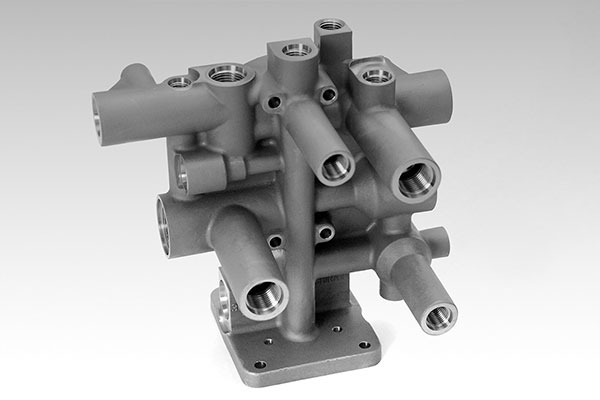
Applying additive manufacturing to lost wax investment casting involves several critical considerations to ensure precision and efficiency. For instance, in SLS-based lost wax investment casting, controlling造型精度 is paramount. The STL model approximates the ideal geometry using triangular facets, and the error between the model and the actual part decreases as the number of facets increases. This can be modeled as:
$$ \text{Error} \propto \frac{1}{N_{\text{facets}}} $$
However, excessive facets slow down data processing, necessitating a balance. Additionally,扫描间隔 and切片厚度 significantly influence the final part quality. A smaller layer thickness reduces the step effect, enhancing accuracy, but it also raises the number of layers and prolongs production. The optimal parameters can be determined through iterative testing, often summarized in tables for specific agricultural components, such as tractor blades or pump housings.
Despite its advantages, the integration of additive manufacturing in lost wax investment casting for agricultural machinery faces several limitations. Firstly, the technology is best suited for small to medium-sized parts; large components may still rely on traditional pattern-making methods due to equipment constraints. Secondly, processes like SLS require high-energy lasers and elevated temperatures, which can induce deformations or internal defects in wax patterns. Current non-destructive testing methods for these issues are underdeveloped, posing quality assurance challenges. Thirdly, the cost of equipment and materials, such as photopolymer resins, remains high, limiting widespread adoption in resource-constrained agricultural sectors. Lastly, environmental concerns arise from the emission of harmful substances during the printing of certain polymers, necessitating better waste management strategies.
To quantify the economic impact, consider the cost-benefit analysis for implementing additive manufacturing in lost wax investment casting. The total cost \( C_{\text{total}} \) can be broken down into material, energy, and time components:
$$ C_{\text{total}} = C_{\text{material}} + C_{\text{energy}} + C_{\text{time}} $$
where \( C_{\text{material}} \) depends on material utilization rates, often higher in additive methods due to reduced waste. For example, in lost wax investment casting, recycling unused powder can lower costs by up to 30% compared to traditional methods. The table below compares key metrics between conventional and additive-based lost wax investment casting for a typical agricultural component, highlighting the benefits of integration.
| Metric | Conventional Casting | Additive-Enhanced Casting |
|---|---|---|
| Production Time | Weeks | Days |
| Material Waste | High (up to 40%) | Low (less than 10%) |
| Accuracy (Tolerance) | ±0.5 mm | ±0.1 mm |
| Cost per Part | $$ C_c $$ | $$ C_a < C_c $$ |
In this table, \( C_c \) and \( C_a \) represent the costs for conventional and additive methods, respectively, with additive approaches often yielding savings over time due to faster iterations and lower waste. The integration of lost wax investment casting with additive manufacturing not only improves efficiency but also supports the trend toward smart manufacturing in agriculture, enabling the production of customized, high-performance parts.
Looking ahead, the fusion of additive manufacturing and lost wax investment casting is set to redefine agricultural machinery production. By leveraging数控 technologies, this combination facilitates the一体化生产 of components, reducing reliance on multiple processing steps. For instance, in producing complex irrigation system parts, additive manufacturing allows for direct digital fabrication of wax patterns, which are then used in lost wax investment casting to create durable metal components. This synergy aligns with global pushes for agricultural modernization, enhancing food security and economic resilience. As research advances, addressing current limitations such as material costs and environmental impacts will be crucial for broader adoption.
In conclusion, the effective application of additive manufacturing in lost wax investment casting for agricultural machinery represents a significant leap forward. It enables higher precision, shorter lead times, and greater operational flexibility, ultimately contributing to sustainable farming practices. By continuously refining these technologies, we can unlock new potentials in agricultural engineering, driving progress toward a more efficient and innovative future.