
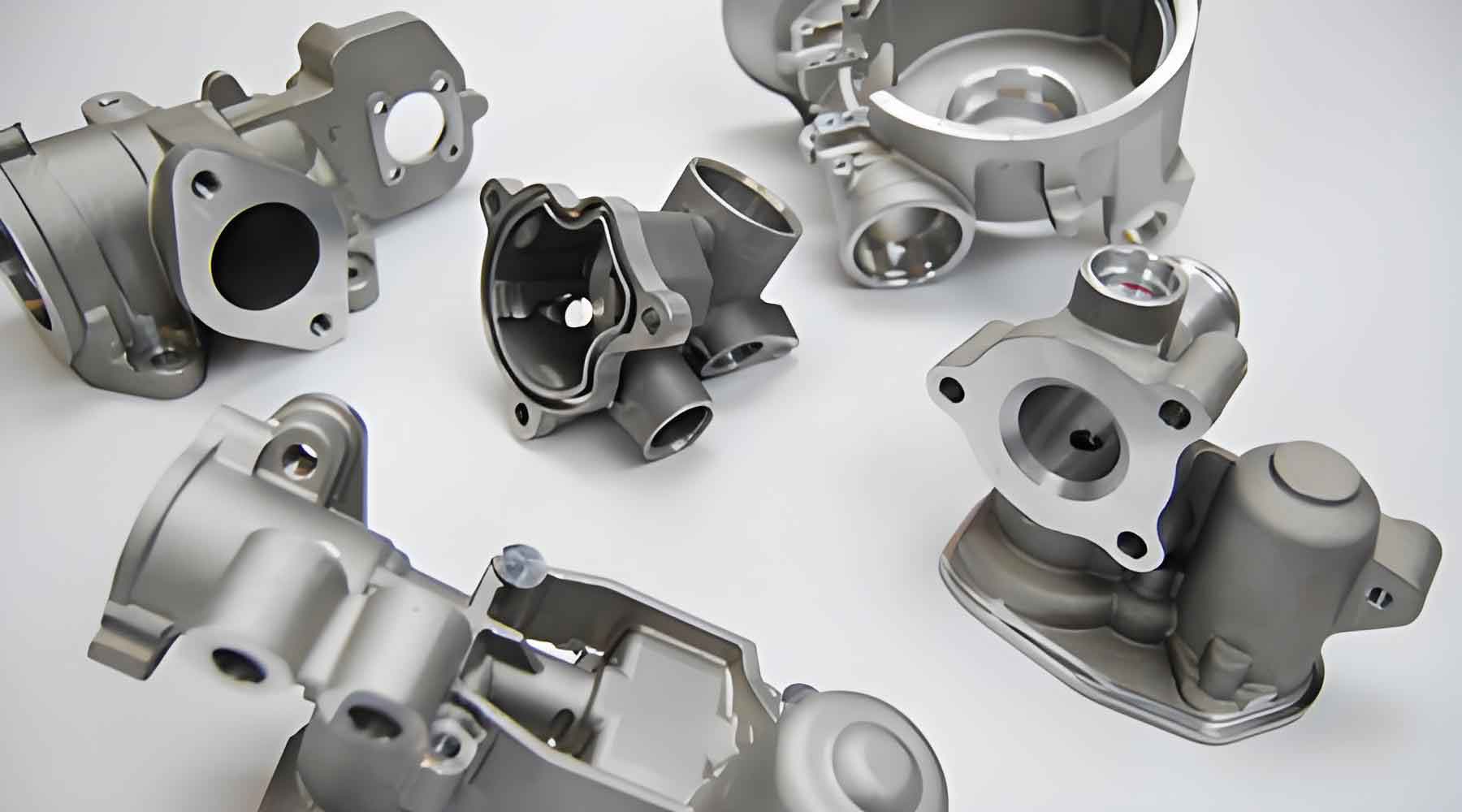
Lost wax investment casting is a widely used manufacturing technique for producing high-precision components with complex geometries and excellent surface finishes. This process involves creating a wax pattern, which is then coated with ceramic material to form a mold. After the wax is melted out, molten metal is poured into the cavity. The quality of the final cast part heavily depends on the wax pattern’s integrity, making the mold filling stage critical. However, the wax injection process is complex, involving non-Newtonian fluid behavior, heat transfer, and free surface dynamics. Traditional trial-and-error methods are time-consuming and costly, highlighting the need for accurate numerical simulations. In this study, we develop a comprehensive numerical model based on the Projection Volume of Fluid (VOF) method to simulate the wax mold filling process in lost wax investment casting. We incorporate the Cross-WLF viscosity model to capture the wax’s rheological properties and solve the flow and temperature fields. Our aim is to provide a robust tool for optimizing process parameters and improving wax pattern quality in lost wax investment casting applications.
The mathematical modeling of the wax mold filling process requires solving coupled equations for mass, momentum, and energy conservation. We assume the wax is an incompressible, non-Newtonian fluid with laminar flow, neglecting inertial and gravitational forces due to the dominance of viscous effects. The continuity equation for incompressible flow is given by:
$$ \nabla \cdot \mathbf{U} = 0 $$
where \(\mathbf{U}\) is the velocity vector. The momentum equation, simplified by omitting inertial and gravity terms, reduces to the Stokes flow approximation:
$$ \frac{\partial \mathbf{U}}{\partial t} = -\frac{1}{\rho} \nabla p + \nu \nabla^2 \mathbf{U} $$
Here, \(\rho\) is density, \(p\) is pressure, and \(\nu\) is kinematic viscosity. To accurately describe the wax’s viscosity, we employ the Cross-WLF model, which accounts for temperature and shear rate dependencies:
$$ \eta = \frac{\eta_0}{1 + \left( \frac{\eta_0 \dot{\gamma}}{\tau^*} \right)^{1-n}} $$
where \(\eta\) is the dynamic viscosity, \(\eta_0\) is the zero-shear viscosity, \(\dot{\gamma}\) is the shear rate, \(\tau^*\) is the critical shear stress, and \(n\) is the power-law index. The temperature dependence is incorporated through:
$$ \eta_0 = D_1 \exp\left[ -\frac{A_1 (T – T^*)}{A_2 + (T – T^*)} \right] $$
with \(A_2 = A_2 + D_3 p\) and \(T^* = D_2 + D_3 p\), where \(D_1\), \(A_1\), \(A_2\), \(D_2\), and \(D_3\) are material constants, and \(T\) is temperature. For the energy equation, we consider heat transfer with phase change:
$$ \rho c_p \frac{\partial T}{\partial t} + \rho c_p \mathbf{U} \cdot \nabla T = \nabla \cdot (\lambda \nabla T) + \dot{S} $$
where \(c_p\) is specific heat capacity, \(\lambda\) is thermal conductivity, and \(\dot{S}\) is the heat source term accounting for latent heat release during solidification, expressed as \(\dot{S} = \rho L \frac{\partial f_s}{\partial t}\), with \(L\) as latent heat and \(f_s\) as solid fraction. The free surface is tracked using the VOF method, where the volume fraction \(F\) obeys:
$$ \frac{\partial F}{\partial t} + \mathbf{U} \cdot \nabla F = 0 $$
Boundary conditions include no-slip walls, prescribed injection velocity or pressure at the inlet, and zero pressure gradient at outlets. The Projection method is used for solving the velocity-pressure coupling, ensuring divergence-free velocity fields. This involves splitting the momentum equation into intermediate velocity and pressure correction steps, with the pressure Poisson equation solved iteratively. The time step is constrained by the CFL condition for stability. Our numerical implementation involves discretizing these equations on a staggered grid using finite differences, and the solution procedure iterates between flow, temperature, and free surface updates until convergence. This approach allows us to simulate the complex behavior of wax during mold filling in lost wax investment casting, providing insights into flow patterns and thermal effects.
To validate our model, we conducted experiments to measure the thermophysical and rheological properties of a commercial wax, K512, commonly used in lost wax investment casting. The thermal properties, including specific heat capacity and thermal conductivity, were measured using differential scanning calorimetry (DSC) and transient plane source methods, respectively. The glass transition temperature was identified as 49°C from DSC curves. Rheological tests were performed using a rotational rheometer over shear rates from 1 to 1000 s⁻¹ and temperatures from 50°C to 64°C. The results showed that wax viscosity decreases with increasing shear rate (shear-thinning behavior) and temperature, as summarized in the table below. We fitted the Cross-WLF model parameters to this data using least-squares optimization, ensuring accurate representation of wax behavior in simulations for lost wax investment casting processes.
| Property | Value | Units |
|---|---|---|
| Density | 1087 | kg/m³ |
| Specific Heat Capacity (at 50°C) | 0.1227 | J/(kg·K) |
| Thermal Conductivity (at 50°C) | 0.25 | W/(m·K) |
| Glass Transition Temperature | 49 | °C |
| Zero-Shear Viscosity (η₀ at 50°C) | 2.18e+36 | Pa·s |
| Critical Shear Stress (τ*) | 0.427887 | Pa |
| Power-Law Index (n) | 0.3691 | – |
The Cross-WLF model parameters derived from fitting are essential for simulating the wax’s flow in lost wax investment casting. The equation for zero-shear viscosity incorporates temperature effects as follows:
$$ \eta_0 = D_1 \exp\left[ -\frac{A_1 (T – T^*)}{A_2 + (T – T^*)} \right] $$
with fitted constants: \(D_1 = 2.18 \times 10^{36}\) Pa·s, \(A_1 = 123.92\), \(A_2 = 51.6\) K, \(D_2 = 263.15\) K, and \(D_3 = 0\) (assuming no pressure effect). This model accurately captures the viscosity variations, which are crucial for predicting flow behavior during mold filling in lost wax investment casting. The shear-thinning characteristic is evident from the power-law index \(n = 0.3691\), indicating significant non-Newtonian behavior. These properties ensure that our numerical simulations reflect real-world conditions, enhancing the reliability of predictions for lost wax investment casting applications.
We applied our model to simulate the mold filling of a trigger component wax pattern, a common part in lost wax investment casting with complex features like concave surfaces and branches. The geometry was discretized into a uniform grid with 1.092 million cells, and simulations were run under two conditions: constant viscosity and variable viscosity based on the Cross-WLF model. For constant viscosity, we set \(\eta = 0.42\) Pa·s, derived from average shear rate calculations, and included full momentum terms. In contrast, the variable viscosity case used the Cross-WLF model and ignored inertial terms. The injection velocity was 4.55 m/s, and initial temperatures were 60°C for wax and 20°C for the mold. The results showed that the constant viscosity model led to unsteady flow with recirculation, whereas the variable viscosity model produced smooth, front-like filling, closely matching experimental observations from literature. This demonstrates the importance of accounting for rheological changes in lost wax investment casting simulations.
Further analysis of the temperature field revealed minimal overall temperature drop (max 1.13°C) during filling, due to low thermal conductivity of wax. However, regions near the gate experienced faster cooling due to wall shear, increasing viscosity and affecting flow. The velocity and viscosity distributions were visualized, showing higher temperatures at the flow front and significant viscosity variations across the domain. The Projection VOF method effectively handled the free surface evolution, with time steps controlled by stability criteria. The numerical approach, including the solution algorithm for flow and temperature fields, is outlined in the following steps: First, initialize fields and set boundary conditions. Then, in each time step, compute intermediate velocity, solve pressure Poisson equation, update velocity, advect volume fraction, and solve energy equation. Iterate until filling is complete. This procedure ensures accurate simulation of the wax mold filling process in lost wax investment casting, enabling optimization of parameters like injection speed and temperature to reduce defects.
| Parameter | Constant Viscosity | Variable Viscosity |
|---|---|---|
| Viscosity Model | Constant (0.42 Pa·s) | Cross-WLF |
| Momentum Terms | Full (including inertia) | Viscous only |
| Reynolds Number | 94.21 | N/A (laminar flow) |
| Filling Time | Similar range | 1.20 s |
| Flow Behavior | Unsteady with recirculation | Smooth with curved front |
The energy equation plays a key role in lost wax investment casting simulations, as temperature affects viscosity and solidification. We solve it using an explicit scheme, with thermal properties varying as per experimental data. The heat transfer coefficients are set to 20 W/(m²·K) for wax-air interface and 500 W/(m²·K) for wax-mold contact. The temperature solution involves calculating heat fluxes between adjacent cells and applying limits to ensure physical consistency. In our simulations, the temperature distribution showed that flow fronts remained warmer due to limited contact with walls, while gate areas cooled faster. This aligns with expectations for lost wax investment casting, where controlling temperature gradients is vital to avoid defects like short shots or warpage. The Projection method’s efficiency in handling the coupled equations makes it suitable for large-scale simulations in lost wax investment casting, providing a foundation for further research into process optimization.
In conclusion, our developed numerical model based on the Projection VOF method and Cross-WLF viscosity model accurately simulates the wax mold filling process in lost wax investment casting. The mathematical framework incorporates essential physics, and experimental data validation ensures realism. The variable viscosity approach outperforms constant viscosity assumptions, highlighting the need for detailed rheological models in lost wax investment casting. Future work could extend to multi-phase flows or optimization algorithms for industrial applications. This study underscores the value of numerical simulation in enhancing the efficiency and quality of lost wax investment casting processes.