
In the modern manufacturing landscape, the demand for high-quality, environmentally sustainable casting processes has led to the widespread adoption of V-method molding, particularly in the production of machine tool castings. As a professional involved in the design and implementation of casting facilities, I have observed how this vacuum-sealed molding technique offers significant advantages, including reduced environmental impact, energy efficiency, and superior surface finish for machine tool castings. The V-method, or negative pressure molding, eliminates the need for binders in sand, which minimizes pollution and simplifies sand reclamation. This article delves into the application of an automated V-method molding line in a dedicated workshop for producing machine tool castings, such as bed plates, tailstocks, and counterweights. Through detailed explanations of the production line,工艺流程, key processes, and workshop layout, I aim to highlight how this approach enhances productivity and sustainability for machine tool casting operations. The integration of automated systems not only addresses challenges like high labor costs and insufficient production capacity but also ensures consistent quality in machine tool castings, making it a viable solution for large-scale manufacturing.
The project under discussion involves the establishment of a new V-method casting workshop designed for mass production of various machine tool castings. With an annual output target of 20,000 tons, this facility specializes in producing components like bed plates (225,000 units), tailstocks (45,000 units), and counterweights (16,000 units). This high-volume production nature allows for specialized, automated processes tailored to machine tool castings, which are characterized by their structural simplicity and minimal core requirements. The workshop operates on a two-shift system, leveraging automation to overcome common issues in traditional foundries, such as low automation levels and poor working environments. By focusing on machine tool castings, the V-method line ensures that each component meets precise dimensional accuracy and surface quality, reducing the need for extensive machining and lowering overall costs. The adoption of this green casting process aligns with industry trends toward eco-friendly manufacturing, as it reduces waste and energy consumption in the production of machine tool castings.
| Component Type | Annual Quantity (units) | Weight per Unit (approx. tons) | Total Annual Weight (tons) |
|---|---|---|---|
| Bed Plates | 225,000 | 0.05 | 11,250 |
| Tailstocks | 45,000 | 0.08 | 3,600 |
| Counterweights | 16,000 | 0.32 | 5,120 |
| Total Annual Production | 20,000 | ||
The workshop layout is meticulously planned to optimize workflow and minimize material handling distances. It is organized as a multi-bay联合厂房, with distinct zones for melting, molding lines, sand treatment, and cleaning operations. This functional分区 ensures efficient logistics, with intra-bay transport handled by overhead cranes and inter-bay movements managed via electric flat cars and forklifts. For instance, the melting zone is equipped with medium-frequency induction furnaces for iron melting and composition adjustment, while the molding area houses the automated V-method line. The cleaning section handles tasks like gate removal, shot blasting, welding, grinding, and painting, with finished machine tool castings transported to rough machining workshops. Model making and maintenance are outsourced to a separate model shop, enhancing specialization. This layout not only supports the high-volume production of machine tool castings but also improves flexibility and equipment utilization, key factors in maintaining competitiveness in the machine tool casting industry.
The core of the workshop is the V-method molding line, which operates as a combined molding circle automated system. Designed for a production rate of 15 complete molds per hour, this line uses sandboxes with internal dimensions of 2500 mm × 1500 mm × 500/450 mm, accommodating a maximum single-box casting weight of 1.1 tons and an average of 0.54 tons. The line comprises several key sections: upper and lower mold molding, core setting, pouring, cooling, and sand treatment. Automated transport systems facilitate the movement of molds, with pouring conducted using overhead cranes. After shakeout, the machine tool castings are transferred via cranes to electric flat cars for delivery to the cleaning area. The sand treatment system ensures that used sand is recycled at a rate exceeding 95%, with minimal new sand additions, highlighting the environmental benefits for machine tool casting production. The entire process is controlled by integrated hydraulic, pneumatic, vacuum, water control, dust removal, and electrical systems, ensuring precision and reliability in producing high-quality machine tool castings.
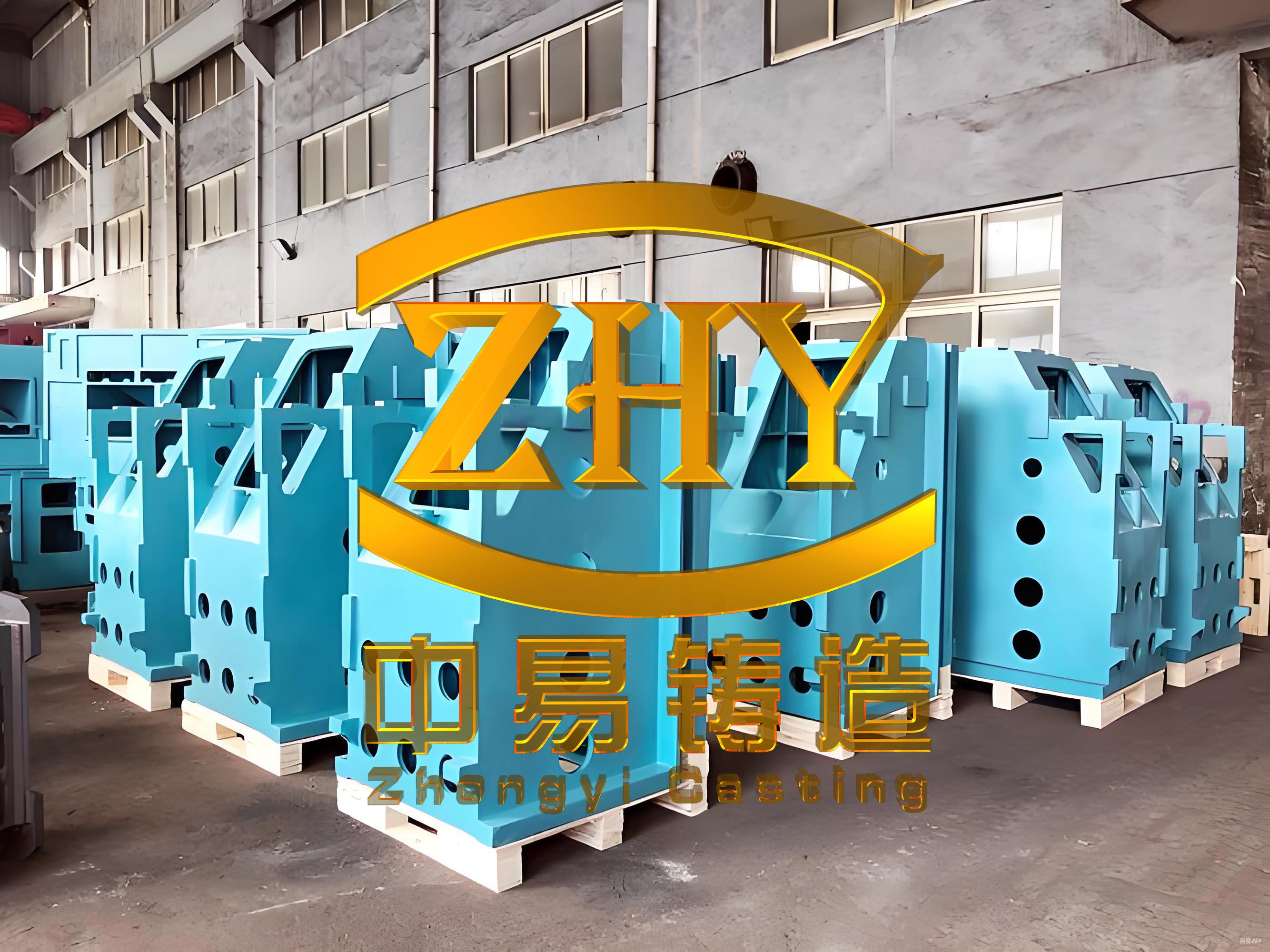
Melting operations are critical to achieving the desired metallurgical properties in machine tool castings. In this workshop, iron melting is performed using medium-frequency induction furnaces, which provide precise temperature control and composition adjustment. Raw materials, including pig iron, scrap steel, and returns, are weighed using electromagnetic proportioning scales controlled by microcomputers for accuracy. These materials are then loaded into the furnaces via charging cars. To maintain stringent quality control, a direct-reading spectrometer and other essential testing equipment are employed to analyze the molten metal. This ensures that the chemical composition meets the specifications required for durable machine tool castings, such as those used in heavy-duty applications. The melting process is designed to support the high throughput of the V-method line, with sufficient capacity to handle the annual production of 20,000 tons of machine tool castings. The use of induction furnaces also contributes to energy efficiency, reducing the overall carbon footprint of the casting process.
Core making is another essential aspect of producing complex machine tool castings. In this facility, cores are manufactured using a combination of manual methods and hot-box core shooting machines. The process involves coating patterns with plastic film, applying coatings, and setting cores in the molds. For the V-method, cores are typically made using覆膜成型 techniques, where the film is heated and stretched over the pattern, followed by coating application and sand filling. The core-making流程 ensures that internal cavities and features of machine tool castings are accurately formed, contributing to the overall dimensional precision. The integration of automated core shooting machines enhances productivity and consistency, which is vital for high-volume production of machine tool castings like bed plates and tailstocks. This hybrid approach allows for flexibility in handling different core designs while maintaining the environmental benefits of the V-method, as no binders are used in the sand.
The V-method molding line is composed of several specialized components that work in harmony to produce machine tool castings. Key equipment includes the film applicator, rain-type sand filling device, lifting vibration table, coating drying device, automatic scraping and back film covering device, molding roller table manipulators, mold stripping and core setting roller tables, empty box return roller tables, and box closing manipulators. These are supported by auxiliary systems such as hydraulic, pneumatic, vacuum, water control, dust removal, and electrical control systems. The line is divided into upper and lower molding circles, each with twelve stations where eleven patterns circulate simultaneously. This setup ensures continuous operation, with stations dedicated to tasks like film application, coating, drying, sand filling, vibration compaction, and mold stripping. The automation reduces human intervention, improving efficiency and consistency in the production of machine tool castings.
| Parameter | Value |
|---|---|
| Design Molding Productivity | 15 complete molds/hour |
| Pallet Car Pitch | 140 mm |
| Sandbox Internal Dimensions | 2500 mm × 1500 mm × 500/450 mm |
| Effective Pouring Stations | 48 sections |
| Core Setting Stations | 8 sections |
| Minimum Cooling Time | 416 minutes |
| Workshop Air Supply Pressure | >0.45 MPa |
| Workshop Water Supply Pressure | >0.18 MPa |
| Vacuum Pipeline Negative Pressure | -0.045 to -0.07 MPa |
| Total Installed Power | Approximately 1960 kW |
| Total Free Air Consumption | 2300 m³/hour |
| Overhead Crane Rail Height | 10.8 m |
The operational sequence of the V-method molding line is designed for efficiency and precision in producing machine tool castings. For the lower mold circle, the process begins with film application, followed by coating, coating inspection, box closing, drying, model transfer, additional drying, drying inspection, sand filling and vibration compaction with back film covering, model inspection, mold stripping, and transfer. Similarly, the upper mold circle follows a parallel sequence. Once the lower mold is completed, it moves to the core setting roller track for修型,补涂, core placement, and inspection before reaching the closing station. The upper mold, after inspection and修型, is flipped 90 degrees by a manipulator and moved to the closing station for assembly. The assembled mold is then transferred to the pouring line via a transfer car, where vacuum is switched and maintained. After pouring, the mold is covered with protective materials like asbestos boards and allowed to cool for a specified time before vacuum release. Cooled molds are placed on vibrating shakeout machines, where the sand is separated and recycled, and the machine tool castings are removed for further processing.
To quantify the productivity and efficiency of the V-method line for machine tool castings, several mathematical models can be applied. For instance, the production rate can be expressed in terms of the number of molds produced per hour, considering the cycle time per station. Let \( P \) represent the productivity in molds per hour, \( N \) the number of stations, and \( T \) the average time per station in minutes. Then, the relationship can be approximated as:
$$ P = \frac{60}{T \times N} $$
In this case, with \( P = 15 \) molds/hour and \( N = 12 \) stations per circle, the average time per station \( T \) can be derived. Additionally, the vacuum pressure required for the process is critical for maintaining mold integrity. The negative pressure \( P_v \) in MPa must satisfy the condition for proper compaction and film adhesion, which can be modeled as:
$$ P_v = -\frac{F}{A} $$
where \( F \) is the force exerted by the vacuum and \( A \) is the surface area of the mold. This ensures that the sand remains tightly packed during the pouring and cooling stages, essential for achieving high-dimensional accuracy in machine tool castings. The energy consumption of the line, with a total installed power of 1960 kW, can be analyzed using efficiency formulas to optimize operational costs for machine tool casting production.
Sand treatment is a vital component of the V-method process, as it directly impacts the sustainability and cost-effectiveness of producing machine tool castings. After shakeout, the used sand passes through screening and cooling systems before being returned to the molding sand hoppers. The reclamation rate exceeds 95%, meaning that only a small fraction of new sand is needed, which significantly reduces material costs and environmental waste. The sand treatment system includes vibratory conveyors, screens, and coolers that ensure the sand is free of debris and at the optimal temperature for reuse. This closed-loop approach is particularly beneficial for high-volume production of machine tool castings, as it minimizes raw material consumption and disposal issues. Moreover, the absence of binders in the sand eliminates harmful emissions, contributing to a healthier workplace environment. The integration of automated sand handling with the molding line ensures a continuous supply of ready-to-use sand, supporting the steady output of machine tool castings.
Quality control and inspection processes are integral to ensuring that the machine tool castings meet stringent industry standards. Throughout the V-method production line, multiple inspection points are incorporated, such as coating checks, drying inspections, and model verifications. After casting, the machine tool castings undergo visual examination, dimensional checks using coordinate measuring machines, and non-destructive testing if required. Any defects, such as surface imperfections or internal voids, are addressed through welding and grinding operations. The use of a direct-reading spectrometer in the melting zone allows for real-time composition analysis, ensuring that the iron alloy properties are optimal for machine tool applications. This rigorous quality assurance framework helps in delivering reliable and durable machine tool castings, which are critical for the precision and longevity of end-use equipment. By maintaining high standards, the workshop can reduce rejection rates and enhance customer satisfaction in the machine tool casting market.
The economic and environmental benefits of the V-method for machine tool castings are substantial. From an economic perspective, the automation of the molding line reduces labor costs and increases throughput, making it feasible to produce large quantities of machine tool castings efficiently. The high sand reclamation rate lowers material expenses, while the superior surface finish of the castings minimizes machining requirements, further cutting costs. Environmentally, the V-method is a green casting process that aligns with global sustainability goals. It eliminates the use of chemical binders, reducing air and soil pollution, and the energy-efficient design of the line, with features like medium-frequency furnaces and automated systems, decreases overall energy consumption. For instance, the vacuum system operates at negative pressures between -0.045 and -0.07 MPa, which is optimized for energy savings. These advantages make the V-method an attractive choice for foundries focused on producing machine tool castings, as it supports both profitability and environmental stewardship.
In conclusion, the application of the V-method molding line in a dedicated workshop for machine tool castings represents a significant advancement in casting technology. By leveraging automation, precise process control, and sustainable practices, this approach addresses the challenges of high-volume production while ensuring superior quality in machine tool castings. The detailed design of the workshop layout, melting operations, core making, and sand treatment systems all contribute to an efficient and eco-friendly manufacturing environment. The repeated emphasis on machine tool casting throughout this discussion underscores its importance in the industry, and the use of tables and formulas helps in summarizing key data and relationships. As the demand for high-performance machine tool castings continues to grow, the V-method offers a viable path toward achieving operational excellence and environmental responsibility. Through continuous improvement and adoption of such innovative processes, the casting industry can better serve the needs of modern manufacturing, particularly in the realm of machine tool castings.