
In my experience as a foundry engineer specializing in machine tool casting, I have witnessed significant advancements that enhance the quality and efficiency of producing machine tool castings. The demand for high-performance machine tool castings drives continuous innovation, and I am excited to share our breakthroughs in core facing sand techniques and vanadium-titanium rare earth iron applications. These methods have revolutionized our approach to machine tool casting, resulting in superior surface finish, ease of cleaning, and enhanced mechanical properties. Throughout this article, I will elaborate on these processes, supported by data tables and formulas, to provide a comprehensive understanding of how we achieve excellence in machine tool castings.
Machine tool casting is a critical process in manufacturing components like engine blocks, beds, and hydraulic parts for machine tools. Traditionally, cores used in casting were coated with refractory paints to prevent sand adherence and improve surface quality. However, this method often led to inconsistencies and increased labor. In our foundry, we explored an alternative: applying a layer of facing sand directly onto the core surface. This innovation stemmed from practical experiments and has proven highly effective for machine tool castings. By integrating this technique, we have eliminated the need for coatings, streamlined production, and achieved castings with exceptionally smooth interiors. The core sand mixture we developed is based on a combination of river sand and red sand, with additional components like coal dust added as a percentage of the sand weight. This formulation ensures optimal properties for machine tool casting applications.
The core sand配方 is designed to balance permeability, strength, and collapsibility, which are essential for high-quality machine tool castings. Below is a table summarizing the typical composition we use, where the sand base consists of equal parts river sand and red sand, and other additives are calculated as percentages of this base. This approach allows for consistent results in machine tool casting production.
| Component | Percentage (%) |
|---|---|
| River Sand | 50 |
| Red Sand | 50 |
| Coal Dust | 3-5 |
| Bentonite | 2-4 |
| Water | 3-5 |
For the facing sand used on cores, we simply increase the coal dust content to enhance its properties further. This modification does not complicate the sand preparation or core-making processes, making it easy to implement in existing machine tool casting operations. The key properties of this core sand, such as wet permeability and strength, are critical for achieving desired outcomes in machine tool castings. We regularly test these properties to ensure consistency, and the following table provides typical values we observe in our foundry.
| Property | Value | Unit |
|---|---|---|
| Wet Permeability | 90-130 | – |
| Wet Compressive Strength | 1.2-1.8 | kg/cm² |
| Dry Tensile Strength | 2.5-3.5 | kg/cm² |
In machine tool casting, the wet compressive strength can be represented by the formula: $$ \sigma_w = \frac{F_w}{A} $$ where $\sigma_w$ is the wet compressive strength in kg/cm², $F_w$ is the force applied, and $A$ is the cross-sectional area. Similarly, dry tensile strength is calculated as: $$ \sigma_d = \frac{F_d}{A} $$ with $\sigma_d$ in kg/cm². These formulas help us optimize the sand mixtures for specific machine tool casting requirements, ensuring that the cores withstand casting pressures without compromising collapsibility.
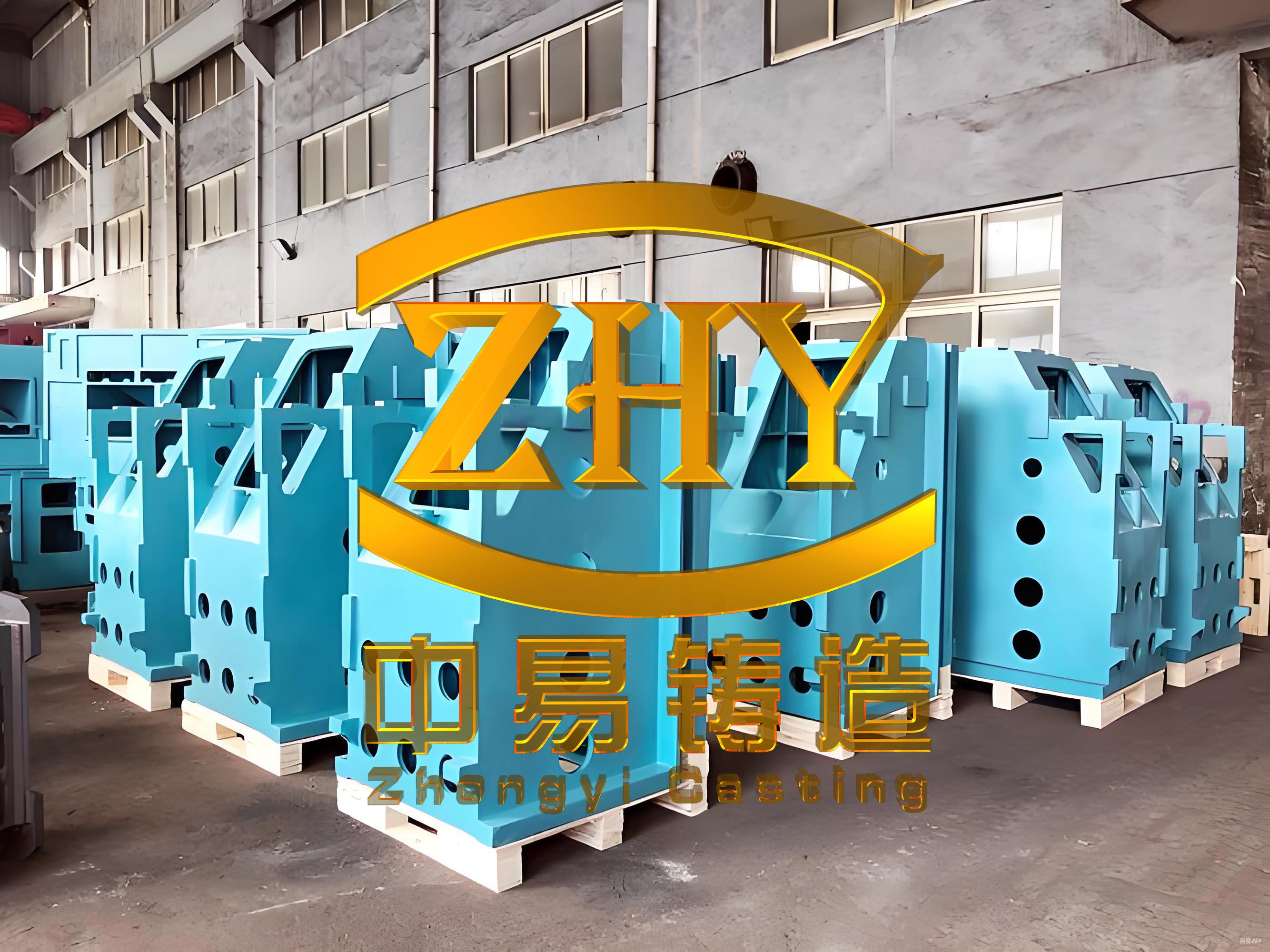
The implementation of facing sand on cores has yielded remarkable results in machine tool castings. The interior surfaces of castings, such as those for engine blocks, are now as smooth as those produced by metal molding. This improvement is visually evident in the image below, which showcases the high-quality finish achievable with this method. Additionally, the sand cores disintegrate easily upon light tapping, simplifying the cleaning process and reducing post-casting labor. We have applied this technique to various critical machine tool castings, and since its adoption, we have consistently observed enhanced surface integrity and dimensional accuracy. Although the lower sections of castings may show slightly lower smoothness compared to upper sections, overall, the method has proven superior for machine tool casting applications.
Another significant advancement in machine tool casting involves the use of vanadium-titanium rare earth iron to produce high-strength, wear-resistant castings. As part of our commitment to leveraging local resources, we developed this alloy to replace conventional materials in machine tool castings. The chemical composition of this iron is carefully controlled to achieve optimal mechanical properties, as summarized in the table below. This composition is tailored for machine tool casting components that require high durability and performance under stress.
| Element | Content (%) |
|---|---|
| Carbon (C) | 3.2-3.4 |
| Silicon (Si) | 1.8-2.2 |
| Manganese (Mn) | 0.6-0.8 |
| Phosphorus (P) | <0.15 |
| Sulfur (S) | <0.12 |
| Vanadium (V) | 0.2-0.3 |
| Titanium (Ti) | 0.06-0.12 |
| Rare Earth (RE) | 0.2-0.4 |
The treatment process for this vanadium-titanium rare earth iron is meticulous and designed to maximize its benefits for machine tool casting. We start by tapping approximately two-thirds of the molten iron, to which we add 0.2-0.4% rare earth in the trough. After thorough mixing, we add the remaining one-third of the iron along with 0.4-0.6% ferrosilicon (75% Si) for inoculation. This step is crucial for refining the microstructure and enhancing the properties of machine tool castings. The slag is promptly removed, and the melt is covered with a protective mixture of cryolite powder and grass ash to prevent oxidation. Rapid casting is essential to preserve the quality of the iron, ensuring that the machine tool castings exhibit consistent performance.
The mechanical properties of this treated iron are exceptional, making it ideal for demanding machine tool casting applications. We conduct rigorous testing to measure tensile strength, bending strength, deflection, hardness, and wear resistance. The results, as shown in the table below, demonstrate the superiority of this material for producing robust machine tool castings.
| Property | Value | Unit |
|---|---|---|
| Tensile Strength | 28-32 (max 38) | kg/mm² |
| Bending Strength | 50-60 (max 66) | kg/mm² |
| Deflection | >6 | mm (gauge length 300 mm) |
| Hardness (Brinell) | 180-220 | HB |
| Wear Resistance | 1.5 times higher than inoculated cast iron | – |
In machine tool casting, the tensile strength can be expressed using the formula: $$ \sigma_t = \frac{F_t}{A} $$ where $\sigma_t$ is the tensile strength in kg/mm², $F_t$ is the maximum tensile force, and $A$ is the original cross-sectional area. For bending strength, we use: $$ \sigma_b = \frac{M \cdot c}{I} $$ where $\sigma_b$ is the bending strength in kg/mm², $M$ is the bending moment, $c$ is the distance from the neutral axis, and $I$ is the moment of inertia. These formulas are integral to our quality control processes for machine tool castings, allowing us to predict and verify performance under load.
The microstructure of the rare earth-treated vanadium-titanium iron plays a vital role in its performance for machine tool castings. We observe that the graphite exists primarily as thick flakes with some nodular and cluster forms, while the matrix consists of fine pearlite. The eutectic cells are refined and irregular, which contributes to the increased strength and wear resistance. This microstructural refinement is achieved through the combined effects of vanadium, titanium, and rare earth elements, which form hard compounds like vanadium carbides and titanium nitrides. These compounds enhance the hardness and abrasion resistance of machine tool castings, making them suitable for high-wear applications such as grinding machines and hydraulic components.
Wear resistance is a critical factor in machine tool casting, as components often undergo significant friction and stress. Our tests, conducted using equipment like the Amsler testing machine, show that the vanadium-titanium rare earth iron exhibits wear resistance approximately 1.5 times higher than conventional inoculated cast iron. This improvement can be attributed to the dispersion hardening effect of vanadium and titanium compounds, as well as the grain refinement induced by rare earth additions. The wear rate can be modeled using the Archard equation: $$ W = k \cdot \frac{F_n \cdot s}{H} $$ where $W$ is the wear volume, $k$ is the wear coefficient, $F_n$ is the normal load, $s$ is the sliding distance, and $H$ is the hardness. By optimizing these parameters through alloy design, we achieve longer service life for machine tool castings.
In practical applications, we have successfully produced various machine tool castings using this advanced iron, including worktables for grinding machines, machine beds, hydraulic cylinders, and valve boxes. These components demonstrate superior performance in terms of strength, durability, and dimensional stability. The use of vanadium-titanium rare earth iron has allowed us to eliminate the need for scrap steel in our charge calculations, reducing costs and enhancing sustainability in machine tool casting production. Moreover, the consistent results we obtain underscore the reliability of this method for mass-producing high-quality machine tool castings.
Looking at the broader implications, these innovations in machine tool casting not only improve product quality but also contribute to operational efficiency. By reducing the time and effort required for core coating and cleaning, the facing sand technique lowers production costs and minimizes environmental impact. Similarly, the vanadium-titanium rare earth iron extends the lifespan of machine tool castings, reducing the frequency of replacements and maintenance. As we continue to refine these processes, we are exploring additional alloys and sand mixtures to further enhance the properties of machine tool castings. Our ongoing research focuses on optimizing rare earth additions and investigating the effects of other elements like chromium and molybdenum for specialized applications.
In conclusion, the advancements in core facing sand and vanadium-titanium rare earth iron have significantly elevated the standards of machine tool casting. Through firsthand experience, I can attest to the transformative impact of these methods on casting quality, efficiency, and performance. The integration of data-driven approaches, including tables and formulas, ensures that we maintain consistency and push the boundaries of what is possible in machine tool casting. As the industry evolves, we remain committed to innovation, continually seeking ways to produce machine tool castings that meet the highest demands of precision and durability. The future of machine tool casting looks promising, with potential breakthroughs in digital modeling and automated processes that could further revolutionize this field.