
As a researcher and practitioner in the field of advanced engineering materials, I have extensively studied and applied Rare Earth Vermicular Graphite Iron (RE-VGI) in various industrial contexts, particularly for machine tool castings. This material has emerged as a superior alternative to traditional cast irons due to its unique combination of properties inherited from both gray and ductile cast irons, along with distinct advantages that make it ideal for demanding applications like machine tool castings. Over the past decade and a half, our work has demonstrated that RE-VGI significantly enhances the performance, durability, and cost-effectiveness of machine tool castings, such as those used in material testing machines and milling equipment. In this article, I will delve into the mechanical-physical properties, wear resistance, rigidity, casting characteristics, and economic benefits of RE-VGI, supported by empirical data, tables, and formulas. The focus will remain on its pivotal role in improving machine tool castings, a term I will emphasize throughout to underscore its relevance.
RE-VGI was developed as a novel engineering material relatively recently, but its rapid adoption stems from its ability to bridge the gap between gray and ductile cast irons. For machine tool castings, this translates to improved mechanical strength, better vibration damping, and enhanced thermal stability. In our facility, we have integrated RE-VGI into the production of critical components like universal testing machine bases, wood testing machine frames, fatigue testing machine foundations, and various machine tool castings for horizontal boring mills, including beds, columns, spindle boxes, and tables. These applications have consistently outperformed those made from inoculated or wear-resistant cast irons, yielding superior technical and economic outcomes. The following sections will explore these aspects in detail, with a particular emphasis on how RE-VGI elevates the quality of machine tool castings.
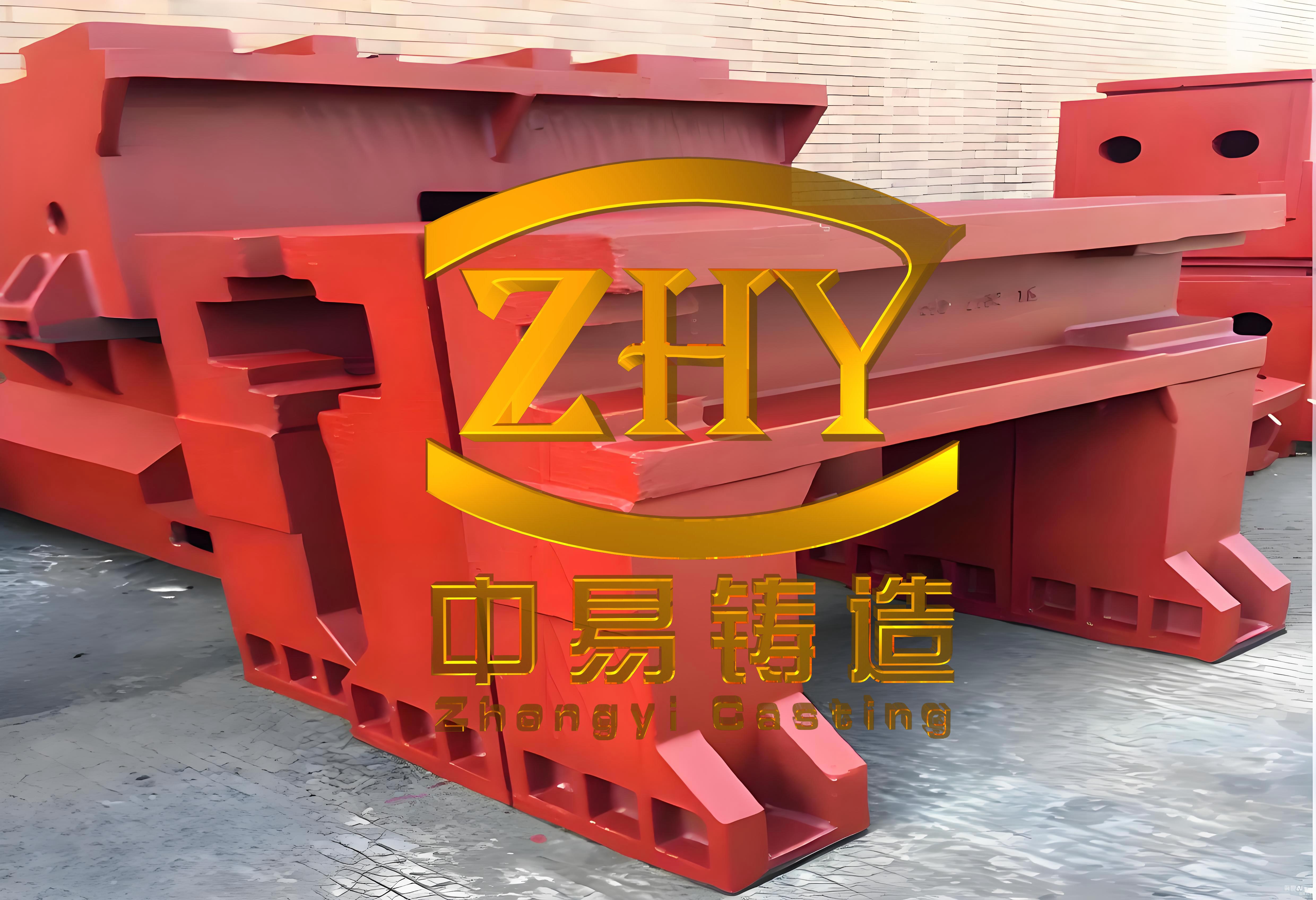
The mechanical-physical properties of RE-VGI position it as an intermediate material between gray and ductile cast irons, yet it excels in certain areas like thermal fatigue resistance, pressure fatigue endurance, and density. These attributes are crucial for machine tool castings, which require stability under dynamic loads and temperature variations. For instance, the tensile strength, bending strength, and hardness of RE-VGI make it suitable for heavy-duty machine tool castings that undergo constant stress. We have conducted comparative tests, and the results, summarized in Table 1, highlight the superiority of RE-VGI. Additionally, the elastic modulus of RE-VGI is notably high, approaching that of ductile cast iron, which contributes to the static and dynamic stiffness of machine tool castings. This can be expressed mathematically using the relationship for elastic modulus: $$ E = \frac{\sigma}{\epsilon} $$ where \( E \) is the elastic modulus, \( \sigma \) is the stress, and \( \epsilon \) is the strain. For RE-VGI, values typically range between that of gray and ductile cast irons, ensuring that machine tool castings maintain dimensional accuracy under load.
| Property | Gray Cast Iron | Ductile Cast Iron | RE-VGI |
|---|---|---|---|
| Tensile Strength (kg/mm²) | 20-30 | 40-80 | 35-50 |
| Bending Strength (kg/mm²) | 40-50 | 60-100 | 50-70 |
| Deflection (mm) | 2-4 | 6-12 | 4-8 |
| Elongation (%) | 0.5-1.0 | 10-20 | 2-5 |
| Hardness (HB) | 150-250 | 150-300 | 180-250 |
| Impact Toughness (kg·m/cm²) | 1-3 | 5-15 | 3-6 |
| Elastic Modulus (kg/mm²) | 8,000-12,000 | 16,000-18,000 | 12,000-15,000 |
| Bending Fatigue Limit (kg/mm²) | 10-15 | 20-30 | 15-25 |
| Thermal Fatigue Limit (cycles to crack) | 500-1,000 | 1,000-2,000 | 1,500-3,000 |
| Specific Gravity (g/cm³) | 7.0-7.2 | 7.1-7.3 | 7.05-7.25 |
Wear resistance is a critical factor for machine tool castings, as components like guide rails and beds are subject to continuous friction. Our experiments involved lubricated sliding wear tests, where RE-VGI demonstrated a significant improvement over traditional inoculated cast irons. For example, in one study, the wear loss of RE-VGI was approximately half that of high-phosphorus copper-titanium cast iron, underscoring its durability in machine tool castings. This can be quantified using the Archard wear equation: $$ V = K \frac{F_n L}{H} $$ where \( V \) is the wear volume, \( K \) is the wear coefficient, \( F_n \) is the normal force, \( L \) is the sliding distance, and \( H \) is the hardness. For RE-VGI, the wear coefficient \( K \) is lower, resulting in extended service life for machine tool castings. Table 2 provides a detailed comparison of wear resistance based on our field tests, which involved tracking the wear on guide rails of machine tool castings over several years. Even with a ferritic matrix, RE-VGI outperformed inoculated cast irons, highlighting its robustness in real-world applications.
| Material | Wear Loss (mg) | Relative Ratio | Application in Machine Tool Castings |
|---|---|---|---|
| Inoculated Cast Iron | 15-25 | 1.0 | Standard guide rails |
| Phosphorus-Copper-Titanium Cast Iron | 10-20 | 0.8 | High-wear areas |
| RE-VGI | 5-10 | 0.5 | Long-life machine tool castings |
The rigidity of machine tool castings is paramount for maintaining precision under operational loads. RE-VGI exhibits a high elastic modulus and excellent vibration damping capacity, which together enhance both static and dynamic stiffness. We conducted rigidity tests on universal testing machine bases made from RE-VGI and inoculated cast iron, applying incremental loads and measuring deformations. The results, shown in Table 3, reveal that RE-VGI machine tool castings deform less and have higher load-bearing capacity, reducing the risk of failure. The natural frequency of a casting can be estimated using the formula: $$ f = \frac{1}{2\pi} \sqrt{\frac{k}{m}} $$ where \( f \) is the frequency, \( k \) is the stiffness, and \( m \) is the mass. For RE-VGI machine tool castings, the increased stiffness \( k \) leads to higher natural frequencies, minimizing resonance issues. This allows for weight reduction in machine tool castings without compromising performance; for instance, we successfully reduced the wall thickness of a boring mill bed from 20 mm to 15 mm, cutting its weight by over 10% while maintaining rigidity. Such optimizations are essential for modern machine tool castings that demand lightweight yet robust designs.
| Load (kg) | Deformation in Inoculated Cast Iron (mm) | Deformation in RE-VGI (mm) | Residual Deformation (mm) in RE-VGI |
|---|---|---|---|
| 5,000 | 0.12 | 0.08 | 0.02 |
| 10,000 | 0.25 | 0.15 | 0.04 |
| 15,000 | 0.40 | 0.22 | 0.06 |
| 20,000 | 0.60 | 0.30 | 0.08 |
| 25,000 (failure for inoculated) | 0.85 (cracked) | 0.38 | 0.10 |
| 30,000 (failure for RE-VGI) | – | 0.50 (cracked) | 0.12 |
Casting performance is another area where RE-VGI shines, particularly in terms of shrinkage tendency and section sensitivity. We measured the shrinkage cavity volume using standard specimens and found that RE-VGI has a lower shrinkage rate compared to inoculated cast iron. The shrinkage rate \( S \) can be defined as: $$ S = \frac{V_c}{V_s} \times 100\% $$ where \( V_c \) is the volume of shrinkage cavities and \( V_s \) is the volume of the specimen. For RE-VGI, \( S \) averages around 2.5%, whereas for inoculated cast iron, it is about 4.5%. This reduced shrinkage minimizes defects in thick sections of machine tool castings, such as bases and beds, ensuring better integrity. Moreover, RE-VGI shows less sensitivity to section thickness variations, which is critical for complex machine tool castings with uneven wall thicknesses. We tested different vermiculating agents—rare earth-silicon-iron, rare earth-zinc-magnesium, and rare earth-zinc-magnesium-aluminum—and observed that the latter offers the least chilling tendency, making it suitable for machine tool castings with thin sections. This is quantified by the chill depth measurement, where RE-VGI with rare earth-zinc-magnesium-aluminum exhibits a chill depth of less than 1 mm in thin walls, compared to over 2 mm for other agents.
The melting and treatment process for RE-VGI involves using a cupola furnace with hot blast systems, typically operating at temperatures between 1380°C and 1420°C. The key steps include controlling the sulfur content in the base iron and adding vermiculating agents to achieve the desired graphite morphology. For machine tool castings, we optimize the process to ensure a pearlitic matrix, which enhances wear resistance. The reaction efficiency can be modeled using kinetic equations, such as: $$ \frac{dC}{dt} = -k C^n $$ where \( C \) is the concentration of vermiculating elements, \( t \) is time, \( k \) is the rate constant, and \( n \) is the reaction order. In practice, this allows us to consistently produce high-quality RE-VGI for machine tool castings, with minimal slag inclusion and gas porosity.
Economically, the adoption of RE-VGI in machine tool castings has yielded substantial benefits. We have calculated the relative cost per ton of molten metal, considering raw material prices, and found that RE-VGI is more cost-effective than traditional alternatives. For example, the cost per ton for inoculated cast iron is approximately 1200 currency units, while for RE-VGI with rare earth-zinc-magnesium treatment, it is about 1100 currency units. In contrast, phosphorus-copper-titanium cast iron costs around 1400 currency units per ton. This cost advantage, combined with reduced scrap rates and lighter weight, makes RE-VGI ideal for machine tool castings. Table 4 summarizes the cost comparison for typical machine tool castings, highlighting the savings achieved through material substitution and design optimizations. Additionally, the lower scrap rate—below 5% for RE-VGI compared to over 20% for inoculated cast iron—further reduces overall production costs for machine tool castings.
| Component | Material | Weight (kg) | Relative Material Cost per Ton | Scrap Rate (%) | Total Cost Saving (%) |
|---|---|---|---|---|---|
| Universal Testing Machine Base | Inoculated Cast Iron | 500 | 1200 | 20 | 0 |
| Universal Testing Machine Base | RE-VGI | 450 | 1100 | 5 | 15 |
| Boring Mill Bed | Inoculated Cast Iron | 800 | 1200 | 15 | 0 |
| Boring Mill Bed | RE-VGI | 700 | 1100 | 4 | 18 |
| Horizontal Boring Machine Column | Phosphorus-Copper-Titanium | 600 | 1400 | 10 | Reference |
| Horizontal Boring Machine Column | RE-VGI | 550 | 1100 | 5 | 25 |
In conclusion, Rare Earth Vermicular Graphite Iron has proven to be a transformative material for machine tool castings, offering a balanced profile of mechanical strength, wear resistance, rigidity, and casting performance. Our first-hand experiences confirm that RE-VGI not only meets but exceeds the requirements for high-precision machine tool castings, enabling weight reduction, cost savings, and extended service life. The integration of RE-VGI into production lines has streamlined processes and enhanced the reliability of machine tool castings across various applications. As the demand for efficient and durable machine tool castings grows, RE-VGI stands out as a sustainable and economical choice. Future work will focus on further optimizing the alloy composition and treatment methods to push the boundaries of what machine tool castings can achieve, ensuring they remain at the forefront of industrial innovation.
Throughout this discussion, I have emphasized the importance of machine tool castings in leveraging the benefits of RE-VGI. The data and analyses presented here underscore why this material is increasingly preferred for critical components in material testing and machining equipment. By continuing to explore its properties and applications, we can unlock even greater potential for machine tool castings in the years to come.