
In our research, we have focused on developing and testing a specific inoculant series for enhancing the properties of machine tool castings. Machine tool castings require high dimensional stability, wear resistance, and uniform microstructure to ensure precision in manufacturing applications. The use of effective inoculants is critical in controlling graphite formation, reducing chilling tendencies, and improving mechanical properties in these castings. This study evaluates the performance of our inoculant series through laboratory experiments and industrial trials, comparing it with conventional inoculants to demonstrate its advantages in real-world machine tool casting production.
We began our investigation by examining the fundamental aspects of inoculant behavior in cast iron, particularly for machine tool castings. The inoculant series we developed aims to address common issues such as衰退 (decline in effectiveness over time),白口倾向 (chill tendency), and断面敏感性 (section sensitivity). Our approach involved systematic testing under controlled conditions to quantify these properties. The primary goal was to ensure that the inoculant could maintain its efficacy during the entire casting process, from inoculation to solidification, thereby producing high-quality machine tool castings with consistent performance.
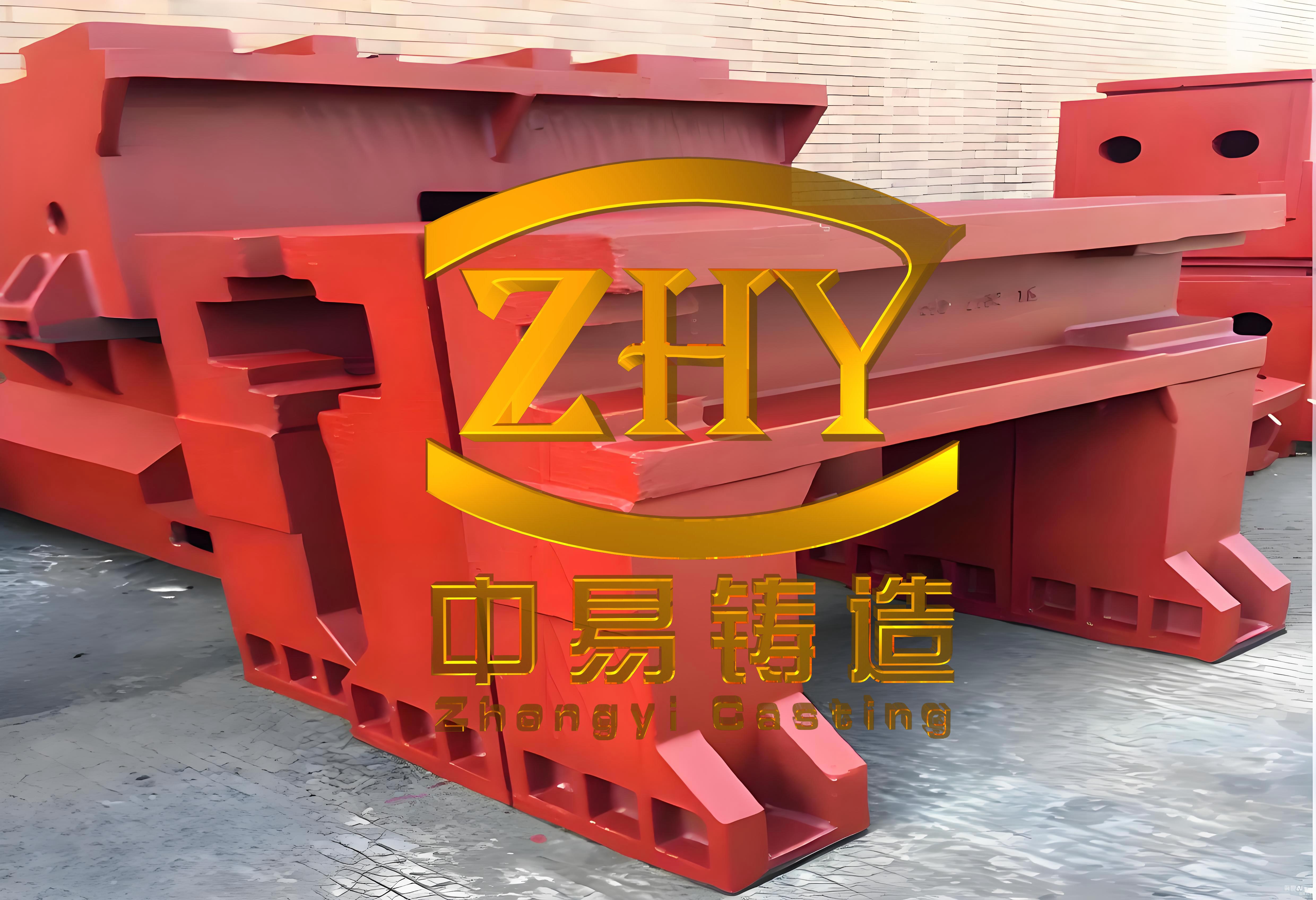
In the experimental phase, we utilized a cupola-melted base iron with a specific composition, which was subsequently remelted in an induction furnace. The inoculants were added during this process to assess their impact on the iron’s properties. The chemical composition of the inoculants played a vital role in determining their effectiveness. For instance, our inoculant series contained elements such as silicon, calcium, and aluminum, which are known to influence graphite nucleation and growth in machine tool castings. The base iron’s carbon equivalent and eutectic degree were calculated using standard formulas to ensure consistency. The carbon equivalent (CE) is given by: $$CE = C + \frac{Si + P}{3}$$ where C, Si, and P represent the percentages of carbon, silicon, and phosphorus, respectively. This formula helps in predicting the iron’s behavior during solidification, which is crucial for achieving desired properties in machine tool castings.
To evaluate the anti-recession properties of the inoculants, we conducted tests where the inoculated iron was held at elevated temperatures, and samples were taken at regular intervals. The chill width of triangular test pieces was measured to monitor the decline in inoculant effectiveness over time. Additionally, we employed thermal analysis techniques to record cooling curves and determine the undercooling degree. The undercooling degree, denoted as ΔT, is defined as the difference between the equilibrium eutectic temperature and the actual solidification temperature: $$ΔT = T_{eutectic} – T_{actual}$$ A smaller ΔT indicates better inoculation, as it reduces the tendency for chill formation in machine tool castings. The time taken for ΔT to return to the base iron’s level was defined as the recession time, providing a quantitative measure of the inoculant’s longevity.
The mechanical properties of the inoculated iron were assessed using standard bend and tensile test specimens. We cast these specimens in dry sand molds and performed tests to determine strength, hardness, and microstructural characteristics. The results were compared across different inoculant types to identify the most suitable one for machine tool castings. Furthermore, we investigated the section sensitivity by casting step-shaped test blocks with varying thicknesses. Hardness measurements were taken at different sections to evaluate uniformity, which is essential for machine tool castings that often have complex geometries and varying wall thicknesses.
Our findings from the laboratory tests revealed significant differences between the inoculant series and conventional ones. For example, the anti-recession performance showed that our inoculant maintained lower chill widths for extended periods, as summarized in Table 1. This table illustrates the relationship between holding time and chill width for different inoculants, highlighting the superior performance of our series in machine tool castings.
| Holding Time (min) | Chill Width – Conventional Inoculant (mm) | Chill Width – Our Inoculant Series (mm) |
|---|---|---|
| 0 | 5.2 | 4.8 |
| 10 | 6.1 | 5.0 |
| 20 | 7.5 | 5.3 |
| 30 | 8.9 | 5.7 |
| 40 | 10.2 | 6.2 |
The thermal analysis curves further supported these results, showing that our inoculant series reduced undercooling more effectively and maintained this reduction for longer durations. This is critical for machine tool castings, as it ensures a finer and more uniform graphite structure, leading to improved mechanical properties. The undercooling ratio, defined as the ratio of undercooling after inoculation to that of the base iron, was used to quantify this effect: $$Undercooling\,Ratio = \frac{ΔT_{inoculated}}{ΔT_{base}}$$ Values closer to 1 indicate poorer performance, whereas lower values signify better inoculation. Our inoculant series consistently achieved ratios below 0.8 even after 30 minutes, demonstrating its resilience in machine tool casting applications.
In terms of mechanical performance, the tensile and bend strengths of specimens treated with our inoculant series were superior to those with conventional inoculants. Table 2 provides a comparison of the average tensile strengths for different holding times, emphasizing the consistency of our inoculant in machine tool castings. The data show that even after prolonged holding, the strength retention was higher, which is vital for ensuring the durability and precision of machine tool castings under operational stresses.
| Inoculant Type | Holding Time (min) | Tensile Strength (MPa) | Standard Deviation (MPa) |
|---|---|---|---|
| Conventional | 0 | 320 | 15 |
| Conventional | 20 | 290 | 18 |
| Our Series | 0 | 335 | 12 |
| Our Series | 20 | 325 | 14 |
| Our Series | 40 | 310 | 16 |
The section sensitivity tests revealed that our inoculant series produced more uniform hardness distributions across different thicknesses in the step-shaped test blocks. This is particularly important for machine tool castings, which often feature varying cross-sections that can lead to inconsistent properties if not properly inoculated. The hardness values at the edges and centers of different sections are summarized in Table 3. The data indicate that our inoculant minimized hardness variations, ensuring that machine tool castings maintain consistent performance regardless of geometry.
| Section Thickness (mm) | Hardness at Edge – Conventional (HB) | Hardness at Center – Conventional (HB) | Hardness at Edge – Our Series (HB) | Hardness at Center – Our Series (HB) |
|---|---|---|---|---|
| 10 | 210 | 205 | 215 | 212 |
| 20 | 200 | 195 | 208 | 206 |
| 30 | 190 | 180 | 198 | 195 |
| 40 | 185 | 170 | 192 | 188 |
| 50 | 175 | 160 | 185 | 182 |
To validate these laboratory findings, we conducted production trials in an industrial setting focused on machine tool castings. Specifically, we applied our inoculant series to the production of bed castings for surface grinding machines, which require high strength and dimensional stability. The castings had complex geometries with sections ranging from thin walls to thick导轨 (guideways), making them ideal for testing inoculant performance. We adjusted the cupola melting parameters to ensure high tap temperatures and minimal composition variations, which are essential for effective inoculation in machine tool castings.
During the trials, we compared the properties of castings treated with our inoculant series to those with conventional inoculants. Chemical composition analyses were performed, and tensile tests were conducted on separately cast and attached test bars. The results, as shown in Table 4, confirmed that our inoculant series produced higher and more consistent tensile strengths, even after delays in pouring. This is crucial for machine tool castings, where processing times can vary, and the inoculant must remain effective throughout.
| Sample Type | C (%) | Si (%) | Mn (%) | P (%) | S (%) | CE | Tensile Strength (MPa) |
|---|---|---|---|---|---|---|---|
| Conventional – Early Pour | 3.4 | 2.1 | 0.8 | 0.05 | 0.02 | 4.2 | 315 |
| Conventional – Late Pour | 3.4 | 2.1 | 0.8 | 0.05 | 0.02 | 4.2 | 295 |
| Our Series – Early Pour | 3.3 | 2.2 | 0.8 | 0.04 | 0.02 | 4.1 | 330 |
| Our Series – Late Pour | 3.3 | 2.2 | 0.8 | 0.04 | 0.02 | 4.1 | 320 |
Hardness measurements on the actual castings further demonstrated the benefits of our inoculant series. The hardness values were more uniform across different sections, and the relative hardness, calculated as the ratio of hardness to tensile strength, was lower, indicating better toughness. This is expressed by the formula: $$Relative\,Hardness = \frac{Hardness\,(HB)}{Tensile\,Strength\,(MPa)} \times 100$$ For machine tool castings, a lower relative hardness is desirable as it implies a better balance between strength and machinability. Our inoculant series achieved values around 0.6, compared to 0.7 for conventional inoculants, highlighting its superiority.
Moreover, we calculated quality indices to overall assess the inoculant performance. The quality index (QI) combines relative strength and relative hardness: $$QI = \frac{Relative\,Strength}{Relative\,Hardness}$$ where relative strength is the ratio of actual tensile strength to the expected value for a given carbon equivalent. Higher QI values indicate better overall quality. Our inoculant series consistently yielded QI values above 1.2, whereas conventional inoculants averaged around 1.0, confirming its enhanced performance in machine tool castings.
In discussion, the improved anti-recession properties of our inoculant series can be attributed to its unique composition, which promotes stable graphite nucleation sites. This reduces the rate of dissolution in the melt, allowing it to remain effective longer. For machine tool castings, this means that even with extended holding times, the risk of chill formation and uneven microstructure is minimized. The uniform hardness distribution achieved with our inoculant is particularly beneficial for complex machine tool castings, as it ensures consistent wear resistance and dimensional accuracy across all sections.
Additionally, the mechanical performance data indicate that our inoculant series enhances the tensile and bend strengths by facilitating a finer graphite structure and more homogeneous matrix. This is vital for machine tool castings subjected to dynamic loads and vibrations during operation. The use of thermal analysis in our experiments provided real-time insights into the solidification behavior, enabling better control over the casting process for machine tool applications.
In conclusion, our inoculant series demonstrates significant advantages over conventional inoculants in the production of machine tool castings. It offers superior anti-recession properties, reduced section sensitivity, and enhanced mechanical performance, making it an ideal choice for high-quality machine tool castings. The consistent results from both laboratory and industrial trials underscore its reliability and effectiveness. We recommend the widespread adoption of this inoculant series in foundries specializing in machine tool castings to improve product quality and operational efficiency. Future work could focus on optimizing the composition for specific grades of machine tool castings and exploring its effects on other properties like thermal conductivity and damping capacity.