
In recent years, the domestic manufacturing of machine tools has been in a critical period of transition from rapid development to high-quality development. During the shift from relatively mature three-axis machine tools to five-axis machining centers and gantry machining centers, issues such as poor machining accuracy and inadequate precision retention have emerged. Simultaneously, the reliance on imported high-end machine tool castings remains unchanged, which has become a bottleneck hindering the transformation and development of China’s manufacturing industry. As essential foundational components of machine tools, traditional process-produced machine tool castings have long suffered from high residual stress, low elastic modulus, susceptibility to deformation, and poor stability, which have become pain points for downstream customers and challenges for the foundry industry. Therefore, I have conducted research in this area to address these issues.
For a considerable period in the past, machine tool castings generally employed low carbon equivalent and high-strength production processes. Due to the low carbon equivalent, these castings exhibited significant shrinkage and a tendency toward chill formation, leading to problems such as high residual stress, low elastic modulus, easy deformation, and poor machinability. Additionally, issues like looseness, shrinkage cavities, and poor hardness uniformity often occurred, with severe cases even resulting in cracking and scrap. The specific problems are as follows.
First, high residual stress: a high proportion of tensile stress, large stress values, and stress concentration in specific areas. Second, poor hardness uniformity: large hardness variations, high hardness in thin-walled sections making them difficult to machine or even causing chill formation, and failure to meet hardness standards in critical areas. Third, the presence of casting defects such as cracks, looseness, and shrinkage cavities.
My company specializes in the production of machine tool castings, using resin sand processes for molding and core-making. Melting is carried out in a one-drag-two 6-ton medium-frequency induction furnace, capable of producing machine tool castings up to 20 tons. The front of the furnace is equipped with detection equipment such as direct-reading spectrometers, nitrogen-oxygen analyzers, and thermal analyzers to achieve precise control of chemical composition. The AnyCasting simulation software is used to optimize the casting process, and residual stress is measured using a blind-hole stress detector produced by Zhengzhou Mechanical Research Institute Co., Ltd.
Chemical composition control is achieved through a synthetic cast iron melting method, with charge ratios primarily based on scrap steel. High-quality carburizers and silicon carbide are used for carbon and silicon addition, while nitrogen is added through nitrogen-manganese iron. The melting temperature ranges from 1,500 to 1,530°C, and the molten iron is poured after high-temperature static holding. The research and validation work primarily focus on high carbon equivalent, high silicon-carbon ratio, micro-alloying, and intensive inoculation, as briefly described below.
First, control of CE and Si/C: Increase CE to 3.8%–3.85% and Si/C to 0.69–0.74. Second, selection of alloying elements: Add Mn, Cr, Sn, Cu, N, and other alloy elements for strengthening. Third, control of melting process: Regulate melting temperature, high-temperature static holding, molten iron pretreatment, select multiple inoculation methods, and strictly control pouring temperature. Fourth, graphite morphology and pearlite content: Ensure that the proportion of Type A graphite exceeds 90%, guarantee graphite size and precipitation, and achieve a pearlite content of 98%.
The carbon equivalent (CE) is a critical parameter in cast iron, defined as:
$$ CE = C + \frac{Si}{3} + \frac{P}{3} $$
However, in our practice, we focus on the overall CE value and the silicon-to-carbon ratio (Si/C). The relationship between these parameters and the mechanical properties can be expressed through empirical formulas, such as the tensile strength (σ) as a function of CE and alloy content:
$$ \sigma = a \cdot CE + b \cdot (Si/C) + c \cdot \sum X_i $$
where \( X_i \) represents the alloy elements like Cr, Sn, and N, and a, b, c are coefficients determined through experimentation.
Through the implementation of the above production process, the carbon equivalent of the castings is increased to above 3.8%, the silicon-carbon ratio is controlled between 0.69 and 0.74, and trace amounts of Sn, Cr, N, and other alloy elements are appropriately added, along with intensive inoculation. Ultimately, high-quality machine tool castings are achieved with tensile strength ≥ 300 MPa, hardness 200–240 HBW, elastic modulus 120–135 GPa, and as-cast residual stress ≤ 50 MPa.
Over 400 heats of experiments have been conducted, confirming the feasibility of high carbon equivalent and high silicon-carbon ratio gray cast iron for medium to large machine tool castings. These castings successfully maintain good hardness uniformity, low residual stress, and excellent machinability. Below, some of the test results for chemical composition, metallurgical quality, microstructure, mechanical properties, machinability, and residual stress are analyzed.
Chemical Composition and Its Impact on Material Properties
The chemical composition plays a vital role in determining the performance of machine tool castings. By controlling elements such as C, Si, Mn, P, S, Cr, Sn, and N, we can achieve the desired mechanical properties and metallurgical quality. The following table summarizes the chemical composition and mechanical properties of selected test heats.
| No. | CE (%) | ω(Si)/ω(C) | C (%) | Si (%) | Mn (%) | P (%) | S (%) | Sn (%) | Cr (%) | N (%) | Tensile Strength (MPa) | Hardness (HBW) | Elastic Modulus (GPa) |
|---|---|---|---|---|---|---|---|---|---|---|---|---|---|
| 1 | 3.81 | 0.68 | 3.10 | 2.12 | 0.894 | 0.028 | 0.095 | 0.017 | 0.072 | 0.0092 | 330 | 232 | – |
| 2 | 3.82 | 0.67 | 3.12 | 2.10 | 0.923 | 0.035 | 0.099 | 0.016 | 0.222 | 0.0090 | 340 | 237 | 132 |
| 3 | 3.84 | 0.67 | 3.14 | 2.09 | 0.970 | 0.035 | 0.103 | 0.015 | 0.221 | 0.0096 | 334 | 241 | 120 |
| 4 | 3.82 | 0.71 | 3.09 | 2.19 | 0.723 | 0.023 | 0.089 | 0.074 | 0.221 | 0.0094 | 345 | 239 | 129 |
| 5 | 3.82 | 0.71 | 3.09 | 2.20 | 0.606 | 0.020 | 0.110 | 0.050 | 0.217 | 0.0091 | 340 | 235 | – |
| 6 | 3.83 | 0.72 | 3.09 | 2.21 | 0.693 | 0.020 | 0.101 | 0.079 | 0.215 | 0.0092 | 330 | 239 | – |
| 7 | 3.81 | 0.70 | 3.09 | 2.17 | 0.614 | 0.020 | 0.089 | 0.073 | 0.198 | 0.0089 | 346 | 235 | – |
| 8 | 3.84 | 0.68 | 3.13 | 2.12 | 1.022 | 0.023 | 0.096 | 0.017 | 0.216 | 0.0091 | 352 | 241 | – |
| 9 | 3.79 | 0.68 | 3.09 | 2.10 | 0.622 | 0.031 | 0.103 | 0.064 | 0.200 | 0.0082 | 313 | 229 | – |
| 10 | 3.78 | 0.69 | 3.07 | 2.12 | 0.945 | 0.032 | 0.105 | 0.074 | 0.191 | 0.0085 | 340 | 239 | – |
| 11 | 3.78 | 0.68 | 3.08 | 2.10 | 0.963 | 0.031 | 0.101 | 0.072 | 0.202 | 0.0087 | 334 | 241 | – |
| 12 | 3.78 | 0.70 | 3.07 | 2.14 | 0.606 | 0.030 | 0.108 | 0.054 | 0.196 | 0.0083 | 353 | 237 | – |
| 13 | 3.79 | 0.69 | 3.08 | 2.12 | 0.914 | 0.029 | 0.088 | 0.017 | 0.175 | 0.0090 | 345 | 234 | – |
| 14 | 3.84 | 0.70 | 3.11 | 2.18 | 0.901 | 0.030 | 0.109 | 0.018 | 0.185 | 0.0083 | 340 | 235 | – |
| 15 | 3.78 | 0.67 | 3.09 | 2.08 | 0.541 | 0.029 | 0.096 | 0.069 | 0.193 | 0.0083 | 364 | 240 | – |
| 16 | 3.84 | 0.71 | 3.10 | 2.21 | 0.864 | 0.029 | 0.099 | 0.016 | 0.195 | 0.0084 | 326 | 244 | – |
| 17 | 3.87 | 0.72 | 3.12 | 2.25 | 0.888 | 0.033 | 0.097 | 0.015 | 0.204 | 0.0076 | 327 | 241 | – |
| 18 | 3.82 | 0.68 | 3.11 | 2.13 | 0.652 | 0.030 | 0.109 | 0.071 | 0.187 | 0.0090 | 325 | 239 | 135 |
| 19 | 3.83 | 0.69 | 3.11 | 2.16 | 0.641 | 0.028 | 0.088 | 0.073 | 0.091 | 0.0094 | 318 | 232 | – |
| 20 | 3.85 | 0.71 | 3.11 | 2.22 | 0.945 | 0.029 | 0.096 | 0.016 | 0.201 | 0.0083 | 332 | 241 | – |
| 21 | 3.84 | 0.72 | 3.09 | 2.24 | 0.901 | 0.030 | 0.095 | 0.016 | 0.198 | 0.0090 | 328 | 236 | – |
| 22 | 3.82 | 0.68 | 3.12 | 2.11 | 0.685 | 0.027 | 0.103 | 0.070 | 0.108 | 0.0097 | 327 | 231 | – |
| 23 | 3.85 | 0.73 | 3.09 | 2.27 | 0.876 | 0.027 | 0.099 | 0.019 | 0.113 | 0.0080 | 314 | 229 | – |
| 24 | 3.85 | 0.72 | 3.11 | 2.23 | 0.548 | 0.027 | 0.100 | 0.072 | 0.080 | 0.0074 | 321 | 234 | – |
| 25 | 3.81 | 0.70 | 3.09 | 2.15 | 0.873 | 0.027 | 0.084 | 0.017 | 0.096 | 0.0080 | 324 | 230 | – |
| 26 | 3.83 | 0.69 | 3.11 | 2.16 | 0.610 | 0.039 | 0.102 | 0.074 | 0.081 | 0.00104 | 327 | 229 | – |
| 27 | 3.82 | 0.69 | 3.11 | 2.14 | 0.901 | 0.039 | 0.109 | 0.015 | 0.201 | 0.0084 | 332 | 234 | 133 |
| 28 | 3.81 | 0.70 | 3.09 | 2.15 | 0.886 | 0.040 | 0.092 | 0.017 | 0.197 | 0.0087 | 345 | 237 | – |
| 29 | 3.82 | 0.68 | 3.11 | 2.12 | 0.940 | 0.038 | 0.106 | 0.018 | 0.075 | 0.0082 | 336 | 229 | – |
| 30 | 3.84 | 0.68 | 3.13 | 2.12 | 0.960 | 0.042 | 0.091 | 0.015 | 0.073 | 0.0083 | 320 | 222 | – |
| 31 | 3.79 | 0.68 | 3.09 | 2.10 | 1.025 | 0.043 | 0.085 | 0.013 | 0.186 | 0.0083 | 343 | 230 | – |
| Average | 3.82 | 0.69 | 3.10 | 2.15 | 0.811 | 0.030 | 0.098 | 0.040 | 0.168 | 0.0084 | 334 | 235 | 130 |
The data shows that with an average CE of 3.82% and Si/C ratio of 0.69, the tensile strength averages 334 MPa, hardness 235 HBW, and elastic modulus around 130 GPa. This confirms that high carbon equivalent and high silicon-carbon ratio can achieve the required properties for machine tool castings.
Metallurgical quality indicators such as eutectic saturation (Sc), maturity degree (RG), hardening degree (HG), and quality coefficient (Qi) are critical for evaluating the performance of machine tool castings. These parameters are derived from the chemical composition and processing conditions. For instance, the maturity degree RG can be expressed as:
$$ RG = \frac{\sigma_{actual}}{\sigma_{theoretical}} $$
where σ_actual is the measured tensile strength, and σ_theoretical is the theoretical strength based on composition. Similarly, the quality coefficient Qi relates to the combined effect of graphite morphology and matrix structure.
| No. | CE (%) | ω(Si)/ω(C) | C (%) | Si (%) | Sn (%) | Cr (%) | N (%) | Tensile Strength (MPa) | Hardness (HBW) | Sc | RG | HG | Qi |
|---|---|---|---|---|---|---|---|---|---|---|---|---|---|
| 1 | 3.81 | 0.68 | 3.10 | 2.12 | 0.017 | 0.072 | 0.0092 | 330 | 232 | 0.87 | 1.10 | 0.83 | 1.32 |
| 2 | 3.82 | 0.67 | 3.12 | 2.10 | 0.016 | 0.222 | 0.0090 | 340 | 237 | 0.88 | 1.15 | 0.86 | 1.33 |
| 3 | 3.84 | 0.67 | 3.14 | 2.09 | 0.015 | 0.221 | 0.0096 | 334 | 241 | 0.88 | 1.14 | 0.89 | 1.29 |
| 4 | 3.82 | 0.71 | 3.09 | 2.19 | 0.074 | 0.221 | 0.0094 | 345 | 239 | 0.88 | 1.16 | 0.86 | 1.34 |
| 5 | 3.82 | 0.71 | 3.09 | 2.20 | 0.050 | 0.217 | 0.0091 | 340 | 235 | 0.88 | 1.14 | 0.85 | 1.35 |
| 6 | 3.83 | 0.72 | 3.09 | 2.21 | 0.079 | 0.215 | 0.0092 | 330 | 239 | 0.88 | 1.11 | 0.87 | 1.28 |
| 7 | 3.81 | 0.70 | 3.09 | 2.17 | 0.073 | 0.198 | 0.0089 | 346 | 235 | 0.88 | 1.15 | 0.84 | 1.37 |
| 8 | 3.84 | 0.68 | 3.13 | 2.12 | 0.017 | 0.216 | 0.0091 | 352 | 241 | 0.88 | 1.20 | 0.88 | 1.36 |
| 9 | 3.79 | 0.68 | 3.09 | 2.10 | 0.064 | 0.200 | 0.0082 | 313 | 229 | 0.87 | 1.03 | 0.81 | 1.27 |
| 10 | 3.78 | 0.69 | 3.07 | 2.12 | 0.074 | 0.191 | 0.0085 | 340 | 239 | 0.87 | 1.11 | 0.84 | 1.32 |
| 11 | 3.78 | 0.68 | 3.08 | 2.10 | 0.072 | 0.202 | 0.0087 | 334 | 241 | 0.87 | 1.09 | 0.85 | 1.29 |
| 12 | 3.78 | 0.70 | 3.07 | 2.14 | 0.054 | 0.196 | 0.0083 | 353 | 237 | 0.87 | 1.16 | 0.83 | 1.39 |
| 13 | 3.79 | 0.69 | 3.08 | 2.12 | 0.017 | 0.175 | 0.0090 | 345 | 234 | 0.87 | 1.13 | 0.83 | 1.37 |
| 14 | 3.84 | 0.70 | 3.11 | 2.18 | 0.018 | 0.185 | 0.0083 | 340 | 235 | 0.88 | 1.16 | 0.86 | 1.35 |
| 15 | 3.78 | 0.67 | 3.09 | 2.08 | 0.069 | 0.193 | 0.0083 | 364 | 240 | 0.87 | 1.19 | 0.85 | 1.41 |
| 16 | 3.84 | 0.71 | 3.10 | 2.21 | 0.016 | 0.195 | 0.0084 | 326 | 244 | 0.88 | 1.11 | 0.89 | 1.24 |
| 17 | 3.87 | 0.72 | 3.12 | 2.25 | 0.015 | 0.204 | 0.0076 | 327 | 241 | 0.89 | 1.14 | 0.90 | 1.26 |
| 18 | 3.82 | 0.68 | 3.11 | 2.13 | 0.071 | 0.187 | 0.0090 | 325 | 239 | 0.88 | 1.09 | 0.86 | 1.26 |
| 19 | 3.83 | 0.69 | 3.11 | 2.16 | 0.073 | 0.091 | 0.0094 | 318 | 232 | 0.88 | 1.08 | 0.84 | 1.27 |
| 20 | 3.85 | 0.71 | 3.11 | 2.22 | 0.016 | 0.201 | 0.0083 | 332 | 241 | 0.89 | 1.14 | 0.89 | 1.28 |
| 21 | 3.84 | 0.72 | 3.09 | 2.24 | 0.016 | 0.198 | 0.0090 | 328 | 236 | 0.88 | 1.11 | 0.86 | 1.29 |
| 22 | 3.82 | 0.68 | 3.12 | 2.11 | 0.070 | 0.108 | 0.0097 | 327 | 231 | 0.88 | 1.10 | 0.84 | 1.32 |
| 23 | 3.85 | 0.73 | 3.09 | 2.27 | 0.019 | 0.113 | 0.0080 | 314 | 229 | 0.88 | 1.07 | 0.84 | 1.28 |
| 24 | 3.85 | 0.72 | 3.11 | 2.23 | 0.072 | 0.080 | 0.0074 | 321 | 234 | 0.89 | 1.10 | 0.87 | 1.28 |
| 25 | 3.81 | 0.70 | 3.09 | 2.15 | 0.017 | 0.096 | 0.0080 | 324 | 230 | 0.87 | 1.08 | 0.82 | 1.31 |
| 26 | 3.83 | 0.69 | 3.11 | 2.16 | 0.074 | 0.081 | 0.00104 | 327 | 229 | 0.88 | 1.11 | 0.84 | 1.33 |
| 27 | 3.82 | 0.69 | 3.11 | 2.14 | 0.015 | 0.201 | 0.0084 | 332 | 234 | 0.88 | 1.12 | 0.85 | 1.32 |
| 28 | 3.81 | 0.70 | 3.09 | 2.15 | 0.017 | 0.197 | 0.0087 | 345 | 237 | 0.88 | 1.15 | 0.85 | 1.35 |
| 29 | 3.82 | 0.68 | 3.11 | 2.12 | 0.018 | 0.075 | 0.0082 | 336 | 229 | 0.88 | 1.13 | 0.83 | 1.36 |
| 30 | 3.84 | 0.68 | 3.13 | 2.12 | 0.015 | 0.073 | 0.0083 | 320 | 222 | 0.88 | 1.09 | 0.82 | 1.34 |
| 31 | 3.79 | 0.68 | 3.09 | 2.10 | 0.013 | 0.186 | 0.0083 | 343 | 230 | 0.87 | 1.13 | 0.82 | 1.39 |
| Average | 3.82 | 0.69 | 3.10 | 2.15 | 0.040 | 0.168 | 0.0084 | 334 | 235 | 0.88 | 1.12 | 0.85 | 1.32 |
The average values for Sc, RG, HG, and Qi are 0.88, 1.12, 0.85, and 1.32, respectively, indicating good metallurgical quality. The high RG and Qi values suggest that the actual strength and quality are superior to theoretical expectations, which is beneficial for machine tool castings requiring high stiffness and low stress.
Machinability is a key factor for machine tool castings, as it affects the efficiency and quality of subsequent machining processes. The machinability index m, defined as the ratio of tensile strength to hardness, is used to evaluate this property. A higher m value indicates better machinability. The relationship can be expressed as:
$$ m = \frac{\sigma}{HBW} $$
where σ is the tensile strength in MPa, and HBW is the Brinell hardness. The following table summarizes the carbon equivalent, silicon-carbon ratio, and machinability for the test heats.
| No. | CE (%) | ω(Si)/ω(C) | Tensile Strength (MPa) | Hardness (HBW) | m = Tensile Strength / Hardness |
|---|---|---|---|---|---|
| 1 | 3.81 | 0.68 | 330 | 232 | 1.42 |
| 2 | 3.82 | 0.67 | 340 | 237 | 1.43 |
| 3 | 3.84 | 0.67 | 334 | 241 | 1.39 |
| 4 | 3.82 | 0.71 | 345 | 239 | 1.44 |
| 5 | 3.82 | 0.71 | 340 | 235 | 1.45 |
| 6 | 3.83 | 0.72 | 330 | 239 | 1.38 |
| 7 | 3.81 | 0.70 | 346 | 235 | 1.47 |
| 8 | 3.84 | 0.68 | 352 | 241 | 1.46 |
| 9 | 3.79 | 0.68 | 313 | 229 | 1.37 |
| 10 | 3.78 | 0.69 | 340 | 239 | 1.42 |
| 11 | 3.78 | 0.68 | 334 | 241 | 1.39 |
| 12 | 3.78 | 0.70 | 353 | 237 | 1.49 |
| 13 | 3.79 | 0.69 | 345 | 234 | 1.47 |
| 14 | 3.84 | 0.70 | 340 | 235 | 1.45 |
| 15 | 3.78 | 0.67 | 364 | 240 | 1.52 |
| 16 | 3.84 | 0.71 | 326 | 244 | 1.34 |
| 17 | 3.87 | 0.72 | 327 | 241 | 1.36 |
| 18 | 3.82 | 0.68 | 325 | 239 | 1.36 |
| 19 | 3.83 | 0.69 | 318 | 232 | 1.37 |
| 20 | 3.85 | 0.71 | 332 | 241 | 1.38 |
| 21 | 3.84 | 0.72 | 328 | 236 | 1.39 |
| 22 | 3.82 | 0.68 | 327 | 231 | 1.42 |
| 23 | 3.85 | 0.73 | 314 | 229 | 1.37 |
| 24 | 3.85 | 0.72 | 321 | 234 | 1.37 |
| 25 | 3.81 | 0.70 | 324 | 230 | 1.41 |
| 26 | 3.83 | 0.69 | 327 | 229 | 1.43 |
| 27 | 3.82 | 0.69 | 332 | 234 | 1.42 |
| 28 | 3.81 | 0.70 | 345 | 237 | 1.46 |
| 29 | 3.82 | 0.68 | 336 | 229 | 1.47 |
| 30 | 3.84 | 0.68 | 320 | 222 | 1.44 |
| 31 | 3.79 | 0.68 | 343 | 230 | 1.49 |
| Average | 3.82 | 0.69 | 334 | 235 | 1.42 |
The average m value of 1.42 indicates good machinability, which is essential for reducing tool wear and improving surface finish during the machining of machine tool castings. The high carbon equivalent and silicon-carbon ratio contribute to this by reducing the chilling tendency and promoting uniform hardness.
Microstructure Analysis
The microstructure of the test HT300 material was examined through samples taken from separately cast test bars (I), attached test bars (II), and machine tool guideway bodies (III). All three types of samples showed Type A graphite content greater than 95%, graphite size of grade 4–5, and pearlite content exceeding 98%. This uniform microstructure is crucial for achieving high stiffness and low stress in machine tool castings. The graphite morphology and matrix structure directly influence the mechanical properties and residual stress distribution. For instance, the elastic modulus E can be related to the graphite shape and content through empirical relationships, such as:
$$ E = E_0 \cdot (1 – k \cdot V_g) $$
where E_0 is the modulus of the matrix, k is a constant dependent on graphite shape, and V_g is the volume fraction of graphite. The predominance of Type A graphite and high pearlite content ensures a high E_0 and favorable k, leading to the observed elastic modulus of 120–135 GPa.
Production Practice
Using the new process, over two thousand tons of machine tool castings have been delivered to domestic and international customers. The produced machine tool castings range in weight from 2.2 to 20 tons, demonstrating the scalability and reliability of the method. The castings exhibit excellent hardness uniformity and low residual stress, as confirmed through various tests.
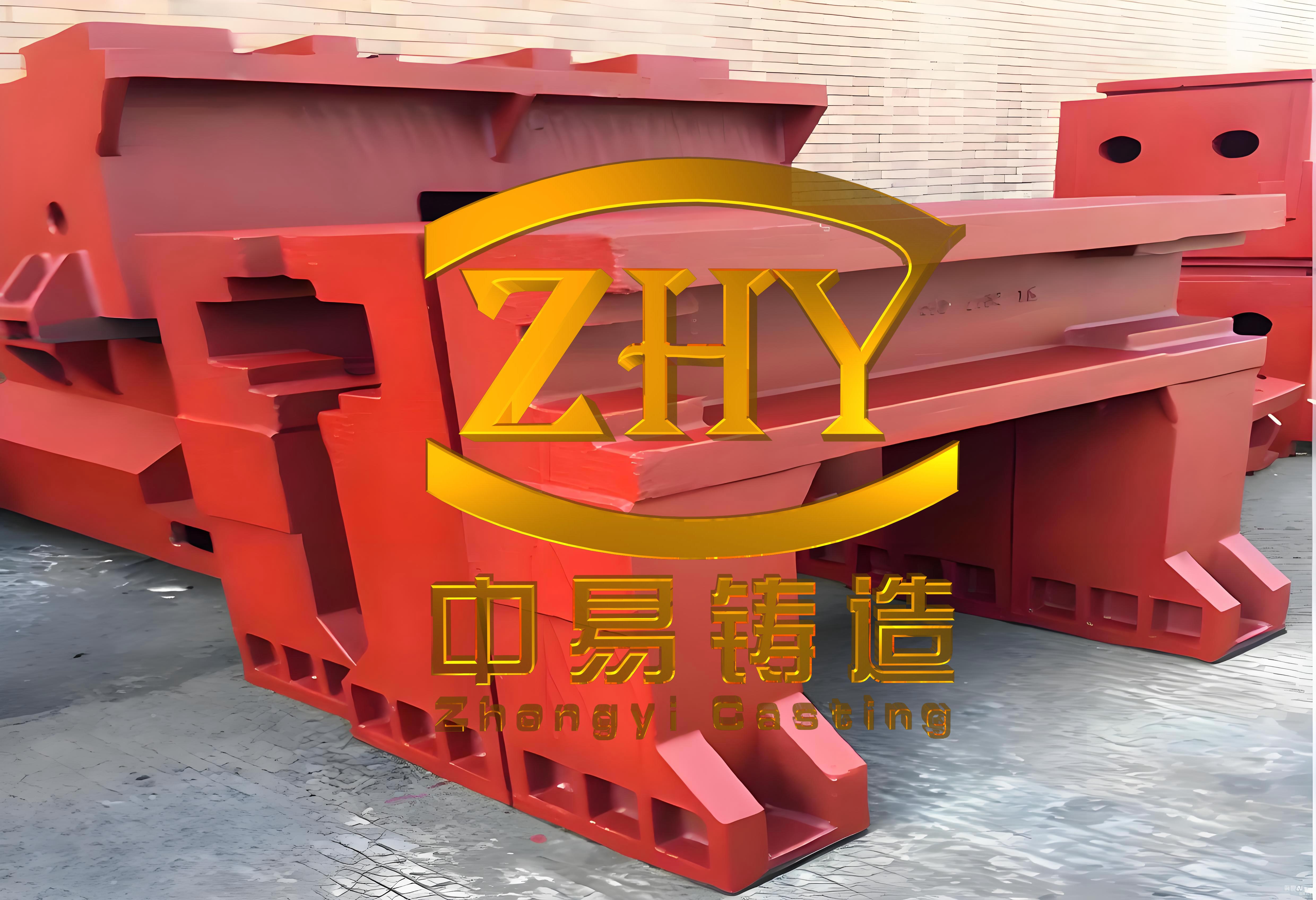
Hardness tests on guideways of different structures showed consistent values within the range of 200–240 HBW, with minimal variation across sections. This uniformity is critical for maintaining precision in machine tool applications. Residual stress measurements on various machine tool structures revealed as-cast stresses below 50 MPa, with a homogeneous distribution that minimizes the risk of deformation during service. The low residual stress is attributed to the high carbon equivalent and controlled cooling, which reduce thermal gradients and phase transformation stresses.
Conclusion
Based on the data from over 400 heats, I conclude that high carbon equivalent and high silicon-carbon ratio alloyed gray iron can reliably achieve HT300 and higher grades under stable conditions. The key advantages of this approach for machine tool castings are as follows.
First, the improved fluidity due to high carbon equivalent allows for lower inoculation and pouring temperatures after high-temperature static holding, reducing energy consumption and potential defects. Second, the as-cast residual stress is lower and more uniform, decreasing the likelihood of deformation and cracking in machine tool castings. Third, hardness uniformity is enhanced, which is particularly beneficial for castings with significant wall thickness variations. Fourth, the process consistently promotes the formation of Type A graphite with abundant and uniform precipitation, leading to stable microstructure in the casting body. Fifth, the overall reduction in chilling tendency significantly improves the machinability of machine tool castings, facilitating efficient downstream processing.
In summary, the implementation of high carbon equivalent, high silicon-carbon ratio, and micro-alloying techniques, combined with intensive inoculation, enables the production of high-performance machine tool castings with high stiffness, low stress, and excellent uniformity. This advancement supports the transition of the machine tool industry towards higher quality and reliability, addressing the longstanding challenges associated with traditional casting methods.