
In the manufacturing of machine tool castings, residual stresses arise during the casting process due to factors like constrained shrinkage, and these are further compounded by machining-induced stresses. These residual stresses, which persist within the castings, undergo relaxation and redistribution over time, often leading to deformation that compromises dimensional accuracy. As modern technology advances, the demand for high dimensional stability in machine tool castings and precision instrument components has intensified. Consequently, research focused on reducing and stabilizing residual stresses to enhance dimensional precision has gained significant attention globally. Both production experience and scientific experiments have consistently demonstrated that aging treatments, particularly heat aging, are effective methods for diminishing residual stresses and achieving stabilization. This article, drawing from extensive collaborative research, explores the relationship between heat aging processes, residual stress, and dimensional stability in machine tool castings, such as bed castings, emphasizing the critical role of stress management in precision engineering.
Residual stresses in machine tool castings primarily originate from three sources: casting-induced stresses, machining-added stresses, and secondary stresses from aging treatments. During casting, as the metal cools through the elastic-plastic temperature range, differential contraction due to temperature gradients generates casting stresses. These are influenced by material properties, molding techniques, pouring conditions, cooling uniformity, and mold-breaking temperature. Subsequently, machining operations, especially heavy roughing cuts, introduce additional stresses by removing stressed layers and causing localized plastic deformation under high temperatures and pressures. Furthermore, during heat aging, the cooling phase through the elastic-plastic range can produce secondary residual stresses if not controlled properly. The cumulative effect of these stresses, coupled with their time-dependent relaxation, directly impacts the geometric accuracy of machine tool castings. For instance, in precision applications like coordinate boring machines or grinding beds, uncontrolled stress relaxation can lead to deviations of several micrometers, undermining performance.
The deformation of machine tool castings is influenced by multiple factors, with structural rigidity being a primary concern. Rigidity, defined as the resistance to deformation under external loads, depends on material strength and the geometric shape and dimensions of the cross-section, often termed structural rigidity. Inadequate structural rigidity can cause significant geometric inaccuracies under load or even self-weight. For example, in a precision lathe bed, poor rigidity led to a sag of 150 micrometers under load, necessitating design modifications like adding intermediate supports to reduce deformation to 30 micrometers. Similarly, a planer machine crossbeam showed a deflection of 150 micrometers before rigidity improvements, which was reduced to just 10 micrometers afterward. Such cases highlight how structural rigidity affects dimensional stability. Additionally, improper handling or storage can induce deformation in beam-type components like worktables; supporting them at the “0.21L” points (where L is the length) minimizes distortion, as illustrated in engineering guidelines.
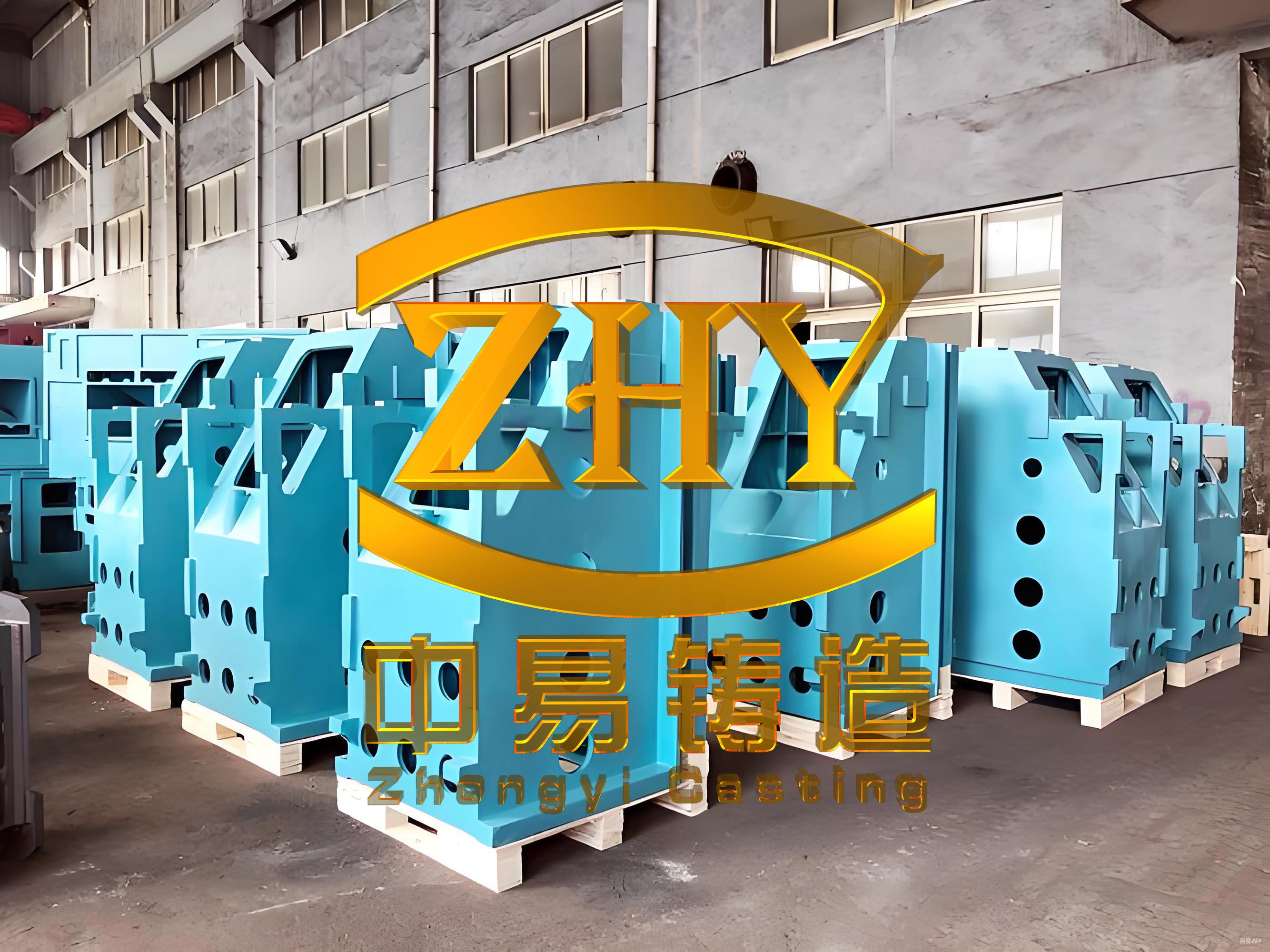
Thermal deformation is another critical factor, where temperature variations cause elastic distortions in machine tool castings. Uneven cooling during casting can result in microstructural inhomogeneities, such as variations in pearlite, ferrite, and cementite phases, each with distinct thermal expansion coefficients (e.g., pearlite: 11–14 × 10^{-6}/°C, ferrite: 12–14 × 10^{-6}/°C, cementite: 8–9 × 10^{-6}/°C). This leads to non-uniform expansion under temperature changes. Moreover, differences in section thickness create temperature gradients, causing warping. For instance, in a universal cylindrical grinder bed, a temperature increase of 1°C caused the guide rail to convex by 10–15 micrometers, with the deformation reversing upon temperature normalization. Studies indicate that a 1°C room temperature change can induce a 0.5°C difference between the upper and lower parts of a bed, resulting in a 5-micrometer curvature. Foundation deformation also plays a role; soil creep or inadequate foundation stability can alter the alignment of machine tool castings, as demonstrated by experiments where human movement on cement foundations caused level changes of 0.1 mm.
The material’s resistance to micro-plastic deformation at room temperature further affects dimensional stability. In cast iron, commonly used for machine tool castings, the presence of graphite (with a strength of only 2 kg/mm²) facilitates micro-yielding due to stress concentrations at graphite tips. This process involves dislocation movements under low stresses, and enhancing resistance through heat treatment or stress relief can improve stability. Residual stress magnitude and stability are pivotal; they consist of casting stresses, machining-added stresses, and secondary aging stresses. The relaxation of these stresses over time drives deformation, making stress reduction and stabilization essential for precision.
Heat aging is a widely adopted method to address residual stresses in machine tool castings. It involves heating the castings to the elastic-plastic temperature range, where stress relaxation occurs, followed by controlled cooling to minimize secondary stresses. Based on short-term creep tests (e.g., 4-hour tests), the elastic-plastic range for cast iron like HT20-40 is determined. The temperature-deformation curve shows that below 400°C, the material behaves elastically, entering the elastic-plastic region above 400°C, with intense deformation starting around 550°C. However, the upper temperature limit must avoid hardness reduction. A recommended heat aging cycle for small to medium precision machine tool castings includes loading at temperatures below 200°C, heating at rates not exceeding 50°C/h, holding at 500–550°C for 4–6 hours, and cooling slowly above 400°C to prevent secondary stresses. Faster cooling below 400°C is acceptable. The effectiveness of this process depends on furnace temperature uniformity; variations should be controlled within ±20°C to achieve stress reductions of 40–60% for HT20-40 cast iron and 50–70% for phosphor-copper-titanium wear-resistant cast iron.
The arrangement of aging sequences significantly impacts stress elimination. For example, in coordinate boring machine beds and instrument lathe beds, residual stress measurements across processes reveal that early mold-breaking increases stresses, while rough machining adds substantial stress (up to 50–100% of the original). Conducting heat aging after rough machining allows better elimination of machining-induced stresses. A double heat aging process further enhances stability; in experiments, coordinate boring machine beds treated with double aging maintained geometric accuracy within 5 micrometers over 15 months, with residual stresses below 1 kg/mm². Similarly, instrument lathe beds showed doubled stability compared to single aging, with stresses under 0.5 kg/mm². This underscores the importance of multiple aging cycles for high-precision machine tool castings.
The relationship between heat aging, residual stress reduction, and dimensional stability is quantifiable. Experiments on various beds, such as those for milling machines and grinders, demonstrate that strict aging protocols yield superior results. For instance, after double heat aging, beds exhibit not only lower residual stresses but also improved resistance to load and thermal deformation. In load tests, double-aged beds showed minimal deformation (e.g., 2–3 micrometers under 1000 kg load), whereas single-aged ones deformed more (e.g., 5–6 micrometers). Under temperature fluctuations of 3°C, double-aged beds maintained accuracy within 2–3 micrometers, compared to 4–5 micrometers for single-aged ones. These findings validate that stress stabilization through aging enhances both static and dynamic precision in machine tool castings.
To summarize experimental data, the following table illustrates residual stress changes across processes for a typical machine tool casting:
| Process Stage | Residual Stress (kg/mm²) | Stress Change (%) |
|---|---|---|
| As-cast | 3.0 | — |
| After mold-breaking | 3.5 | +16.7 |
| After rough machining | 5.0 | +66.7 |
| After first heat aging | 1.5 | -50.0 |
| After second heat aging | 0.5 | -83.3 |
The stress reduction can be modeled using relaxation theory, where the stress relaxation during aging follows an exponential decay: $$\sigma(t) = \sigma_0 e^{-kt},$$ where $\sigma(t)$ is the stress at time $t$, $\sigma_0$ is the initial stress, and $k$ is a material-dependent constant. For cast iron, $k$ values range from 0.1 to 0.3 h^{-1} at aging temperatures, indicating rapid initial stress relief.
Other aging methods, such as natural aging, vibration aging, low-temperature annealing, water-electric effects, shot peening, static loading, and thermal shock, offer alternatives. These can be categorized into three groups: those that minimally alter stress but enhance relaxation rigidity (e.g., natural aging, vibration aging), those that significantly reduce stress while strengthening the matrix (e.g., static loading, thermal shock), and heat aging, which substantially lowers stress. Vibration aging, in particular, has gained interest for its efficiency; using resonant frequencies for 10–30 minutes can stabilize stresses, with claims of superior dimensional stability compared to natural or heat aging. However, heat aging remains prevalent in the machine tool industry due to its proven effectiveness, though vibration methods show promise for automation and energy savings.
In precision measurement of dimensional stability, techniques like mechanical-electrical methods (e.g., drilling, ring-core, or layer-removal) are employed to assess residual stresses in machine tool castings. These methods involve measuring strain changes after local material removal, with calculations based on elastic theory. For example, the original stress $\sigma_x$ and $\sigma_y$ in a biaxial field can be derived from strain measurements using: $$\sigma_x = \frac{E}{1-\nu^2} (\varepsilon_x + \nu \varepsilon_y), \quad \sigma_y = \frac{E}{1-\nu^2} (\varepsilon_y + \nu \varepsilon_x),$$ where $E$ is Young’s modulus, $\nu$ is Poisson’s ratio, and $\varepsilon_x$, $\varepsilon_y$ are measured strains. Although destructive, these methods provide accurate low-stress measurements, with errors typically within 10%. Non-destructive techniques are under development for broader applicability.
Geometric accuracy monitoring in constant-temperature environments (e.g., 20±1°C) using instruments like auto-collimators (accuracy ±0.5 micrometers) or precision levels (accuracy ±1 micrometer) reveals that double-aged machine tool castings maintain stability within 2–5 micrometers over years, underscoring the efficacy of proper aging. For instance, in coordinate boring machine beds, double aging limited deviations to 5 micrometers over 15 months, rivaling international standards. This highlights that residual stress control is indispensable for high-precision machine tool castings.
In conclusion, the interplay between heat aging, residual stress, and dimensional stability in machine tool castings is complex yet manageable through optimized processes. Key recommendations include avoiding early mold-breaking, implementing double heat aging after rough machining, controlling furnace temperature uniformity, and considering alternative methods like vibration aging for efficiency. As industries strive for higher precision, ongoing research into stress measurement and aging techniques will continue to enhance the performance of machine tool castings, ensuring they meet the rigorous demands of modern manufacturing.