
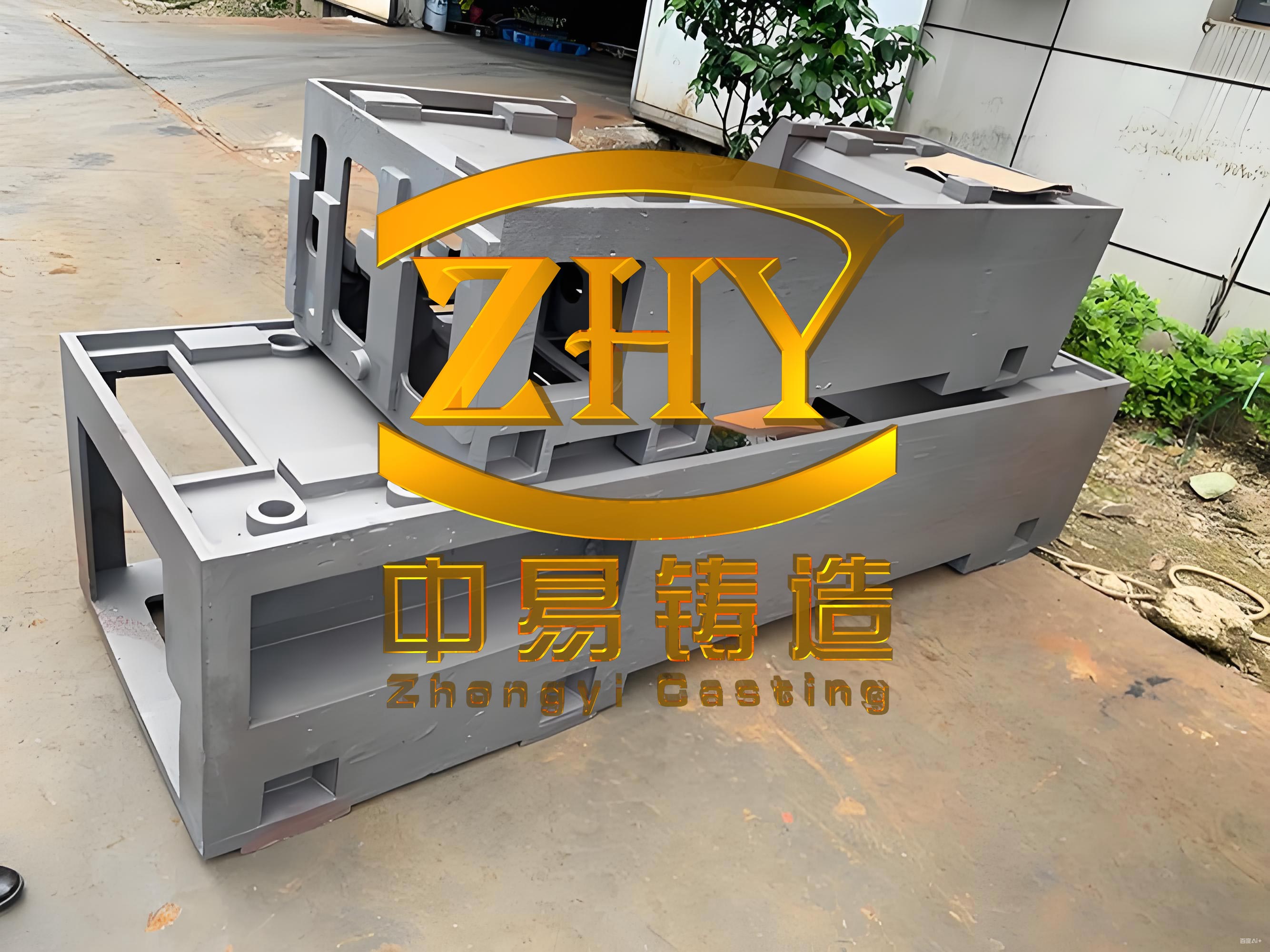
In the field of mechanical engineering, the quality and performance of machine tool castings are critical for ensuring precision and stability in manufacturing processes. As a researcher focused on improving casting methods, I have explored the application of bimetal pouring technology to address common defects in gray iron castings, such as casting cracks, white structures, shrinkage cavities, and porosity. This approach not only enhances the mechanical properties of machine tool castings but also reduces production costs. In this article, I will detail the design, implementation, and benefits of bimetal pouring, supported by experimental data, formulas, and tables to summarize key findings.
Machine tool castings, which constitute up to 90% of components in various mechanical equipment, often face challenges due to uneven wall thickness and complex geometries. For instance, in machine tool slideway guides, variations in thickness can lead to stress concentration and defects when using high-grade iron solutions like HT300 or HT350. Conversely, lower-grade materials like HT200 may result in insufficient hardness and structural integrity. Bimetal pouring offers a solution by allowing different iron solutions to be applied to specific regions of a casting, thereby optimizing performance. Throughout this discussion, I will emphasize the importance of machine tool casting and machine tool castings in industrial applications, highlighting how this technology can be tailored to meet demanding requirements.
Problem Statement: Defects in Machine Tool Castings
The primary issue in producing high-quality machine tool castings lies in the inherent limitations of single-metal pouring. When a high-grade iron solution, such as HT350, is used for entire components like slideway guides, the significant differences in wall thickness—often varying by three to four times—can cause localized stress concentrations. This leads to defects like casting cracks and white structures, which compromise the casting’s integrity. On the other hand, using a lower-grade material like HT200 for the entire casting results in reduced hardness and organizational looseness, failing to meet the precision demands of machine tools. For example, in a slideway guide, the hardness and microstructure directly influence machining accuracy and long-term stability. Through my research, I have identified that bimetal pouring can mitigate these issues by selectively applying materials to areas with distinct requirements. This not only improves the casting process but also enhances the overall quality of machine tool castings.
To quantify these problems, consider the relationship between material properties and casting defects. The occurrence of white structures, for instance, is often linked to rapid cooling rates and high carbon equivalents. A general formula for predicting such defects can be expressed as:
$$ \text{Defect Probability} = k \cdot \left( \frac{\Delta T}{\tau} \right) $$
where \( \Delta T \) is the temperature gradient, \( \tau \) is the solidification time, and \( k \) is a material-specific constant. For machine tool castings, this highlights the need for controlled cooling and tailored material selection.
Design of Bimetal Pouring System
In my work on bimetal pouring for machine tool castings, I designed two separate gating systems to prevent the intermixing of iron solutions. This is crucial for maintaining distinct material properties in different sections of the casting, such as the slideway guide and the base. The following sections describe the A and B gating systems, which were implemented along the sides of the test specimen to ensure layered pouring.
A Gating System for High-Grade Iron Solution
The A gating system was designed to inject HT350 iron solution directly into the slideway guide area of the machine tool casting. I employed a closed gating system with a cross-sectional ratio of sprue: runner: ingate = 1.25:1.15:1. This configuration ensures a controlled flow and minimizes turbulence. The ingates were positioned at the lowest part of the casting to facilitate bottom-up filling, reducing the risk of slag inclusion. To further enhance quality, I incorporated a metal filter screen between the sprue and the pouring basin, along with a slag trap in the runner. Given the short length of the test specimen (1825 mm), continuous pouring was challenging with standard ladles. Therefore, I used a plug-type pouring basin to allow for sequential filling, maintaining a consistent pouring temperature for the HT350 solution. This design is particularly effective for machine tool castings where hardness and wear resistance are paramount.
B Gating System for Low-Grade Iron Solution
For the base section of the machine tool casting, which requires less stringent properties, the B gating system was designed as an open system to inject HT200 iron solution. The cross-sectional ratio here was sprue: runner: ingate = 1:1.15:1.20, promoting a smoother flow and reducing the likelihood of mixing with the underlying HT350 layer. The ingates were placed approximately 45 mm from the top of the casting, allowing the HT200 to fill the upper regions while minimizing penetration into the HT350 zone. This setup aims to limit the mixed region to a height of 30-40 mm, preserving the integrity of the slideway guide. In my experiments, this approach proved essential for achieving a clear transition between materials in machine tool castings, ensuring that the导轨 area maintains high hardness without defects.
To illustrate the design parameters, Table 1 summarizes the key aspects of both gating systems for typical machine tool castings:
| Gating System | Type | Cross-Sectional Ratio (Sprue:Runner:Ingate) | Ingate Position | Target Material |
|---|---|---|---|---|
| A System | Closed | 1.25:1.15:1 | Bottom of casting | HT350 |
| B System | Open | 1:1.15:1.20 | 45 mm from top | HT200 |
Additionally, test blocks were integrated into the mold to evaluate the mechanical properties of the machine tool casting. These blocks mirrored the dimensions and gating of the actual slideway guide, and multiple test bars were placed vertically to assess variations in hardness and microstructure along the height. This allowed me to correlate the gating design with performance outcomes in machine tool castings.
Pouring Process and Parameter Selection
Implementing an effective pouring process is vital for the success of bimetal technology in machine tool castings. In my research, I used two cranes and a plug-type pouring basin to sequentially inject the iron solutions. The process began with pouring a set of Φ30 test bars to baseline the material properties. Then, the A system delivered HT350 into the mold until the metal level rose about 30 mm above the slideway guide. Immediately after, the B system injected HT200 into the upper sections. The simultaneous pouring time was tightly controlled between 2 to 5 seconds to prevent excessive mixing.
Temperature control played a critical role; for the HT350 solution, I aimed for a pouring temperature close to the solidification point to induce a semi-solid state when the HT200 was added. This minimized downward penetration and confined the mixed zone. The superheat for the base HT200 was maintained between 35°C and 60°C to accommodate the thinner walls and complex geometry of the machine tool casting. The relationship between pouring temperature and defect formation can be modeled using thermal analysis formulas, such as:
$$ T_{\text{pour}} = T_{\text{solidus}} + \Delta T_{\text{superheat}} $$
where \( T_{\text{solidus}} \) is the solidus temperature of the iron alloy, and \( \Delta T_{\text{superheat}} \) is the superheat degree. For bimetal pouring, this ensures that the lower layer partially solidifies before the upper layer is introduced, reducing intermixing in machine tool castings.
Table 2 outlines the recommended pouring parameters for bimetal applications in machine tool castings:
| Parameter | Value for HT350 | Value for HT200 | Overall Range |
|---|---|---|---|
| Pouring Temperature | Near solidus + 15-25°C | Solidus + 35-60°C | Material-dependent |
| Simultaneous Pouring Time | 2-5 seconds | 2-5 seconds | 2-6 seconds |
| Mixed Zone Height | ≤ 40 mm | ≤ 40 mm | 30-40 mm |
Experimental Methodology and Results Analysis
To validate the bimetal pouring approach, I conducted experiments on three slideway specimens of machine tool castings. One was poured with a single metal (HT200) for comparison, while the others used bimetal pouring with HT350 and HT200. Test bars were positioned vertically in the mold to measure hardness and microstructure variations. The results demonstrated significant improvements in the bimetal samples, particularly in the slideway guide areas.
Impact on Hardness and Microstructure
In the single-metal HT200 casting, hardness values were uniform but low, averaging around 150-180 HB, which is insufficient for high-precision machine tool castings. The microstructure comprised 75-80% pearlite (P) and 20-25% ferrite (F), indicating suboptimal strength. In contrast, the bimetal castings showed higher and more consistent hardness in the导轨 regions, often exceeding 200 HB, when pouring temperatures and times were optimized. For instance, with a pouring temperature of \( T_{\text{pour}} = T_{\text{solidus}} + 20^\circ \text{C} \) and a simultaneous pouring time of 3 seconds, the hardness distribution was even, and the microstructure was nearly 100% pearlite, meeting HT350 standards. However, improper control led to uneven hardness and the appearance of ferrite, reducing the effectiveness for machine tool castings.
The hardness (H) can be related to the cooling rate (CR) and composition through empirical formulas like:
$$ H = a \cdot \text{CR} + b \cdot \text{C}_{\text{eq}} + c $$
where \( a \), \( b \), and \( c \) are constants, and \( \text{C}_{\text{eq}} \) is the carbon equivalent. This emphasizes the importance of process control in bimetal pouring for machine tool castings.
Table 3 compares the results from the experiments, highlighting the advantages of bimetal pouring in machine tool castings:
| Casting Type | Average Hardness (HB) | Microstructure (P/F Ratio) | Defects Observed |
|---|---|---|---|
| Single-Metal (HT200) | 150-180 | 75-80% P, 20-25% F | Low hardness, looseness |
| Bimetal (Optimized) | 200-250 | ~100% P | Minimal |
| Bimetal (Non-optimized) | Variable (150-220) | P with F inclusions | Mixing, reduced integrity |
Conclusions and Economic Benefits
Based on my research, bimetal pouring technology offers a robust solution for enhancing machine tool castings. Key conclusions include: the A gating system should have excellent slag resistance, while the B system must be open to minimize mixing heights; accurate calculation of metal requirements and chemical composition is essential for achieving desired mechanical properties; and optimal pouring parameters involve a metal temperature of \( T_{\text{solidus}} + 15-25^\circ \text{C} \) and a simultaneous pouring time of 2-6 seconds. Moreover, surface hardening of slideway guides in bimetal castings can reach HRC 55, positioning this method as a leader in the industry for machine tool castings.
Economically, bimetal pouring reduces material costs by approximately 255 USD per ton, as it allows the use of cheaper HT200 for non-critical sections without compromising performance. This makes it a cost-effective choice for mass-producing high-quality machine tool castings. Future work could focus on refining thermal models and expanding the application to other types of machine tool castings, further solidifying its role in advanced manufacturing.
In summary, the integration of bimetal pouring into the production of machine tool castings addresses longstanding issues of defects and performance, paving the way for more reliable and efficient machinery. As I continue to explore this technology, I am confident that it will become a standard practice in the foundry industry, particularly for complex components like those in machine tools.