
In the realm of heavy-duty manufacturing, the production of large-scale machine tool castings has always presented significant challenges due to limitations in equipment capacity, such as crane lifting capabilities and drying facilities. As an engineer involved in this field, I have witnessed how traditional methods often fall short when dealing with massive components like bed frames and crossbeam guides. However, through continuous technical innovation and the adoption of advanced processes like coarse core molding, we have overcome these obstacles. This article delves into the intricacies of machine tool casting, focusing on the application of coarse core molding for large workpieces. I will explore the methodology, benefits, and technical aspects, supported by formulas and tables, to highlight how this approach enhances efficiency and quality in producing machine tool castings. The integration of this technique has revolutionized our operations, allowing us to tackle projects that were previously deemed infeasible with conventional sand molding or pit casting methods.
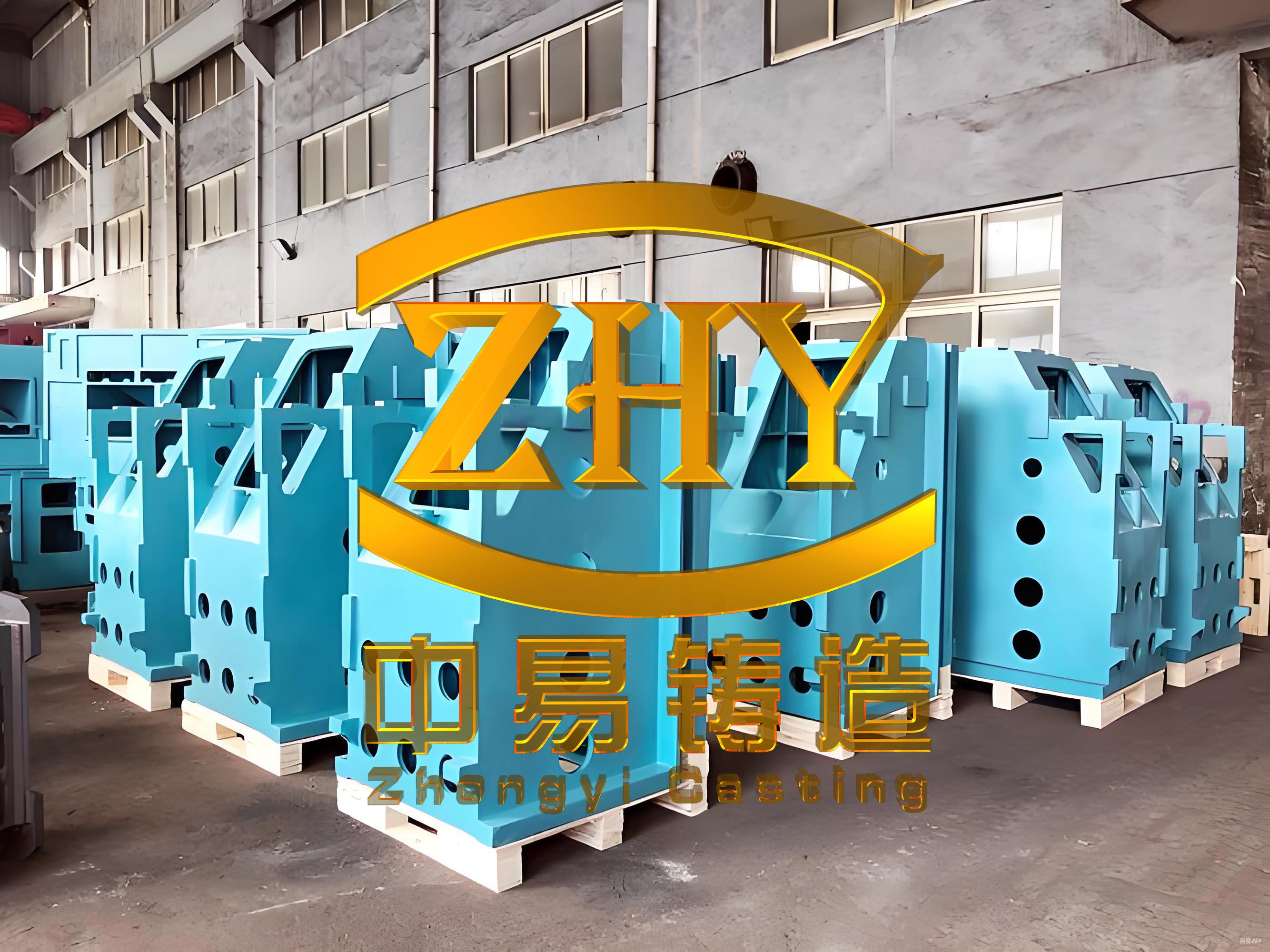
The foundation of machine tool casting lies in creating robust, precise components that form the backbone of industrial machinery. In our experience, the weight and volume of parts like bed frames—often exceeding tens of thousands of kilograms—require specialized handling. Traditional sand box molding or pit casting often led to issues such as deformation, sinking, and extended production cycles, especially in areas with high groundwater levels. By shifting to coarse core molding, we have optimized the process, reducing reliance on large-scale drying equipment and minimizing material waste. This method involves assembling the mold from multiple coarse cores, which are pre-formed and then combined to create the final cavity. For instance, in one project, a bed frame weighing approximately 30,000 kg was successfully cast using this technique, eliminating the need for separate drying and complex foundations. The key to success in machine tool casting with coarse core molding is meticulous planning of core assembly, ventilation, and gating systems to ensure uniform hardness and prevent defects.
To illustrate the process, let me describe a typical application for a heavy machine tool casting, such as a bed frame. Initially, we used a split sand box approach, but this introduced difficulties in handling and quality assurance. Under expert guidance, we transitioned to a full coarse core assembly. The lower part of the mold was constructed using wet sand molding, while the upper sections were built from coarse cores. This not only simplified operations but also allowed for fixed sand boxes, reducing the risk of deformation. The gating system was designed with multiple inlets to ensure even metal distribution. One critical aspect was ensuring proper ventilation; we incorporated coke-based venting channels in each core to facilitate gas escape during pouring. Additionally, we implemented clamping mechanisms to secure the cores during assembly, preventing displacement. The table below summarizes a comparison between traditional sand molding and coarse core molding for machine tool castings, highlighting key parameters:
| Parameter | Traditional Sand Molding | Coarse Core Molding |
|---|---|---|
| Production Cycle (days) | 30-40 | 15-20 |
| Material Savings (tons) | Baseline | Up to 5 tons |
| Equipment Utilization | High (e.g., large cranes, drying kilns) | Low (e.g., standard cranes suffice) |
| Wood Pattern Savings (cubic meters) | 0 | Approx. 10 m³ |
| Quality Assurance | Moderate (risk of defects) | High (uniform hardness, minimal deformation) |
Another example involves the casting of a crossbeam guide for a planer machine, which also benefited from coarse core molding. This component, with its substantial width and weight, required a tailored approach. We designed the mold using multiple coarse cores arranged to form the guide’s profile, with the lower section crafted via刮板 (scraping board) molding to achieve precise dimensions. Ventilation was enhanced by embedding焦炭 (coke) layers, and the cores were tightly fastened with pins and beams to maintain integrity during pouring. The gating system included risers to maintain adequate metallostatic pressure, crucial for preventing shrinkage cavities. This method not only shortened the production timeline but also conserved resources, demonstrating the versatility of coarse core molding in various machine tool casting applications. The repeated use of machine tool castings in such contexts underscores its importance in heavy industry.
From a technical perspective, the success of machine tool casting with coarse core molding can be analyzed through thermodynamic and mechanical principles. For instance, the risk of casting defects like hot tearing or porosity is mitigated by controlling the cooling rate and venting. One fundamental formula relates to thermal stress during solidification: $$ \sigma = E \cdot \alpha \cdot \Delta T $$ where $\sigma$ is the thermal stress, $E$ is the elastic modulus of the material, $\alpha$ is the coefficient of thermal expansion, and $\Delta T$ is the temperature gradient. In coarse core molding, the use of multiple cores allows for better heat dissipation, reducing $\Delta T$ and minimizing stress-related issues. Additionally, the shrinkage compensation in machine tool castings can be modeled as: $$ S = k \cdot L \cdot (T_p – T_r) $$ where $S$ is the linear shrinkage, $k$ is a material-dependent constant, $L$ is the characteristic length of the casting, $T_p$ is the pouring temperature, and $T_r$ is the room temperature. By optimizing core design, we can adjust for shrinkage, ensuring dimensional accuracy in final machine tool castings.
Ventilation and gas escape are critical in machine tool casting to avoid defects like blowholes. In coarse core molding, each core is designed with dedicated venting channels, often filled with permeable materials like coke. The efficiency of venting can be expressed using Darcy’s law for flow through porous media: $$ Q = \frac{k A \Delta P}{\mu L} $$ where $Q$ is the volumetric flow rate of gases, $k$ is the permeability of the venting material, $A$ is the cross-sectional area, $\Delta P$ is the pressure difference, $\mu$ is the dynamic viscosity of the gas, and $L$ is the length of the vent path. By maximizing $A$ and $k$ in core design, we ensure that gases are efficiently expelled during the pouring of machine tool castings, leading to higher integrity components. Moreover, the clamping force required to hold cores in place can be calculated to prevent buoyancy effects: $$ F_c = \rho_m g V – W_c $$ where $F_c$ is the clamping force, $\rho_m$ is the density of the molten metal, $g$ is gravity, $V$ is the volume of the core submerged in metal, and $W_c$ is the weight of the core. This equation highlights the importance of secure fastening in coarse core molding for large machine tool castings.
The advantages of adopting coarse core molding for machine tool casting are multifaceted. Firstly, it significantly shortens the production cycle by eliminating lengthy drying times and simplifying mold assembly. In our projects, we observed a reduction of up to 50% in cycle time compared to traditional methods. Secondly, resource savings are substantial; for example, in one instance, we saved over 10 cubic meters of wood and numerous pattern-making hours. This aligns with sustainable practices, reducing the environmental footprint of machine tool castings. Thirdly, the method enhances quality by ensuring uniform hardness and minimizing deformation, as evidenced by improved surface finish and dimensional stability. The table below provides a detailed breakdown of cost and efficiency gains in machine tool casting using coarse core molding:
| Aspect | Impact | Quantitative Benefit |
|---|---|---|
| Energy Consumption | Reduced drying needs | Savings of ~20% in fuel |
| Labor Efficiency | Simplified operations | 30% reduction in man-hours |
| Material Usage | Optimized core assembly | 15% less sand and binders |
| Equipment Lifespan | Lower stress on cranes and kilns | Extended service life by 10-15% |
Despite these benefits, coarse core molding for machine tool castings does present challenges, such as the complexity of core matching and management. However, with robust planning and coordination, these issues are manageable. For instance, we developed a standardized core identification system to streamline assembly. Furthermore, the mechanical properties of the final machine tool castings can be predicted using strength models: $$ \sigma_u = \sigma_0 + K \cdot d^{-1/2} $$ where $\sigma_u$ is the ultimate tensile strength, $\sigma_0$ and $K$ are material constants, and $d$ is the grain size. By controlling the cooling rate through core design, we refine the microstructure, enhancing the durability of machine tool castings. This technical depth ensures that coarse core molding is not just a practical solution but also a scientifically sound approach for advanced manufacturing.
In conclusion, the integration of coarse core molding into machine tool casting represents a significant leap forward in heavy equipment production. My firsthand experience confirms that this method addresses the inherent矛盾 (contradictions) between equipment limitations and workpiece demands, enabling the fabrication of large, high-quality components efficiently. The repeated emphasis on machine tool casting and machine tool castings throughout this discussion underscores their centrality in industrial progress. As we continue to innovate, further research into automation and material science will likely expand the applications of coarse core molding, solidifying its role in the future of manufacturing. By sharing these insights, I hope to inspire broader adoption of this technique, ultimately driving advancements in the global machine tool industry.