
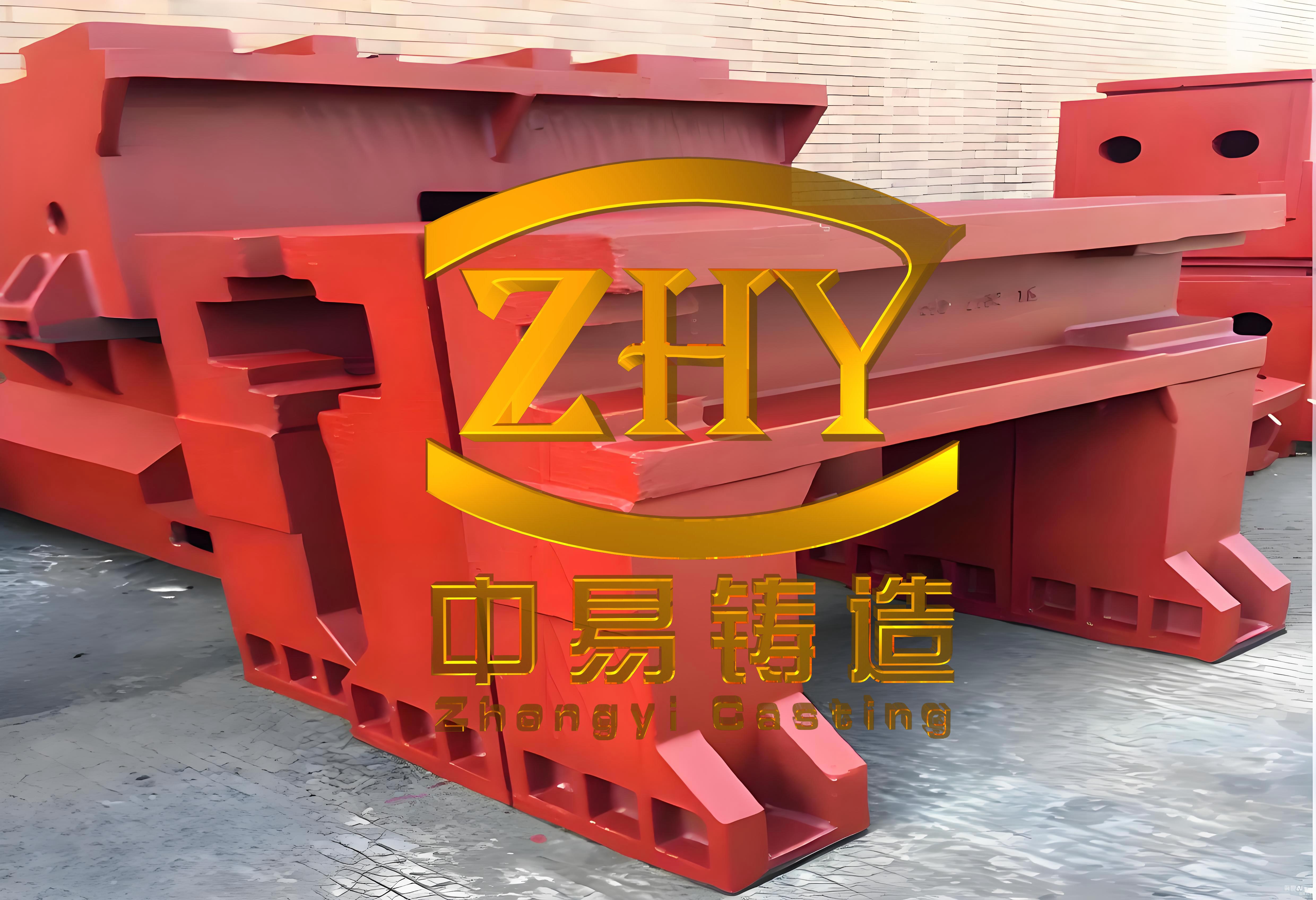
In our foundry, we have extensively adopted resin sand processes for producing machine tool castings, which has proven to be a highly efficient method for achieving superior dimensional accuracy, smooth surface finishes, and reduced energy consumption. The transition to resin sand has allowed us to manufacture machine tool castings with complex geometries while maintaining high productivity. Over the years, we have refined our approach to address challenges such as gas defects and sand sticking, leading to significant improvements in the quality of machine tool castings. This article delves into the key aspects of our resin sand process, including parameter determination, gating system design, defect prevention, and economic benefits, all aimed at enhancing the production of durable and precise machine tool castings.
The resin sand process involves using synthetic binders that harden through chemical reactions, providing excellent mold stability. For machine tool castings, which often require high strength and precision, we have optimized the mix proportions to ensure consistent performance. Our typical resin sand composition includes silica sand, phenolic resin, and a catalyst like para-toluene sulfonic acid. The optimal ratio is determined through rigorous testing, with resin content maintained at around 1.0–1.5% and catalyst at 20–30% of resin weight. This formulation minimizes gas evolution while maximizing strength, crucial for producing robust machine tool castings. Below is a table summarizing the key properties of our resin sand mix for machine tool castings:
| Parameter | Value | Unit |
|---|---|---|
| Resin Content | 1.0–1.5 | % |
| Catalyst Content | 20–30 | % of resin |
| Tensile Strength | 1.2–1.8 | MPa |
| Gas Evolution at 1000°C | 15–25 | mL/g |
| pH Value | 4–6 | – |
Determining the correct process parameters is essential for minimizing defects in machine tool castings. We have established that the pattern shrinkage rate for resin sand molds ranges from 0.8% to 1.2%, depending on the geometry of the machine tool casting. For instance, box-shaped castings with multiple cores experience higher restraint during solidification, so we use a shrinkage rate of 1.0–1.2%, whereas simpler shapes use 0.8–1.0%. Although resin sand offers high dimensional accuracy, we slightly increase machining allowances to account for potential gas-related issues, typically adhering to values similar to clay sand processes. The parting line allowance is reduced due to the flat surfaces achieved with pattern plates, as shown in the following table based on sandbox dimensions:
| Sandbox Internal Dimension (Length + Width, mm) | Parting Line Allowance (mm) |
|---|---|
| ≤1000 | 0.5 |
| 1000–2000 | 1.0 |
| 2000–3000 | 1.5 |
| >3000 | 2.0 |
The gating system design plays a pivotal role in the quality of machine tool castings, as improper flow can lead to defects like gas porosity and sand erosion. We calculate the total cross-sectional area of the ingates using the formula: $$A_{\text{inner}} = \frac{W}{K}$$ where \(A_{\text{inner}}\) is the total ingate area in cm², \(W\) is the total weight of molten metal in kg, and \(K\) is a coefficient typically ranging from 4 to 6 for machine tool castings. This ensures adequate metal flow without excessive turbulence. The pouring time is determined by: $$t = C \sqrt{W}$$ where \(t\) is the pouring time in seconds, \(W\) is the metal weight in kg, and \(C\) is a coefficient between 1.5 and 2.0, depending on the complexity of the machine tool casting. Shorter pouring times help reduce gas entrapment by quickly building up metallostatic pressure.
Positioning of ingates is critical to avoid issues like cold shuts and slag inclusion in machine tool castings. We follow several principles: minimize the flow distance of molten metal in the mold cavity, avoid sharp turns that increase resistance, and prevent dispersed ingates that can cause uneven filling. For long bed-type machine tool castings, we avoid top-down gating systems and instead use strategically placed ingates to ensure smooth, uniform filling. Additionally, slag traps are incorporated to collect impurities. These include pre-mold traps placed before the ingates to remove slag and gas, in-mold traps at areas prone to metal accumulation to capture cold metal with inclusions, and post-mold traps at the end of flow paths to collect residual cold metal. This approach significantly enhances the integrity of machine tool castings.
To support the resin sand process, we have designed specialized equipment such as split-pattern sandboxes for high-volume production of machine tool castings like beds and frames. These sandboxes reduce the sand-to-metal ratio by minimizing sand volume around the pattern. Pattern plates are used for batch production to improve mold release quality and reduce parting line allowances. Moreover, we have established strict quality control points at key stages, such as sand mixing and core making, where parameters like resin addition, strength, gas evolution, pH, and loss on ignition are regularly monitored. This ensures consistency in the production of machine tool castings.
Coatings are applied to resin sand molds and cores to prevent burning-on and improve surface finish of machine tool castings. We have developed zircon-based and high-alumina coatings that offer high refractoriness and good application properties. These coatings are essential because resin sand has lower thermal resistance compared to traditional sands, and machine tool castings often require high pouring temperatures. The coatings are applied evenly to avoid defects, and in critical areas like sprue bases, we use refractory sleeves or bricks to enhance durability.
Despite the advantages, resin sand processes can lead to defects in machine tool castings if not properly controlled. Gas porosity is a common issue, primarily due to the high gas evolution of resin sand, which we measured at 20–30 mL/g at 1000°C. This is often “invasive” gas porosity, where gases penetrate the metal surface during pouring. To mitigate this, we optimize pouring parameters: increasing pouring speed to shorten pouring time, which builds pressure faster and reduces gas invasion. The relationship between sand thickness and permeability is crucial, as thinner sand layers improve venting. The table below illustrates how sand thickness affects permeability, which is vital for preventing gas defects in machine tool castings:
| Sand Thickness (mm) | Permeability |
|---|---|
| 100 | 600 |
| 200 | 400 |
| 300 | 200 |
Additionally, we use venting techniques such as multiple vents in cores and molds, and place slag traps in prone areas. The formula for the pressure balance at the metal-mold interface can be expressed as: $$P_{\text{metal}} = P_{\text{atm}} + \rho g h – P_{\text{gas}}$$ where \(P_{\text{metal}}\) is the metallostatic pressure, \(P_{\text{atm}}\) is atmospheric pressure, \(\rho\) is metal density, \(g\) is gravity, \(h\) is metal height, and \(P_{\text{gas}}\) is the gas pressure from mold decomposition. By increasing \(P_{\text{metal}}\) through faster pouring, we counteract \(P_{\text{gas}}\), reducing gas defects in machine tool castings.
Sand sticking, particularly mechanical penetration, is another challenge in machine tool castings due to resin burnout at high temperatures, creating gaps for metal infiltration. This occurs in areas like sprue zones or thick sections where thermal and mechanical stresses are high. To prevent this, we apply high-quality coatings with good penetration resistance and suspendibility. In high-risk areas, we incorporate refractory materials, and the coating thickness is optimized based on the section modulus of the machine tool casting. The effectiveness of coatings can be modeled using the following relation for metal penetration depth: $$d = k \sqrt{\frac{\Delta P \cdot t}{\mu}}$$ where \(d\) is penetration depth, \(k\) is a constant, \(\Delta P\) is pressure difference, \(t\) is time, and \(\mu\) is metal viscosity. By reducing \(\Delta P\) and \(t\) through process control, we minimize sticking in machine tool castings.
The economic benefits of using resin sand for machine tool castings are substantial. We have implemented sand reclamation systems that allow up to 90% of used sand to be recycled, reducing raw material costs. For an annual production of 10,000 tons of machine tool castings, this saves approximately 9,000 tons of new sand, translating to significant cost reductions. Moreover, resin consumption decreases from 1.5% to 1.0% in reclaimed sand, further lowering expenses. The table below summarizes the cost savings and productivity gains for machine tool castings production:
| Factor | Value | Impact |
|---|---|---|
| Sand Reclamation Rate | 90% | Reduces new sand purchase by 9,000 tons/year |
| Resin Usage Reduction | 0.5% | Lowers resin and catalyst costs by $50,000/year |
| Productivity Increase | 50–100 tons/person-year | Up from 30–40 tons/person-year with other processes |
| Scrap Rate Reduction | From 15% to 5% | Saves $200,000 annually in waste |
| Rework Rate Reduction | From 20% to 10% | Improves overall efficiency |
Labor productivity has also improved due to integrated sand feeding and compacting processes, with output reaching 50–100 tons per person per year for machine tool castings. This is a marked increase from previous methods, and the reduction in scrap and rework rates further enhances profitability. Socially, the process reduces environmental pollution by minimizing waste sand and emissions, aligning with sustainable manufacturing practices for machine tool castings.
In conclusion, the resin sand process is a forward-looking approach for producing high-quality machine tool castings, offering precision and efficiency. However, we continue to address issues like刺激性 gas emissions during mixing and pouring, which require better ventilation systems. Coatings for resin sand still need improvements in high-temperature resistance and application uniformity. Future work will focus on developing eco-friendly binders and advanced coatings to further optimize the production of machine tool castings. Through continuous innovation, we aim to solidify resin sand as the preferred method for manufacturing durable and accurate machine tool castings in the global foundry industry.