
In the manufacturing of textile machinery, the wall panel serves as a critical support component, and its machining quality directly influences the assembly, operational precision, and noise levels of the loom. As a large-scale thin-walled casting, the wall panel typically undergoes metal mold casting processes. For instance, in a specific model like the PQPQ loom wall panel, the minimum wall thickness is only P% mm, while the dimensional area reaches P PR$ mm × T!” mm. This component features numerous machining surfaces—up to PP in total—involving operations such as milling, boring, reaming, and drilling. The primary challenge lies in integrating these diverse cutting types into a cohesive process while maintaining precision for such a expansive thin-walled structure. Key machining requirements include achieving surface roughness values of !” ≤ $% &!’ for foot surfaces and ≤ &% *!’ for critical holes like “($) mm and “*) mm, alongside strict positional tolerances such as a center distance of &!& + ,% () mm between two “($) mm holes. This paper details my design approach for a combined machine tool that addresses these complexities through innovative positioning, tooling, and sequencing strategies.
The positioning scheme for thin-walled castings like the wall panel is paramount, as it directly affects cutting rigidity, vibration suppression, and final accuracy. I implemented a six-point complete localization system to constrain all degrees of freedom. Given the significant milling and boring forces at the two “($) mm holes, I added spherical self-aligning supports beneath each to counteract Z-direction force components. Similarly, an auxiliary support point was introduced under the “*) mm hole area to bolster structural rigidity during reaming operations, preventing deformations. For clamping, I opted for a pneumatic system to ensure uniform force distribution across multiple points, avoiding the inconsistencies of mechanical clamping. Pad blocks were incorporated at clamping locations to increase contact area and balance stresses. This setup minimizes定位 errors and enhances stability during high-volume production. The following table summarizes the定位 and support points:
| Location | Type | Function |
|---|---|---|
| “($) mm holes (2 points) | Spherical supports | Counter Z-direction forces |
| “*) mm hole area | Auxiliary support | Enhance local rigidity |
| Clamping points | Pneumatic with pads | Uniform clamping force |
Machining station design was pivotal in consolidating multiple operations. I combined移动工位 and固定工位 to streamline the process. The mobile station involves fixing the wall panel horizontally on a worktable that slides linearly along a mechanical slide. During this motion, two foot surfaces and two菱形搭子面 on the “($) mm holes are milled continuously, forming a single-pass operation. Upon reaching a predefined position, the worktable engages a dead stop to create a fixed station for precision boring of the “($) mm and “*) mm holes. This integration eliminates repeated repositioning errors and improves efficiency. The machine tool casting layout adopts an L-shaped configuration, with the main line handling primary surfaces and a side mechanical slide managing minor搭子面 and threaded holes. The arrangement ensures compactness and reduces production footprint, which is crucial for large machine tool castings.
Specific machining processes were tailored for精度 control. For the “($) mm holes, which require a surface roughness of !” ≤ &% *!’ and a tolerance of -(,, I employed simultaneous boring with dual boring heads to ensure parallelism and center distance accuracy. The machine tool casting was adjusted using copper shims, with fine-tuning via scraping rather than grinding to avoid clogging. The “*) mm hole, with a tolerance of )* and roughness ≤ +, ( “&, presented challenges due to its cast pre-hole. To avoid secondary setup errors, I designed a combined expanding-reaming tool made from .$/01-2 material, enabling continuous feed in one operation. The cutting force $F_c$ for such operations can be modeled as:
$$F_c = K_c \cdot a_p \cdot f_z \cdot z$$
where $K_c$ is the specific cutting force, $a_p$ is the depth of cut, $f_z$ is the feed per tooth, and $z$ is the number of teeth. This formula helps in optimizing parameters to minimize forces.
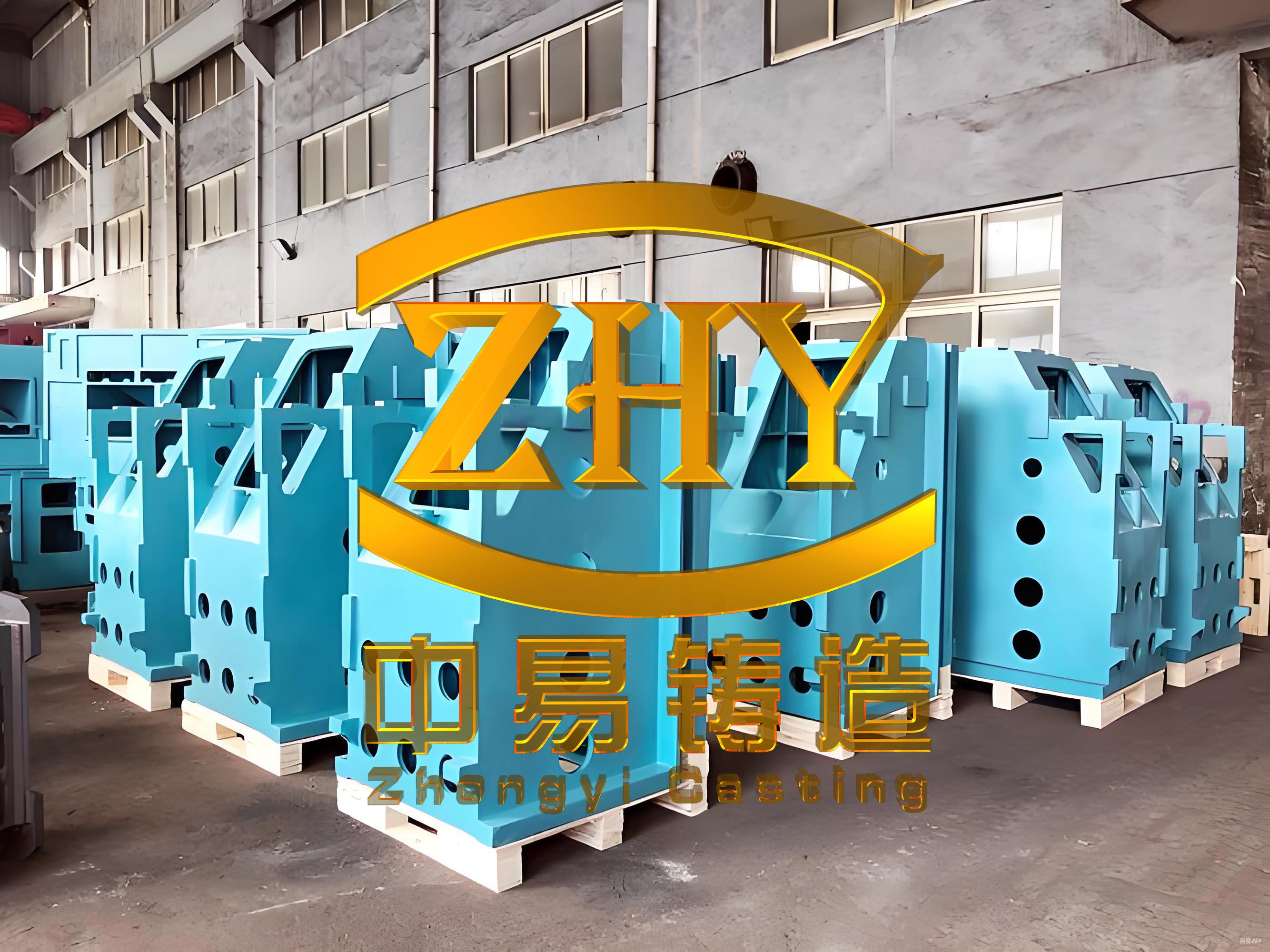
Cutting force management was critical to prevent vibrations and displacements. I implemented symmetric cutting for the菱形搭子面 milling, where two milling heads rotate oppositely to cancel out X-direction forces. For the “($) mm hole boring, a two-stage approach—roughing and finishing—was used with reduced cutting parameters. The roughing phase utilized a double-edged boring tool symmetrically arranged to balance radial forces, while finishing employed a single-edged tool for precision. The boring tool was designed with adjustable features to compensate for wear, ensuring dimensional accuracy over time. The following table outlines cutting parameters for key operations:
| Operation | Tool Type | Cutting Speed (m/min) | Feed Rate (mm/rev) | Depth of Cut (mm) |
|---|---|---|---|---|
| Rough Boring | Double-edged | 60-80 | 0.1-0.2 | 1.5 |
| Finish Boring | Single-edged | 100-120 | 0.05-0.1 | 0.5 |
| Combined Expand-Ream | Composite tool | 20-30 | 0.15 | 0.8 |
Sequencing the operations was essential for efficiency and精度. I designed an L-shaped production line where the main work slide handles the primary machining, and a side slide manages auxiliary features. The timing diagram illustrates the sequence: the mobile station performs continuous milling of foot and搭子面, followed by the fixed station for boring and reaming. The side station concurrently processes small搭子面 and threaded holes. This coordinated approach reduces cycle time and maintains synchronization. The machining timeline $T_{total}$ can be expressed as:
$$T_{total} = T_{mobile} + T_{fixed} + T_{side}$$
where $T_{mobile}$ is the time for mobile station milling, $T_{fixed}$ for fixed station boring/reaming, and $T_{side}$ for side operations. Optimizing these intervals ensures high throughput for machine tool castings.
In conclusion, the combined machine tool design effectively addresses the challenges of large-scale thin-walled castings like the wall panel. By integrating mobile and fixed stations, employing composite tools, and implementing force-control strategies, the solution enhances positioning accuracy, reduces errors, and boosts productivity. The compact layout saves valuable floor space, making it ideal for high-volume production of precision machine tool castings. Future work could focus on adaptive control systems to further optimize cutting parameters in real-time, pushing the boundaries of machining efficiency for complex castings.