
In my extensive career specializing in foundry operations, I have dedicated significant effort to mastering the production of high-quality machine tool castings using vermicular graphite iron (VGI). This material, which occupies an intermediate position between ductile iron and gray iron, offers a unique combination of high elastic modulus, excellent wear resistance, and superior dimensional stability. These properties make it exceptionally suitable for critical components in machine tools, such as planer beds, saddles, beams, and levers, where precision and durability are paramount. Through numerous trials and applications, I have accumulated practical insights into optimizing the process parameters for VGI production under cupola furnace conditions. This article delves into the key aspects I have refined, including temperature control during vermicularization, the impact of sulfur content on mechanical properties, gating system design, and other critical factors that influence the quality of machine tool castings. I will share these experiences in detail, supported by empirical data, tables, and formulas, to provide a comprehensive guide for producing reliable vermicular graphite iron machine tool castings.
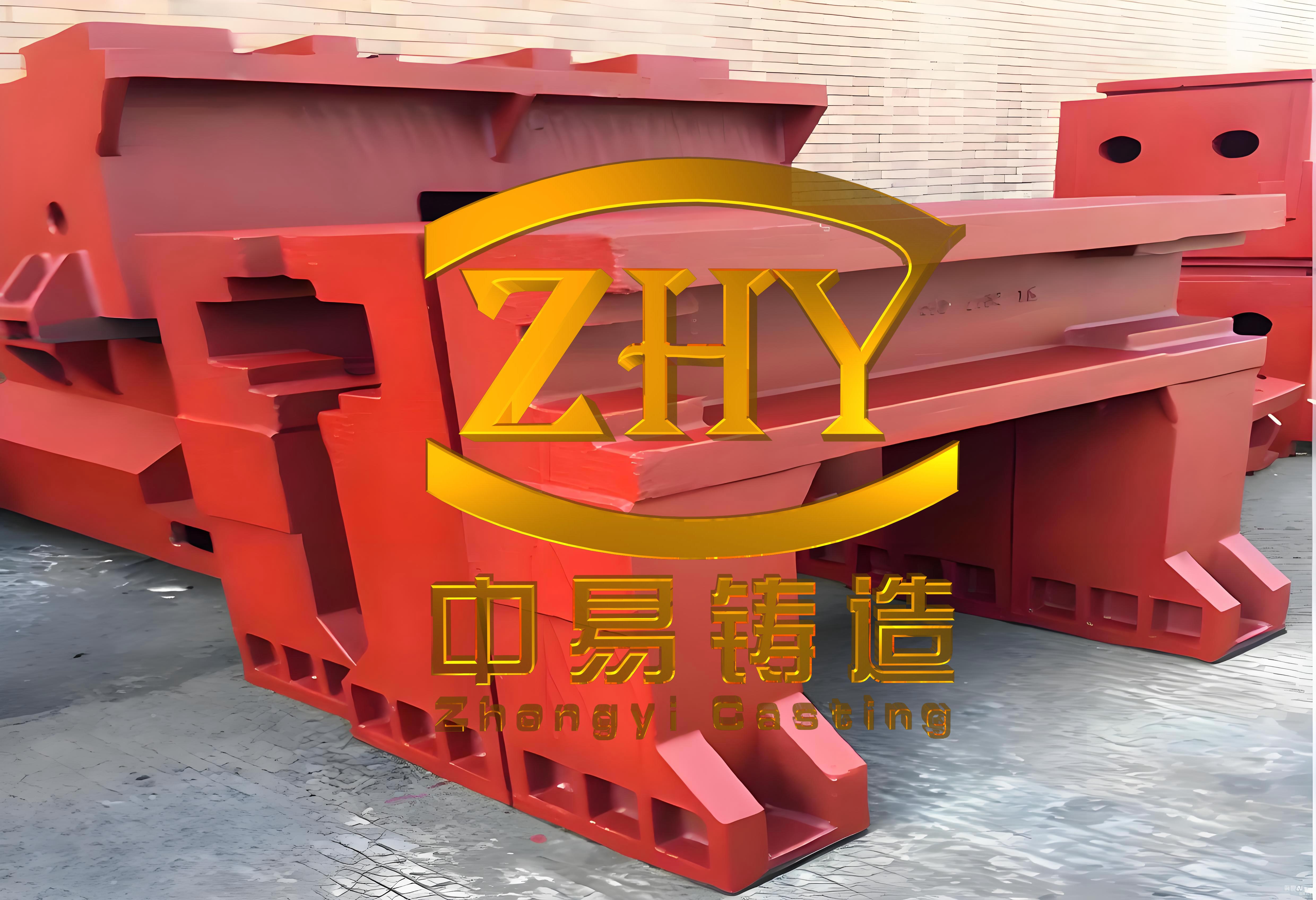
One of the most critical factors I have identified in producing vermicular graphite iron for machine tool castings is the precise control of the molten iron temperature during the vermicularization treatment. Based on my observations, deviations in temperature—whether too low or too high—can lead to significant defects in the final machine tool castings. When the temperature is too low, typically below 1400°C, the vermicularizing agent fails to melt completely, resulting in uneven distribution and localized segregation. This inconsistency often manifests as poor graphite formation, reduced strength, and increased scrap rates. Conversely, when the temperature exceeds 1480°C, excessive oxidation and burning loss of the alloying elements occur, leading to vermicularization failure or rapid衰退, which compromises the integrity of the machine tool castings. Through systematic experimentation, I have established an optimal temperature range of 1420°C to 1450°C, which consistently yields a vermicularization rate above 80% and ensures the desired mechanical properties for machine tool applications.
The relationship between treatment temperature and the quality of machine tool castings can be further elucidated through the following table, which summarizes my findings from multiple production batches:
| Temperature Range (°C) | Vermicularization Rate (%) | Tensile Strength (MPa) | Common Defects in Machine Tool Castings |
|---|---|---|---|
| <1400 | <50 | 300-350 | Incomplete vermicularization, chill zones |
| 1400-1420 | 60-75 | 350-400 | Moderate segregation, reduced durability |
| 1420-1450 | 400-500 | Minimal defects, optimal for machine tool castings | |
| 1450-1480 | 70-80 | 380-450 | Increased oxidation, potential衰退 |
| >1480 | <60 | 300-380 | Severe burning, poor surface quality |
Furthermore, the treatment temperature must be adjusted according to the amount of molten iron being processed, as this affects heat retention and reaction kinetics. For instance, when handling batches of 0.5 to 1 ton—common in medium-scale production of machine tool castings—I maintain the temperature within 1420-1450°C. For larger volumes exceeding 1 ton, the temperature can be slightly elevated to 1450-1480°C to account for greater thermal mass, while for smaller batches below 0.5 ton, I recommend a lower range of 1400-1430°C to prevent overheating. This tailored approach minimizes temperature-related inconsistencies and enhances the reproducibility of high-quality machine tool castings. The underlying principle can be expressed through a simplified heat transfer equation that I often use for estimation:
$$ Q = m \cdot c_p \cdot \Delta T $$
where \( Q \) represents the heat required (in Joules), \( m \) is the mass of the iron (in kg), \( c_p \) is the specific heat capacity of iron (approximately 0.45 kJ/kg·K), and \( \Delta T \) is the temperature change (in °C). By calculating the energy input needed for different batch sizes, I can optimize furnace settings to achieve the target temperature range for vermicularization, thereby ensuring consistent results in machine tool casting production.
Another pivotal aspect I have explored is the influence of sulfur content in the base iron on the mechanical properties of vermicular graphite iron machine tool castings. Sulfur acts as a potent anti-vermicularizing element, interfering with graphite nucleation and growth by forming sulfides that consume the vermicularizing agent. In my experience, high sulfur levels—typically above 0.06%—necessitate increased additions of vermicularizing agents, which in turn lower the molten iron temperature and exacerbate issues like chill formation, shrinkage porosity, and inclusion defects. These deficiencies are particularly detrimental to machine tool castings, where structural integrity and wear resistance are critical. To mitigate this, I strive to keep the sulfur content below 0.03% through careful selection of raw materials and, where feasible, preliminary desulfurization treatments. However, in cupola furnace operations without dedicated desulfurization, achieving such low levels is challenging, and sulfur often ranges between 0.04% and 0.08%. In these cases, I adjust the vermicularizing agent dosage dynamically based on real-time sulfur analysis.
The correlation between sulfur content and the performance of machine tool castings is quantified in the table below, derived from my experimental data:
| Sulfur Content (%) | Vermicularizing Agent Dosage (kg/ton) | Tensile Strength (MPa) | Elongation (%) | Impact on Machine Tool Castings |
|---|---|---|---|---|
| 0.02-0.03 | 1.0-1.5 | 480-520 | 4-6 | Excellent vermicularization, high durability |
| 0.04-0.06 | 1.5-2.0 | 420-470 | 3-5 | Good properties, suitable for most machine tool castings |
| 0.07-0.08 | 2.0-2.5 | 380-430 | 2-4 | Moderate defects, requires careful control |
| >0.08 | >2.5 | 350-400 | 1-3 | Poor vermicularization, high scrap rates |
To formalize the relationship between sulfur content and vermicularizing agent requirements, I often employ a linear approximation formula that has proven effective in my practice:
$$ W_a = k \cdot S_i + b $$
where \( W_a \) is the weight of the vermicularizing agent in kg per ton of iron, \( S_i \) is the initial sulfur content in %, \( k \) is a proportionality constant (typically between 20 and 30 for common agents), and \( b \) is a base addition factor (around 0.5 to 1.0 kg/ton). This equation helps in preemptively determining the agent dosage to achieve consistent vermicularization in machine tool castings, reducing the reliance on trial-and-error methods.
In addition to temperature and sulfur management, the design of the gating system is a crucial element that I have optimized to enhance the quality of machine tool castings. Initially, I encountered issues such as cold shuts, slag inclusions, and shrinkage defects when using gating systems designed for gray iron castings. These problems were especially prevalent in complex components like planer beds and beams, where the high fluidity requirements of VGI demand precise control. Through iterative redesigns, I adopted a semi-open gating system characterized by an extended runner and multiple ingates. This configuration promotes the flotation of slag inclusions and reduces temperature gradients within the mold, which is vital for achieving uniform solidification in machine tool castings. Specifically, I increased the total cross-sectional area of the ingates by 20-30% compared to conventional designs, which shortened the pouring time and minimized thermal stresses.
The effectiveness of this modified gating system is evident in the reduction of defect rates. For example, in the production of planer bed castings, the scrap rate decreased from over 15% to approximately 5%, with no instances of shrinkage porosity even after increasing the riser size by 10%. The pouring time \( t \) can be estimated using the following fluid dynamics formula, which I use to validate gating designs for machine tool castings:
$$ t = \frac{V}{A \cdot v} $$
where \( V \) is the volume of the casting (in m³), \( A \) is the total cross-sectional area of the ingates (in m²), and \( v \) is the flow velocity (in m/s), typically maintained between 0.5 and 1.0 m/s for VGI to avoid turbulence. By optimizing these parameters, I ensure that the molten iron fills the mold efficiently, reducing the likelihood of defects in critical machine tool castings. The table below illustrates a comparison between the original and improved gating systems based on my applications:
| Gating System Type | Pouring Time (s) | Slag Inclusion Rate (%) | Scrap Rate for Machine Tool Castings (%) | Remarks |
|---|---|---|---|---|
| Original (closed) | 30-40 | 8-12 | 15-20 | Frequent cold shuts and shrinkage |
| Improved (semi-open) | 20-25 | 2-4 | 4-6 | Uniform filling, minimal defects |
Beyond these primary factors, I have also focused on ancillary aspects such as inoculation practices, cooling rate control, and compositional adjustments to further refine the production of vermicular graphite iron machine tool castings. Inoculation with ferrosilicon-based compounds, for instance, enhances graphite nucleation and reduces the chilling tendency, which is especially important for thin-sectioned machine tool castings. I typically add inoculants at a rate of 0.2-0.4% of the iron weight during tapping, and I monitor the cooling curves to ensure that the solidification pattern aligns with the desired vermicular graphite structure. The cooling rate \( R \) can be described by the following empirical equation that I use for analysis:
$$ R = \frac{T_p – T_s}{t_s} $$
where \( T_p \) is the pouring temperature (°C), \( T_s \) is the solidus temperature (approximately 1150°C for VGI), and \( t_s \) is the solidification time (in seconds). By maintaining \( R \) within 0.5-1.0°C/s through mold design and chilling techniques, I achieve a fine, uniform graphite distribution that enhances the mechanical properties of machine tool castings.
Moreover, regular chemical analysis and microstructure examination are integral to my quality assurance process. The typical composition range I target for vermicular graphite iron in machine tool castings is summarized in the table below:
| Element | Target Range (%) | Influence on Machine Tool Castings |
|---|---|---|
| Carbon (C) | 3.4-3.8 | Promotes graphite formation, improves machinability |
| Silicon (Si) | 2.1-2.6 | Enhances fluidity and inoculating effect |
| Manganese (Mn) | 0.4-0.7 | Counteracts sulfur effects, increases strength |
| Phosphorus (P) | <0.05 | Minimizes brittleness in machine tool castings |
| Sulfur (S) | <0.06 | Critical for vermicularization control |
| Magnesium (Mg) | 0.015-0.035 | Residual vermicularizing element, key to graphite shape |
To quantify the mechanical performance, I frequently conduct tensile tests and hardness measurements on produced machine tool castings. The data consistently show that vermicular graphite iron offers a balanced combination of strength and ductility, with tensile strengths ranging from 400 to 500 MPa and hardness values between 180 and 220 HB. These properties are essential for withstanding the dynamic loads and abrasive conditions encountered in machine tool applications. The relationship between graphite morphology and mechanical properties can be expressed using a simplified model that I developed based on microstructure analysis:
$$ \sigma_t = \sigma_0 + k_g \cdot (1 – V_v) $$
where \( \sigma_t \) is the tensile strength (in MPa), \( \sigma_0 \) is the base strength of the iron matrix (around 300 MPa), \( k_g \) is a graphite-related constant (approximately 200 MPa for VGI), and \( V_v \) is the volume fraction of vermicular graphite (aiming for >80% in optimal machine tool castings). This model helps in predicting the performance variations and guiding process adjustments.
In terms of economic and operational efficiency, I have observed that optimizing these parameters not only improves the quality of machine tool castings but also reduces production costs by minimizing scrap and rework. For instance, by controlling the vermicularization temperature and sulfur content, I have achieved a consistent yield of over 90% for acceptable castings, compared to initial rates of 70-80%. Additionally, the enhanced gating system has lowered energy consumption by reducing pouring times and improving metal yield. The overall cost savings can be estimated using a basic cost-benefit analysis formula that I apply periodically:
$$ C_s = (R_i – R_f) \cdot U_c + E_r \cdot t_p $$
where \( C_s \) is the total cost saving per batch, \( R_i \) and \( R_f \) are the initial and final scrap rates, respectively, \( U_c \) is the unit cost per casting, \( E_r \) is the energy rate per second of pouring, and \( t_p \) is the pouring time saved. This approach underscores the tangible benefits of refining the production process for machine tool castings.
Looking broadly, the production of vermicular graphite iron for machine tool castings involves a delicate balance of multiple variables, and my experiences highlight the importance of a systematic, data-driven approach. While the parameters I have shared—such as treatment temperatures of 1420-1450°C, sulfur contents below 0.06%, and optimized gating designs—have proven effective in my context, they are most applicable to conditions where base iron sulfur ranges from 0.04% to 0.08% and temperature fluctuations are within ±10°C. Continuous monitoring and adaptation to specific furnace characteristics are indispensable for achieving consistent results. The journey of perfecting these machine tool castings has reinforced my belief in the value of vermicular graphite iron as a superior material, and I am confident that these insights will aid others in advancing their own foundry practices for high-performance machine tool applications.