
In recent years, the adoption of 3D printing technology in the foundry industry has revolutionized the production of machine tool castings, particularly for large-scale components like worktables. As a foundry engineer specializing in machine tool castings, I have witnessed firsthand how this innovative approach addresses the limitations of traditional wood pattern methods, such as high costs for single-piece production, dimensional inaccuracies, and susceptibility to environmental factors like temperature and humidity. This article delves into our comprehensive application of 3D printed sand molds for manufacturing machine tool worktable castings, emphasizing the integration of advanced design, process optimization, and defect prevention strategies to achieve high-quality, cost-effective outcomes. By leveraging 3D printing, we have streamlined the production of machine tool castings, enabling faster development cycles, improved precision, and enhanced sustainability in the manufacturing of machine tool castings.
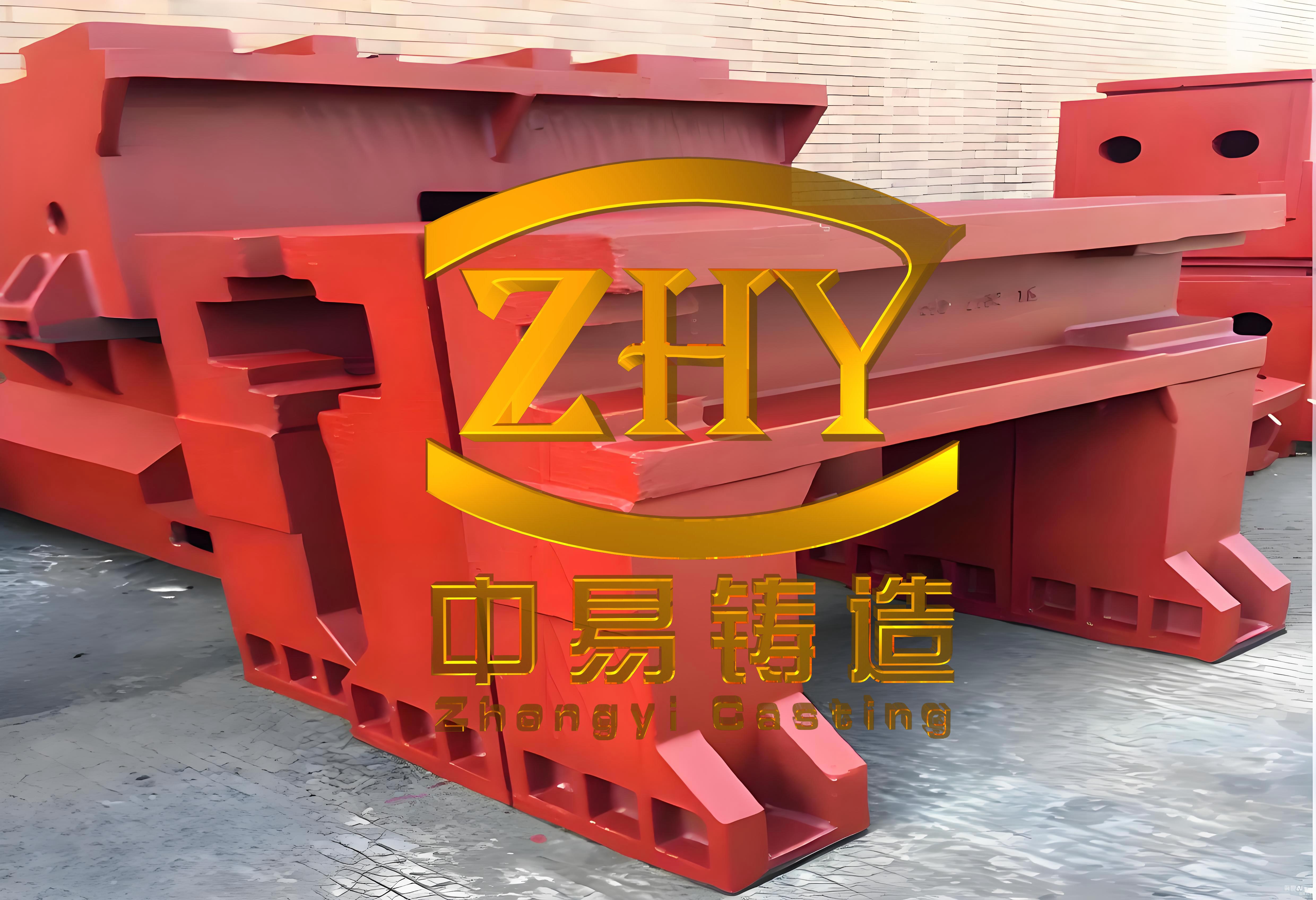
The machine tool casting in focus is a worktable for a vertical machining center, with post-machining dimensions of 2000 mm × 900 mm × 190 mm and a weight of 1.4 tons. Made from HT300 gray iron, this machine tool casting serves as a critical component for securing workpieces and managing chips during machining operations. Its exposed surface and T-slots demand impeccable quality, with no defects allowed on the tabletop or within the slots, and welding repairs are strictly prohibited. Traditional methods often struggle with such requirements, but 3D printing offers a viable alternative. The structural simplicity of this machine tool casting allows for full-scale sand mold printing, which we optimized using our in-house 3D printing equipment capable of handling molds up to 2500 mm × 1500 mm × 1000 mm. This approach not only reduces lead times but also enhances the dimensional stability of machine tool castings, as it eliminates cumulative errors from manual core assembly.
In designing the casting process for this machine tool casting, we prioritized the gating system and tooling to ensure efficient metal flow and solidification. The gating system was configured as a semi-open, semi-closed design, with iron alloy introduced along one long edge and a pressurized riser placed on the opposite edge to facilitate feeding and reduce shrinkage defects. To prevent material loss during riser removal, we extended an 8 mm thick, 30 mm long wall from the worktable, which was later ground off. The total pouring time was controlled within 25 seconds to ensure rapid filling of the large surface area, minimizing the risk of cold shuts or misruns. The cross-sectional area ratios of the gating system were set as follows: ΣSsprue : ΣSrunner : ΣSingate = 1 : 1.6 : 0.8. This ratio can be expressed mathematically as: $$ \frac{\Sigma S_{\text{sprue}}}{\Sigma S_{\text{runner}}} = 0.625 \quad \text{and} \quad \frac{\Sigma S_{\text{ingate}}}{\Sigma S_{\text{sprue}}} = 0.8 $$ These proportions help maintain a balanced flow rate, reducing turbulence and oxidation in the molten metal, which is critical for high-integrity machine tool castings.
Tooling design played a pivotal role in addressing the thick sections of the T-slots, which are prone to shrinkage porosity due to prolonged solidification. Instead of traditional isolated chill placements, we developed an integrated tooling plate that functions as a large-scale chill. This plate measures 6000 mm × 2500 mm × 300 mm, with a 100 mm thick upper surface and a 10 mm recessed area within a 200 mm periphery for sand isolation. The plate features nine T-slots and 17 dovetail slots arranged in a grid pattern to enhance sand adhesion and heat dissipation. The effectiveness of this design in accelerating cooling can be approximated using Fourier’s law of heat conduction: $$ q = -k \nabla T $$ where \( q \) is the heat flux, \( k \) is the thermal conductivity of the mold material, and \( \nabla T \) is the temperature gradient. By increasing the surface area for heat transfer through the slots, we reduce the solidification time in critical zones, thereby minimizing shrinkage defects in machine tool castings. This innovative tooling not only improves productivity but also conserves resin sand by eliminating the need for additional height in the bottom mold box.
| Parameter | Value |
|---|---|
| Mesh Size (mesh) | 70–140 |
| Water Content (%) | ≤ 0.1 |
| Clay Content (%) | ≤ 0.2 |
| Loss on Ignition (%) | < 0.2 |
| Bulk Density (g/cm³) | ≥ 1.35 |
| SiO2 Content (%) | ≥ 95 |
The sand molds for these machine tool castings were printed using silica sand with the parameters summarized in Table 1. We maintained a resin content of 2.1% by weight, achieving a 24-hour tensile strength of 2.5–3.0 MPa to withstand the metallostatic pressure during pouring. The mold walls were designed with a thickness of 120 mm on the sides and 80 mm on the top to ensure structural integrity. After printing, the molds were coated with a water-based coating applied via flow coating in two layers, followed by drying to reduce moisture content to ≤ 0.3%. This step is crucial for preventing gas-related defects in machine tool castings, as residual moisture can lead to hydrogen and nitrogen porosity. The coating process enhances surface finish and reduces metal penetration, contributing to the overall quality of the machine tool casting.
Mold assembly, or “box fitting,” was optimized for efficiency, taking approximately 20 minutes per mold. After coating and drying, a layer of sand was spread over the tooling plate within the recessed area, and the printed sand mold was positioned and secured with clamping plates. The periphery was then filled with resin sand to complete the assembly. This streamlined process highlights the advantages of 3D printing in reducing labor intensity and human error, aligning with the principles of intelligent and green manufacturing for machine tool castings. The rapid assembly not only cuts costs but also ensures consistent quality across production batches.
Melting and pouring operations were tailored to the requirements of HT300 gray iron for machine tool castings. We employed a short-process method combining medium-frequency induction furnace melting with 15% blast furnace iron, 70% scrap steel, and the remainder as returns of the same grade. Pre-treatment of the blast furnace iron in an intermediate ladle was conducted to enhance purity and consistency. The chemical composition was carefully controlled, as detailed in Table 2, to achieve the desired mechanical properties and minimize defects. Carbon and silicon levels were adjusted using carburizers and silicon carbide, with melting temperatures held between 1510°C and 1540°C to ensure proper dissolution and homogeneity.
| Element | Content Range |
|---|---|
| C | 3.0–3.1 |
| Si | 2.3–2.4 |
| Mn | 0.7–0.8 |
| S | 0.06–0.08 |
| P | ≤ 0.06 |
| Cr | 0.2–0.3 |
| Sn | 0.06–0.08 |
Inoculation was performed in three stages to refine the graphite structure and enhance the strength of the machine tool castings. Pre-inoculation involved adding 0.1% silicon carbide two minutes before tapping to promote nucleation. During tapping, 0.3% barium-calcium-silicon inoculant was used for its long-lasting effects, followed by a final stream inoculation with 0.1% sulfur-oxygen inoculant (0.2–0.7 mm grain size) to further modify the eutectic cells. The pouring temperature was maintained at 1360–1380°C to balance fluidity and solidification characteristics. The solidification process can be modeled using Chvorinov’s rule: $$ t = B \left( \frac{V}{A} \right)^n $$ where \( t \) is the solidification time, \( V \) is the volume, \( A \) is the surface area, \( B \) is a mold constant, and \( n \) is an exponent typically around 2 for sand castings. By optimizing these parameters, we ensure that the machine tool casting solidifies uniformly, reducing internal stresses and defects.
Defect prevention is a critical aspect of producing high-quality machine tool castings. Two common issues we addressed are shrinkage porosity in the T-slot bases and subsurface pinholes on the tabletop and slider mounting surfaces. Shrinkage porosity in T-slots arises from thermal hotspots due to the 60 mm wall thickness, which prolongs solidification. To mitigate this, we employed insulated chills in the tooling and adjusted the carbon equivalent to leverage graphite expansion during the late stages of solidification. The carbon equivalent (CE) can be calculated as: $$ \text{CE} = \%C + \frac{\%Si + \%P}{3} $$ For our machine tool castings, CE values around 3.8–4.0 were maintained to enhance feeding through volumetric expansion, effectively countering shrinkage.
Gas porosity, often manifested as pinholes after machining, is primarily caused by nitrogen segregation and moisture in the molds. Nitrogen, introduced through charge materials, can form bubbles in slow-solidifying sections, while residual moisture reacts with molten iron to produce hydrogen. Preventive measures included rigorous control of charge materials to limit nitrogen content, using only shot-blasted returns, and ensuring mold dryness (≤ 0.3% moisture). Additionally, the use of sulfur-oxygen inoculant helps neutralize nitrogen by forming stable compounds. The relationship between gas solubility and temperature can be described by Sieverts’ law: $$ [G] = k \sqrt{P_G} $$ where \( [G] \) is the gas concentration in the melt, \( k \) is a temperature-dependent constant, and \( P_G \) is the partial pressure of the gas. By managing these factors, we significantly reduced gas defects in our machine tool castings.
To date, we have successfully produced 56 units of this worktable machine tool casting using the described 3D printing approach, with a 100% qualification rate. The machined surfaces, including the T-slots and slider mounts, are free of defects, demonstrating the reliability of this method. The integration of 3D printing not only improves the surface quality and dimensional accuracy of machine tool castings but also aligns with sustainable practices by reducing waste and energy consumption. As the demand for customized machine tool castings grows, the flexibility and efficiency of 3D printing will continue to drive innovation in the foundry sector, solidifying its role in the future of manufacturing high-performance machine tool castings.
In conclusion, the application of 3D printed sand molds has transformed the production of machine tool castings, offering unparalleled advantages in design flexibility, cost savings, and environmental impact. Our experience confirms that this technology is well-suited for complex and large-scale machine tool castings, enabling rapid prototyping and mass production with consistent results. Future work will focus on further optimizing process parameters and expanding the range of alloys used for machine tool castings, ensuring that we remain at the forefront of foundry innovation.