
In the manufacturing of high-precision machine tool castings, the control of graphite morphology is paramount to achieving superior mechanical properties, dimensional stability, and longevity. Graphite morphology directly influences the uniformity of microstructure, stress distribution, and performance under operational conditions. Specifically, the presence of Type A graphite, characterized by its uniform, non-directional distribution, is critical for enhancing the strength, stiffness, and hardness homogeneity of machine tool castings. This research focuses on optimizing melting, inoculation, and compositional parameters to promote Type A graphite formation, thereby addressing common defects such as shrinkage porosity, cracking, and residual stress in complex machine tool castings.
Traditional production methods for machine tool castings often involve reducing carbon equivalent (CE) to increase austenite content and improve strength. However, this approach leads to poor fluidity of molten iron, necessitating higher pouring temperatures. Consequently, thick sections like guide rails are prone to shrinkage defects, while thin walls develop undesirable Type D and E graphite, increasing section sensitivity. Moreover, low CE results in elevated casting stresses and deformation, compromising precision and stability. For instance, in a turning bed machine tool casting with a weight of 2,500 kg and complex internal structures, traditional low-CE practices caused fixed-position cracking due to directional graphite and stress concentration.
To overcome these challenges, a comprehensive optimization strategy was implemented, focusing on charge ratio adjustments, chemical composition control, and advanced inoculation techniques. The primary goal was to increase the proportion of Type A graphite while maintaining high strength and low stress in machine tool castings. Key modifications included eliminating pig iron from the charge, increasing scrap steel proportion, and incorporating pre-treatment and multi-stage inoculation processes. This article details the experimental procedures, results, and analytical discussions, supported by tables and mathematical formulations to elucidate the relationships between process parameters and graphite morphology in machine tool castings.
Charge Ratio and Chemical Composition Optimization
The initial step in improving graphite morphology involved revising the charge ratio to minimize the hereditary effects of coarse graphite from pig iron. By completely removing pig iron and increasing the scrap steel proportion from 50% to 70%, combined with carbon-enhancing practices, the nucleation sites for graphite were refined. This adjustment promoted finer graphite distribution and improved the overall microstructure of machine tool castings. The chemical composition was simultaneously optimized by raising the carbon equivalent (CE) above 3.70%, calculated using the standard formula for gray cast iron:
$$ CE = C + \frac{Si}{3} $$
where C and Si represent the weight percentages of carbon and silicon, respectively. Higher CE enhances fluidity, reduces shrinkage defects, and encourages Type A graphite formation in thin sections, thereby lowering section sensitivity. However, to counteract potential strength reduction from increased CE, alloying elements such as Copper (Cu), Chromium (Cr), and Tin (Sn) were incorporated. These elements strengthen the matrix by promoting pearlite formation and refining grain boundaries, ensuring that the machine tool castings meet stringent hardness and tensile requirements. The optimized charge ratio and chemical composition controls are summarized in Table 1.
| Component | Proportion (wt%) | Element | Control Range (wt%) |
|---|---|---|---|
| Scrap Steel | 70 | C | 3.10–3.20 |
| Return Material | 30 | Si | 1.70–1.90 |
| Pre-treatment Agent | 0.2 | Mn | 1.00–1.20 |
| – | – | P | ≤ 0.10 |
| – | – | S | 0.08–0.10 |
| – | – | Cu | 0.50–0.70 |
| – | – | Cr | 0.20–0.25 |
| – | – | Sn | 0.03–0.05 |
The increase in CE from 3.55% to approximately 3.78% significantly improved graphite morphology, as evidenced by metallographic analysis. However, preliminary trials indicated a slight decrease in hardness due to reduced austenite dendrites, necessitating the addition of alloys. The relationship between CE and tensile strength (σ_t) can be expressed empirically for machine tool castings:
$$ \sigma_t = k_1 \cdot CE + k_2 \cdot \sum Alloy – k_3 \cdot E_{graphite} $$
where k1, k2, k3 are material constants, ΣAlloy represents the cumulative effect of alloying elements, and E_graphite denotes the presence of non-Type A graphite. This formula highlights the trade-off between CE and strength, underscoring the importance of balanced composition design for high-performance machine tool castings.
Melting and Treatment Process Enhancements
Melting procedures were refined to include high-temperature superheating of the molten iron at 1,510–1,530°C for 5–8 minutes, followed by cooling with 2% scrap steel to improve purity and nucleation potential. This pre-treatment step is crucial for enhancing the effectiveness of subsequent inoculation in machine tool castings. Pre-treatment agents (0.2% by weight) were added during melting to increase graphite nucleation cores, reducing undercooling tendencies and promoting uniform Type A graphite formation. The process parameters for melting and treatment are outlined in Table 2.
| Process Stage | Temperature Range (°C) | Time (min) | Additives | Addition Rate (wt%) |
|---|---|---|---|---|
| Superheating | 1,510–1,530 | 5–8 | None | – |
| Cooling | 1,450–1,480 | 2–5 | Scrap Steel | 2.0 |
| Pre-treatment | 1,470–1,500 | 3–5 | Pre-treatment Agent | 0.2 |
Inoculation plays a pivotal role in graphite morphology control. Comparative studies evaluated three inoculants: 75SiFe, SiBaCa, and SiSrZr, using test blocks with dimensions of 500 mm × 120 mm × 70 mm. The blocks were produced under identical conditions, with inoculation performed during tapping and no secondary inoculation during pouring. The inoculation parameters and results are summarized in Table 3. SiSrZr inoculant demonstrated superior performance, producing fine Type A graphite with higher tensile strength and minimal graphite degeneration. The efficiency of inoculation (η_inoc) can be modeled as:
$$ \eta_{inoc} = \frac{A_g}{A_g + E_g} \cdot \frac{1}{t_d} $$
where A_g is the area fraction of Type A graphite, E_g is the area fraction of Type E graphite, and t_d is the time delay between inoculation and pouring. For machine tool castings, SiSrZr achieved η_inoc values above 0.95, indicating effective graphite control even with extended processing times.
| Inoculant Type | Addition (wt%) | Graphite Morphology | Tensile Strength (MPa) | Hardness (HBW) |
|---|---|---|---|---|
| 75SiFe | 0.7 | A + Minor E | 220 | 182 |
| SiBaCa | 0.5 | A | 217 | 185 |
| SiSrZr | 0.5 | A | 232 | 185 |
Based on these findings, the optimized inoculation protocol for machine tool castings involves primary inoculation with 0.3% SiSrZr (0.7–3 mm grain size) during tapping and secondary inoculation with 0.1% SiSrZr (0.2–0.7 mm grain size) during pouring. This two-stage approach mitigates inoculation fading and ensures consistent Type A graphite formation throughout the casting process.
Experimental Validation and Production Application
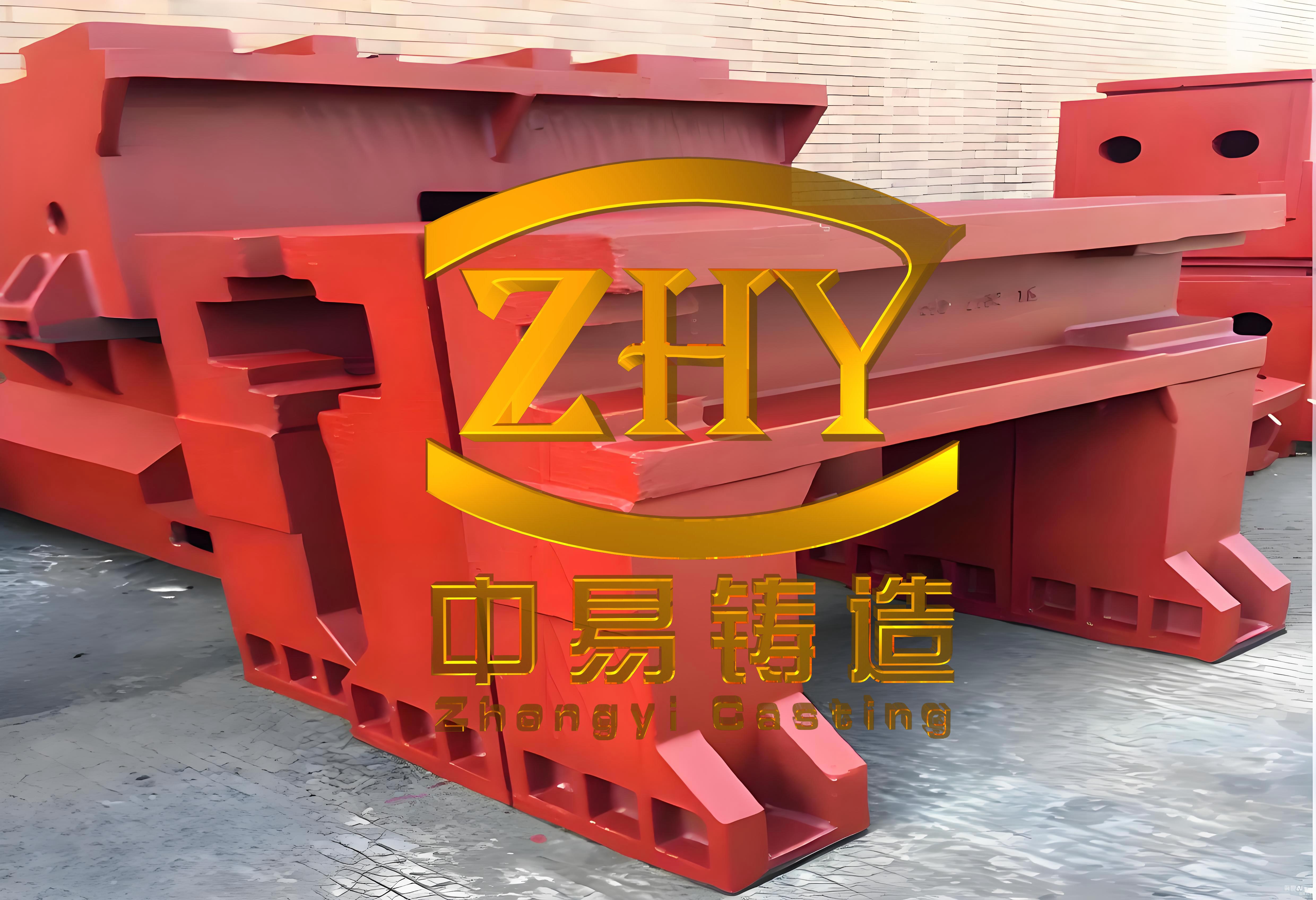
The optimized parameters were applied to the production of high-precision turning bed machine tool castings, with a focus on gating design, chemical control, and residual stress management. The gating system was modified to feature multiple, dispersed ingates along the guide rail plane, preventing localized overheating and coarse microstructure. Chemical composition was tightly controlled as per Table 1, with CE maintained at 3.78% and alloying elements added to bolster strength. The inoculation process followed the details in Table 4, ensuring robust graphite morphology in the final machine tool castings.
| Inoculant Type | Grain Size (mm) | Addition Method | Addition (wt%) |
|---|---|---|---|
| Pre-treatment Agent | 0–10 | During Melting | 0.2 |
| SiSrZr (Primary) | 0.7–3 | Tapping Stream | 0.3 |
| SiSrZr (Secondary) | 0.2–0.7 | Pouring Stream | 0.1 |
Metallographic examination of the produced machine tool castings revealed predominantly Type A graphite with a length rating of 4 (according to GB/T 7216-2009), pearlite content of 98%, and minimal phosphide/carbide phases. Tensile strength reached 345 MPa, while hardness measurements across the guide rails showed values between 191 and 202 HBW, with uniformity within -4/+5 HBW. The hardness distribution across the casting is represented by the equation for hardness homogeneity (H_hom):
$$ H_{hom} = \frac{H_{max} – H_{min}}{H_{avg}} \times 100\% $$
where H_max, H_min, and H_avg are the maximum, minimum, and average hardness values, respectively. For the optimized machine tool castings, H_hom was calculated to be less than 3%, indicating exceptional consistency.
Residual stress analysis using blind-hole methods demonstrated a significant reduction in maximum principal stress from -101.97 MPa in traditional castings to -77.74 MPa in optimized castings—a 24% decrease. The stress state in machine tool castings can be described by the principal stress components σ1 and σ2, with the mean stress σ_m given by:
$$ \sigma_m = \frac{\sigma_1 + \sigma_2}{2} $$
The lower residual stresses in the optimized machine tool castings contribute to improved dimensional accuracy and reduced risk of distortion during machining and service.
Discussion on Graphite Morphology and Performance Relationships
The transition to Type A graphite in machine tool castings is fundamentally linked to the increased CE and effective inoculation. Higher CE reduces the cooling rate sensitivity, allowing for uniform graphite precipitation across varying section thicknesses. The role of inoculation with SiSrZr is critical, as strontium (Sr) and zirconium (Zr) act as potent nuclei for graphite formation, suppressing undercooling and directional growth. The kinetics of graphite formation can be modeled using the Avrami equation for phase transformation:
$$ X(t) = 1 – \exp(-k t^n) $$
where X(t) is the fraction of Type A graphite formed at time t, k is the rate constant influenced by inoculation, and n is the Avrami exponent dependent on nucleation sites. For machine tool castings under optimized conditions, n approaches 3, indicating three-dimensional growth of graphite flakes from abundant nuclei.
Furthermore, the addition of Cu, Cr, and Sn enhances hardenability and matrix strength without compromising graphite morphology. The combined effect of these elements on tensile strength (σ_t) can be quantified as:
$$ \sigma_t = \sigma_0 + \Delta \sigma_{CE} + \Delta \sigma_{alloy} $$
where σ0 is the base strength, Δσ_CE is the strength change due to CE adjustment, and Δσ_alloy is the strengthening from alloys. For machine tool castings, Δσ_alloy contributed approximately 30–40 MPa to the overall strength, compensating for the softening effect of higher CE.
The improvement in residual stress is attributed to the more uniform thermal contraction enabled by Type A graphite, which acts as stress relievers during solidification. The residual stress (σ_res) in machine tool castings correlates with the graphite aspect ratio (AR) and cooling rate (CR):
$$ \sigma_{res} \propto \frac{CR}{AR} $$
where AR is defined as the ratio of graphite length to width. Type A graphite typically exhibits AR values close to 1, promoting isotropic stress distribution and lower residual stresses in machine tool castings.
Conclusion
This research demonstrates that optimizing charge ratio, chemical composition, and inoculation processes effectively controls graphite morphology in high-precision machine tool castings. By eliminating pig iron, increasing scrap steel proportion, and raising carbon equivalent above 3.70%, Type A graphite formation is enhanced, leading to improved mechanical properties and reduced defects. The use of SiSrZr inoculant in a two-stage process ensures consistent graphite refinement, while alloying elements maintain strength and hardness. Experimental results confirm that the optimized machine tool castings exhibit Type A graphite, high tensile strength (345 MPa), excellent hardness uniformity (191–202 HBW), and significantly lower residual stress (24% reduction). These advancements support the production of reliable, high-performance machine tool castings for precision applications, with batch production validating the robustness of the methodology. Future work could explore dynamic solidification modeling to further refine process windows for complex machine tool castings.