
In my extensive research and practical experience with machine tool casting, I have found that expendable pattern casting (EPC) offers significant advantages for producing high-quality machine tool castings, especially for large and complex components like bed frames and worktables. The demand for advanced数控机床 has driven the need for efficient casting methods that reduce costs and shorten production cycles. This article delves into the critical aspects of EPC, focusing on coating formulations, material selection, process design, and practical applications to achieve superior machine tool castings. Throughout this discussion, I will emphasize the importance of optimizing each step to ensure the integrity and performance of machine tool castings in industrial settings.
The role of coatings in EPC cannot be overstated, as they are pivotal to the success of machine tool casting processes. Based on my experiments, coatings serve multiple functions: enhancing the strength and dimensional stability of foam patterns, acting as a barrier between molten metal and sand, and facilitating the removal of decomposition products. For instance, in machine tool castings, a well-formulated coating prevents defects like gas holes and sand penetration. The key components of an effective coating include refractory powders, carriers, binders, and additives. I have developed a proprietary coating blend that ensures excellent performance for large machine tool castings. Below is a table summarizing the typical composition I use:
| Component | Percentage Range | Function |
|---|---|---|
| Graphite Powder (Earthly) | 30% – 35% | Provides耐火度 and light density |
| Graphite Flake | 30% – 35% | Enhances thermal stability |
| Ethanol/Methanol Mixture | 30% – 35% | Serves as carrier for easy application |
| Polyvinyl Butyral (PVB) | 2.5% – 3.0% | Acts as organic binder for strength |
| Phenolic Resin | 1.0% – 1.5% | Improves high-temperature properties |
| Rosin and Additives | Trace amounts | Enhances surface activity and anti-foaming |
In my work, I have observed that the coating thickness should be controlled between 1.5 mm and 2.5 mm for alcohol-based coatings to balance permeability and durability. This is crucial for machine tool castings, where surface quality is paramount. The coating’s performance can be modeled using equations related to fluid dynamics and heat transfer. For example, the rate of gas evolution during decomposition can be approximated by:
$$ \frac{dG}{dt} = k \cdot A \cdot (T – T_0) $$
where \( G \) is the gas volume, \( t \) is time, \( k \) is a constant, \( A \) is the surface area, \( T \) is the metal temperature, and \( T_0 \) is the initial foam temperature. This equation helps in designing coatings that efficiently handle gas release in machine tool castings.
Material selection is another critical factor I have optimized for machine tool casting. For foam patterns, I prefer polystyrene foam boards with a density of 22 kg/m³, as they offer high rigidity and minimize deformation during handling. However, higher density foams can produce more smoke during vaporization, so I carefully control the process to avoid slag inclusions. Additionally, I use specialized tape to seal gaps and imperfections in the pattern, preventing coating infiltration and sand intrusion. For molding sand, resin sand with a grain size of 40-70 mesh is ideal, as it provides a strength exceeding 100 N/cm² when combined with 1.2% resin and 60% curing agent relative to the resin weight. This combination ensures dimensional accuracy for complex machine tool castings.
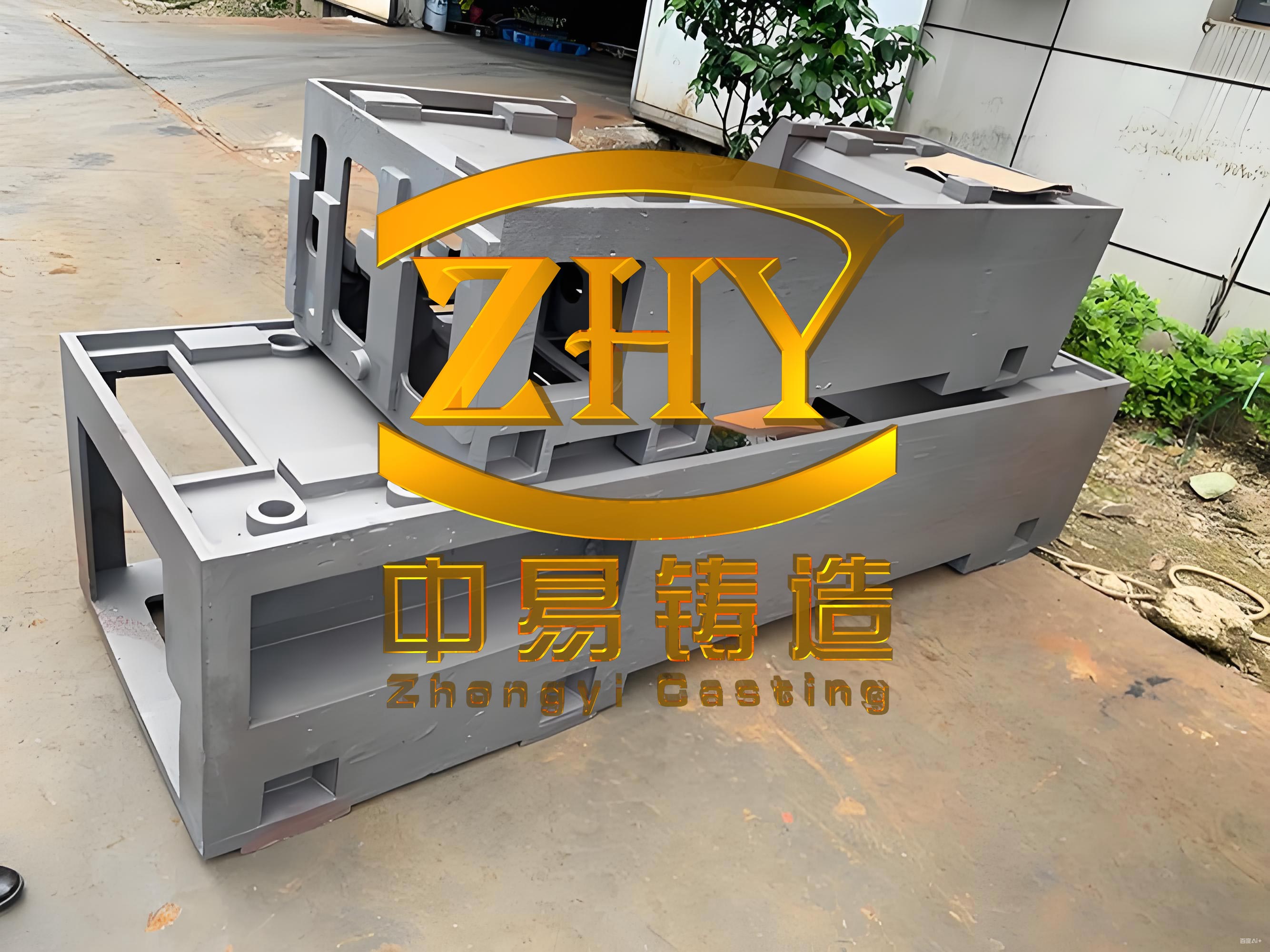
Casting process design for machine tool castings requires meticulous planning to prevent defects such as distortion and carbon deposition. In one of my projects involving a bed frame with dimensions 8100 mm × 2100 mm × 900 mm and a weight of 27.1 tons, I incorporated support frames and auxiliary molds to enhance stability. The use of an auxiliary mold, as illustrated in the image, simplifies internal support and reduces the risk of deformation. This approach is particularly beneficial for single-piece or small-batch production of machine tool castings, where traditional methods might be too time-consuming. The gating system design is amplified by 50% to 100% compared to conventional calculations to account for resistance from foam decomposition. I often employ a combination of shower-type and layered gates to ensure uniform metal flow and gas escape. For instance, the cross-sectional area of each ingate is set to 20 mm × 20 mm, and the gates are arranged to promote sequential filling, which helps in evacuating decomposition products and maintaining high temperature in critical areas like guide rails.
When it comes to feeding and riser design for machine tool castings, I opt for multiple small blind risers to improve feeding efficiency and trap residues. In my experience, risers with a diameter of 100 mm and height of 180 mm, connected by foam channels, effectively handle shrinkage and gas release. The riser neck diameter is typically 50 mm. This design minimizes slag entrapment and enhances the quality of machine tool castings. The solidification process can be analyzed using Chvorinov’s rule:
$$ t_s = k \cdot \left( \frac{V}{A} \right)^2 $$
where \( t_s \) is the solidification time, \( k \) is a constant dependent on the material, \( V \) is the volume, and \( A \) is the surface area. By applying this, I optimize riser placement to ensure sound machine tool castings without porosity.
Pattern making and molding techniques are hands-on aspects I have refined. I fabricate patterns from polystyrene foam boards using cutting and bonding methods, ensuring precise geometry for machine tool castings. After assembly, I apply multiple coats of alcohol-based coating and allow natural drying. For molding, I use a method involving auxiliary molds and ventilation channels—typically Ø12 mm rods spaced 200 mm apart—to facilitate gas evacuation. This step is vital for preventing gas-related defects in large machine tool castings. The entire process, from pattern creation to mold assembly, reduces lead times and costs compared to traditional wood pattern methods.
Melting and pouring operations are equally important for achieving high-quality machine tool castings. I utilize medium-frequency induction furnaces and holding furnaces to melt iron with a composition tailored for HT250 grade, commonly used in machine tool castings. The charge consists of 35% pig iron, 45% scrap steel, and 20% returns, with carbon additives adjusted based on real-time analysis. The superheating temperature is maintained at 1500–1510°C, and the chemical composition is fine-tuned at 1430–1450°C. Inoculation is performed with 0.4% ferrosilicon added during tapping and 0.2% for floating silicon treatment. The pouring temperature for machine tool castings is strictly controlled at 1380 ± 10°C to balance fluidity and defect minimization. The heat transfer during pouring can be described by:
$$ Q = m \cdot c_p \cdot \Delta T + m \cdot L_f $$
where \( Q \) is the heat required, \( m \) is the mass of metal, \( c_p \) is the specific heat, \( \Delta T \) is the temperature change, and \( L_f \) is the latent heat of fusion. This equation aids in determining energy needs for producing consistent machine tool castings.
Throughout my work, I have identified several best practices for machine tool casting: selecting coatings with good涂挂性 and permeability, properly supporting internal cavities to avoid distortion, and pre-placing core supports to prevent floating or sinking. Temperature control during pouring is non-negotiable for defect-free machine tool castings. The economic benefits are substantial—EPC reduces pattern costs and shortens production cycles, making it ideal for custom machine tool castings. In conclusion, the adoption of expendable pattern casting for machine tool castings is not only feasible but also highly advantageous, delivering reliable performance and cost savings for the manufacturing industry.
To further illustrate the process parameters, here is a table summarizing key metrics for machine tool casting production:
| Parameter | Value or Range | Remarks |
|---|---|---|
| Coating Thickness | 1.5 – 2.5 mm | For alcohol-based coatings |
| Foam Density | 22 kg/m³ | Polystyrene for patterns |
| Resin Sand Strength | >100 N/cm² | With 1.2% resin content |
| Pouring Temperature | 1380 ± 10°C | For HT250 machine tool castings |
| Riser Diameter | 100 mm | With 180 mm height |
| Ingate Cross-Section | 20 mm × 20 mm | Per individual gate |
In summary, my first-hand experience confirms that expendable pattern casting is a transformative approach for machine tool castings, enabling the production of large, intricate components with enhanced efficiency. By integrating advanced coatings, robust materials, and precise工艺设计, manufacturers can achieve superior results in machine tool casting applications. The repeated emphasis on machine tool casting throughout this article underscores its significance in modern industrial practices, and I am confident that these insights will contribute to further innovations in the field.