
In the machine tool industry, cast iron remains a dominant structural material, accounting for approximately 70% of the total weight of machine tool products. Modern machine tools are evolving towards higher load capacity, efficiency, and precision, demanding cast iron materials with superior strength, stiffness, and dimensional stability. However, machine tool castings often exhibit significant challenges due to large variations in wall thickness, uneven hardness, high section sensitivity, and substantial internal stresses. These factors lead to deformation after machining and poor dimensional stability, necessitating one or multiple artificial aging treatments to mitigate distortions. This increases production costs and reduces efficiency. HT300 is a primary material for machine tool beds, and optimizing its composition to enhance strength and reduce residual stresses is crucial for producing high-performance machine tool castings.
This study investigates the casting process for HT300 high-strength, low-stress machine tool castings. We examine the effects of chemical composition, particularly the silicon-to-carbon ratio (Si/C) and alloying elements, on mechanical properties, metallurgical structure, section sensitivity, residual stress, and chilling tendency. Through systematic experimentation and production validation, we aim to identify optimal parameters for achieving stable, high-quality machine tool castings.
Experimental Materials and Methods
The experimental materials included gray cast iron test bars, stress frames, and triangular test blocks with varying compositions. The chemical composition range was selected as follows: ω(C) 2.85%–3.25%, ω(Si) 1.50%–2.60%, ω(Mn) 0.80%–1.00%, ω(P) 0.040%–0.070%, ω(S) ≤ 0.100%, with some groups alloyed with chromium (Cr). Test bars with diameters of ϕ30 mm, ϕ50 mm, ϕ90 mm, and ϕ120 mm were produced. A total of 18 different chemical compositions were prepared, each used to cast the four sizes of test bars and stress frames. Additionally, triangular test blocks were cast for specific groups to assess white iron formation.
Melting was conducted using a 6,000 kg medium-frequency induction furnace. The chemical compositions of all groups met the experimental requirements, as summarized in Table 1.
| Group No. | C | Si | Mn | P | S | Cr |
|---|---|---|---|---|---|---|
| 1 | 2.90 | 1.60 | 0.95 | 0.042 | 0.092 | – |
| 2 | 2.88 | 1.98 | 0.91 | 0.055 | 0.084 | – |
| 3 | 2.92 | 2.10 | 0.92 | 0.054 | 0.100 | 0.35 |
| 4 | 2.92 | 2.20 | 1.00 | 0.050 | 0.100 | – |
| 5 | 2.95 | 2.12 | 0.80 | 0.054 | 0.082 | – |
| 6 | 2.94 | 2.61 | 0.87 | 0.043 | 0.092 | – |
| 7 | 3.02 | 1.61 | 0.80 | 0.043 | 0.064 | – |
| 8 | 2.98 | 2.03 | 0.96 | 0.052 | 0.100 | – |
| 9 | 2.98 | 2.03 | 0.99 | 0.050 | 0.098 | 0.3 |
| 10 | 2.98 | 2.35 | 0.88 | 0.059 | 0.100 | – |
| 11 | 3.20 | 1.55 | 0.98 | 0.049 | 0.098 | – |
| 12 | 3.20 | 1.55 | 0.99 | 0.052 | 0.096 | 0.3 |
| 13 | 3.15 | 1.60 | 0.96 | 0.056 | 0.086 | – |
| 14 | 3.23 | 1.55 | 0.97 | 0.062 | 0.095 | – |
| 15 | 3.15 | 1.59 | 1.00 | 0.060 | 0.096 | 0.3 |
| 16 | 3.14 | 2.00 | 0.80 | 0.042 | 0.094 | – |
| 17 | 3.22 | 2.16 | 0.85 | 0.048 | 0.074 | – |
| 18 | 3.16 | 2.55 | 0.99 | 0.056 | 0.095 | – |
All specimens were molded using resin sand, with each group’s samples poured from the same ladle of molten iron. Inoculation was performed using SiFe75 inoculant at 0.6%–0.7% by weight, added via the pouring stream method. The tapping temperature exceeded 1430°C, and the pouring temperature ranged from 1350°C to 1380°C.
Experimental Plan and Specimen Dimensions
The experimental plan focused on evaluating the impact of Si/C ratio and alloying on material properties and microstructure. Key aspects included:
- Casting 18 composition groups into four sizes of test bars and stress frames.
- Testing tensile strength and hardness for each size of test bar.
- Examining metallographic structure of ϕ30 mm test bars.
- Measuring residual stress via stress frame deformation before and after cutting.
- Assessing white iron tendency using triangular test blocks for selected groups.
The tensile test specimens were machined according to standardized dimensions, as illustrated in Figure 1. A WEW-300D hydraulic universal testing machine was used for tensile tests, and a HB-3000 Brinell hardness tester measured hardness. Metallographic analysis was conducted using a J-E68S optical microscope.
Stress frames, with dimensions shown in Figure 3, were used to measure residual stress. Points A and B were marked, and the distance L1 was measured before cutting. After cutting, the distance L2 was measured, and the elongation percentage was calculated as (L2 – L1)/L1 × 100%. A lower elongation indicates lower residual stress.
Triangular test blocks, with dimensions in Figure 4, were employed to evaluate white iron formation. The width of the white iron zone was measured after solidification.
Results and Analysis
Mechanical Properties
The mechanical properties of the 18 composition groups were tested for the four sizes of test bars. Brinell hardness and tensile strength decreased with increasing specimen diameter. The differences between the smallest and largest diameters (ΔHBW and ΔRm) indicate section sensitivity. Key results are summarized in Table 2.
| Group No. | CE (%) | Si/C | Cr (%) | Brinell Hardness (HBW) | ΔHBW | Tensile Strength (MPa) | ΔRm | ||||||
|---|---|---|---|---|---|---|---|---|---|---|---|---|---|
| ϕ30 | ϕ50 | ϕ90 | ϕ120 | ϕ30 | ϕ50 | ϕ90 | ϕ120 | ||||||
| 1 | 3.43 | 0.55 | – | 233 | 217 | 192 | 181 | 52 | 348 | 328 | 285 | 245 | 103 |
| 2 | 3.54 | 0.69 | – | 237 | 219 | 201 | 190 | 47 | 365 | 345 | 319 | 268 | 97 |
| 3 | 3.62 | 0.72 | 0.35 | 235 | 230 | 225 | 220 | 15 | 352 | 342 | 304 | 285 | 67 |
| 4 | 3.65 | 0.75 | – | 238 | 218 | 201 | 193 | 45 | 355 | 325 | 298 | 262 | 93 |
| 5 | 3.66 | 0.72 | – | 219 | 206 | 191 | 180 | 39 | 315 | 282 | 245 | 221 | 94 |
| 6 | 3.81 | 0.89 | – | 227 | 212 | 195 | 179 | 48 | 320 | 289 | 262 | 235 | 85 |
| 7 | 3.56 | 0.53 | – | 217 | 208 | 185 | 158 | 59 | 300 | 275 | 238 | 198 | 102 |
| 8 | 3.66 | 0.68 | – | 225 | 210 | 195 | 179 | 46 | 330 | 305 | 275 | 235 | 95 |
| 9 | 3.66 | 0.68 | 0.3 | 241 | 235 | 219 | 208 | 33 | 352 | 328 | 302 | 281 | 71 |
| 10 | 3.76 | 0.79 | – | 227 | 210 | 196 | 180 | 47 | 300 | 271 | 252 | 212 | 88 |
| 11 | 3.72 | 0.48 | – | 211 | 199 | 175 | 155 | 56 | 275 | 245 | 198 | 158 | 117 |
| 12 | 3.72 | 0.48 | 0.3 | 223 | 209 | 198 | 181 | 42 | 310 | 285 | 250 | 225 | 85 |
| 13 | 3.68 | 0.51 | – | 215 | 205 | 178 | 161 | 54 | 281 | 260 | 208 | 165 | 116 |
| 14 | 3.75 | 0.48 | – | 218 | 210 | 180 | 165 | 53 | 283 | 261 | 203 | 162 | 121 |
| 15 | 3.68 | 0.50 | 0.3 | 233 | 225 | 205 | 192 | 41 | 341 | 323 | 291 | 260 | 81 |
| 16 | 3.81 | 0.64 | – | 207 | 192 | 165 | 156 | 52 | 275 | 248 | 192 | 168 | 107 |
| 17 | 3.94 | 0.67 | – | 201 | 189 | 162 | 152 | 49 | 250 | 225 | 185 | 155 | 95 |
| 18 | 4.01 | 0.81 | – | 195 | 178 | 160 | 148 | 47 | 235 | 205 | 188 | 155 | 80 |
Groups 1–10, 12, and 15 achieved tensile strengths ≥300 MPa for ϕ30 mm test bars. Without Cr addition, achieving this required a carbon equivalent (CE) between 3.43% and 3.76% and Si/C between 0.55 and 0.89. The relationship between CE and mechanical properties is illustrated in Figure 5, showing that tensile strength and hardness decrease with increasing CE, regardless of Si/C. However, at constant CE, higher Si/C ratios (0.60–0.75) improve strength and hardness. For instance, at CE=3.60%–3.75%, Si/C=0.60–0.75 yields stable strength meeting HT300 requirements.
The carbon equivalent is calculated as:
$$ CE = \%C + \frac{1}{3}\%Si $$
And the Si/C ratio is:
$$ \text{Si/C} = \frac{\%Si}{\%C} $$
Alloying with Cr enhances strength and hardness by stabilizing pearlite and refining graphite. For example, Groups 8 and 9 have similar CE and Si/C but differ in Cr content; Group 9 with Cr shows higher strength (352 MPa vs. 330 MPa) and hardness (241 HBW vs. 225 HBW). Metallographic analysis revealed finer graphite and pearlite in Cr-alloyed samples, contributing to improved properties.
Section Sensitivity
Section sensitivity, critical for machine tool castings with varying wall thicknesses, was evaluated by comparing mechanical properties across different diameters. Lower differences in hardness (ΔHBW) and tensile strength (ΔRm) between ϕ30 mm and ϕ120 mm indicate reduced sensitivity. Groups with Si/C between 0.67 and 0.81, such as Groups 2–6, 8–10, 12, 15, 17, and 18, exhibited ΔHBW < 50 HBW and ΔRm < 100 MPa, demonstrating low section sensitivity. Higher Si/C ratios promote uniform microstructure by enhancing graphite formation and solid solution strengthening, reducing property variations across sections.
Residual Stress
Residual stress was measured using stress frames. The elongation percentage after cutting indicates stress levels; lower values correspond to reduced residual stress. Results are shown in Table 3.
| Group No. | C (%) | Si (%) | Cr (%) | CE (%) | Si/C | Tensile Strength (MPa) | Brinell Hardness (HBW) | L2 (mm) | L1 (mm) | L2-L1 (mm) | Elongation Percentage (%) |
|---|---|---|---|---|---|---|---|---|---|---|---|
| 1 | 2.90 | 1.60 | – | 3.43 | 0.55 | 348 | 233 | 89.98 | 88.30 | 1.68 | 1.90 |
| 2 | 2.88 | 1.98 | – | 3.54 | 0.69 | 365 | 237 | 90.03 | 88.74 | 1.29 | 1.45 |
| 3 | 2.91 | 2.10 | 0.35 | 3.63 | 0.72 | 352 | 235 | 89.31 | 88.02 | 1.29 | 1.47 |
| 4 | 2.92 | 2.20 | – | 3.65 | 0.75 | 355 | 238 | 89.04 | 87.84 | 1.20 | 1.37 |
| 5 | 2.95 | 2.12 | – | 3.66 | 0.72 | 315 | 219 | 89.38 | 88.10 | 1.28 | 1.45 |
| 6 | 2.94 | 2.61 | – | 3.81 | 0.89 | 320 | 227 | 89.11 | 87.92 | 1.19 | 1.36 |
| 7 | 3.02 | 1.61 | – | 3.56 | 0.53 | 300 | 217 | 89.82 | 88.08 | 1.74 | 1.98 |
| 8 | 2.98 | 2.03 | – | 3.66 | 0.68 | 330 | 225 | 90.14 | 88.90 | 1.24 | 1.39 |
| 9 | 2.98 | 2.03 | 0.3 | 3.67 | 0.68 | 352 | 241 | 89.14 | 87.88 | 1.26 | 1.43 |
| 10 | 2.98 | 2.35 | – | 3.76 | 0.79 | 300 | 227 | 89.21 | 87.96 | 1.25 | 1.42 |
| 11 | 3.20 | 1.55 | – | 3.72 | 0.48 | 275 | 211 | 89.72 | 87.92 | 1.80 | 2.05 |
| 12 | 3.20 | 1.55 | 0.3 | 3.73 | 0.48 | 310 | 223 | 89.75 | 87.91 | 1.84 | 2.09 |
| 13 | 3.15 | 1.60 | – | 3.68 | 0.51 | 281 | 215 | 89.56 | 87.84 | 1.72 | 1.96 |
| 14 | 3.23 | 1.55 | – | 3.75 | 0.48 | 283 | 218 | 90.11 | 88.25 | 1.86 | 2.11 |
| 15 | 3.15 | 1.59 | 0.3 | 3.69 | 0.50 | 341 | 233 | 89.96 | 88.12 | 1.84 | 2.09 |
| 16 | 3.14 | 2.00 | – | 3.81 | 0.64 | 275 | 207 | 89.58 | 88.16 | 1.42 | 1.61 |
| 17 | 3.22 | 2.16 | – | 3.94 | 0.67 | 250 | 201 | 89.43 | 87.98 | 1.45 | 1.65 |
| 18 | 3.16 | 2.55 | – | 4.01 | 0.81 | 235 | 195 | 89.42 | 88.04 | 1.38 | 1.57 |
Groups with Si/C ≤ 0.55 (e.g., Groups 1, 7, 11–15) showed elongation percentages ≥1.9%, indicating higher residual stress. In contrast, groups with Si/C ≥ 0.60 (e.g., Groups 2–6, 8–10, 16–18) had elongation percentages ≤1.7%, demonstrating lower stress. Thus, higher Si/C ratios effectively reduce residual stress in machine tool castings.
White Iron Tendency
The chilling tendency was assessed using triangular test blocks for Groups 5, 7, 8, and 12, representing varying Si/C ratios. White iron widths before and after inoculation are listed in Table 4.
| Group No. | CE (%) | Si/C | Tensile Strength (MPa) | White Iron Width (mm) – Base Iron | White Iron Width (mm) – Inoculated |
|---|---|---|---|---|---|
| 5 | 3.66 | 0.72 | 315 | 10 | 3 |
| 7 | 3.56 | 0.53 | 300 | 25 | 15 |
| 8 | 3.66 | 0.68 | 330 | 12 | 8 |
| 12 | 3.72 | 0.48 | 310 | 30 | 10 |
Groups with Si/C < 0.60 (Groups 7 and 12) exhibited larger white iron zones, with inoculated widths ≥10 mm. Groups with Si/C > 0.60 (Groups 5 and 8) had smaller zones (<10 mm after inoculation), confirming that higher Si/C ratios reduce chilling tendency, beneficial for producing sound machine tool castings.
Production Validation
To validate the findings, we produced machine tool bed castings (specifically, grinding machine beds) with HT300 material. The castings weighed 10,700 kg, with dimensions of 8,500 mm × 1,035 mm × 550 mm. The bed guide rails were 8,000 mm long and 130 mm thick, while other sections were 35–40 mm thick. Two castings, V501091 and V501092, were manufactured with different compositions, as shown in Table 5.
| Casting ID | C (%) | Si (%) | Mn (%) | P (%) | S (%) | Cr (%) | CE (%) | Si/C |
|---|---|---|---|---|---|---|---|---|
| V501091 | 3.02 | 1.68 | 0.92 | 0.042 | 0.076 | – | 3.58 | 0.56 |
| V501092 | 2.96 | 2.03 | 0.98 | 0.046 | 0.082 | 0.3 | 3.64 | 0.68 |
Melting was performed in a 6,000 kg medium-frequency induction furnace. Pouring temperature was 1370°C ± 10°C, with 0.6% SiFe75 inoculant added during tapping. The mold breakdown time exceeded 192 hours. For V501092, artificial aging was omitted before rough machining to assess natural stress relief; only after rough machining was aging conducted at 520°C ± 10°C for 6 hours, followed by finish machining.
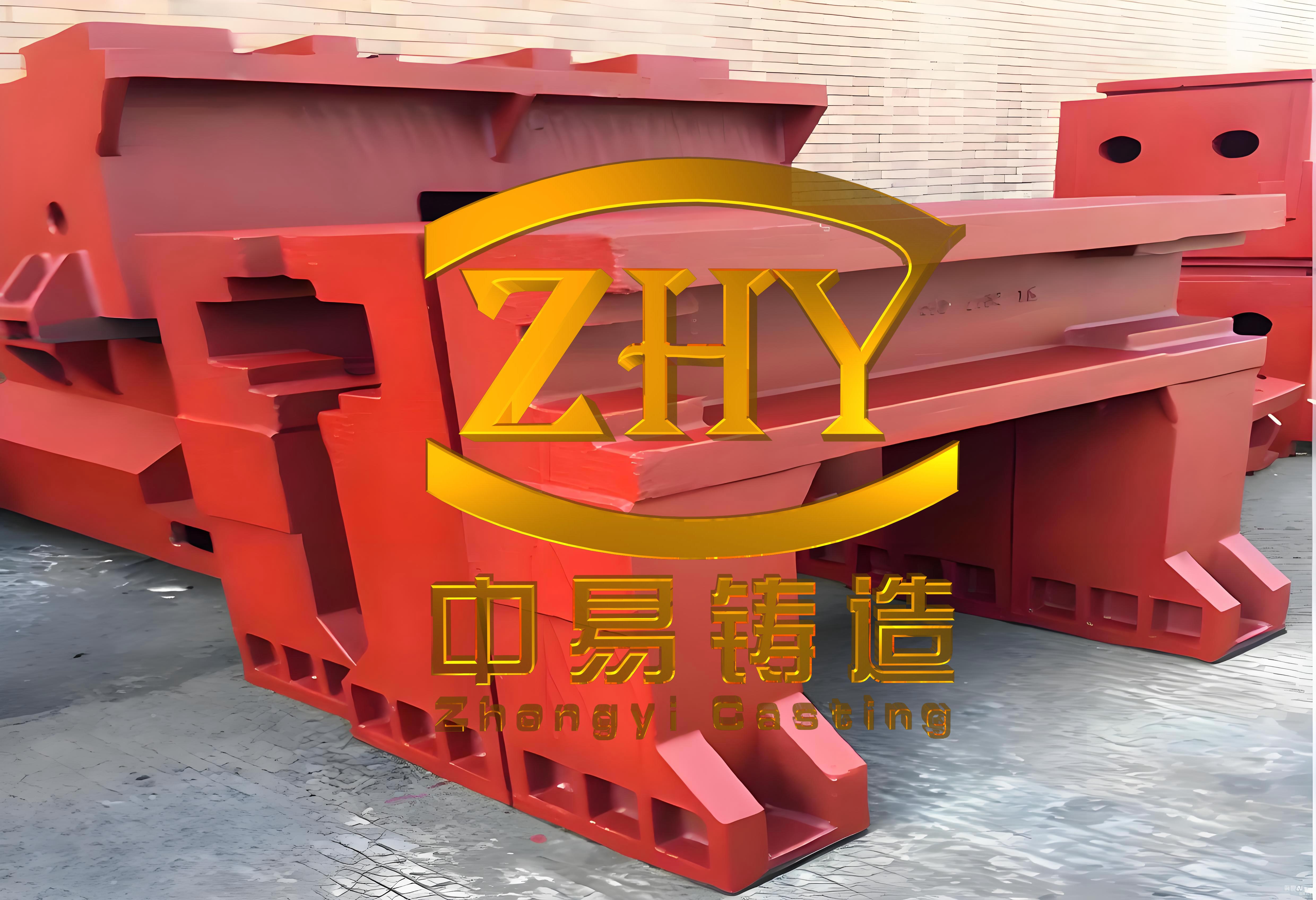
Testing results for the castings:
- V501091: Tensile strength 309 MPa, hardness 219 HBW, microstructure with A-type graphite (length grade 4), >98% fine pearlite, and minor ferrite. Deformation along the length was ≤6 mm; guide rail hardness ranged from 180 to 196 HBW.
- V501092: Tensile strength 348 MPa, hardness 241 HBW, similar microstructure but with finer pearlite due to Cr addition. Deformation was ≤6 mm; guide rail hardness was 201–210 HBW, showing better uniformity.
Deformation tracking over time (Table 6) revealed that V501092 (low-stress composition) maintained stable dimensions with only 0.012 mm concavity after six months, whereas V501091 (conventional composition) exhibited increasing concavity up to 0.079 mm. This demonstrates that the optimized composition reduces long-term deformation, enhancing stability for machine tool castings.
| Casting ID | 1 Hour | 24 Hours | 30 Days | 3 Months | 6 Months | Remarks |
|---|---|---|---|---|---|---|
| V501091 | Concave 0.011 mm | Concave 0.013 mm | Concave 0.025 mm | Concave 0.048 mm | Concave 0.079 mm | Conventional Cast Iron |
| V501092 | Concave 0.010 mm | Concave 0.011 mm | Concave 0.012 mm | Concave 0.012 mm | Concave 0.012 mm | Low-Stress Cast Iron |
Conclusion
This study systematically investigated the casting process for HT300 high-strength, low-stress machine tool castings. Key findings include:
- Mechanical properties, including tensile strength and hardness, decrease with increasing carbon equivalent (CE). To consistently achieve HT300 grade, CE should be controlled within a specific range.
- At constant CE, higher Si/C ratios (above 0.60) improve strength, reduce residual stress, and minimize section sensitivity. The optimal range for Si/C is 0.60–0.75.
- Alloying with chromium enhances pearlite stability and refines microstructure, further boosting strength and hardness.
- For HT300 machine tool castings requiring tensile strength over 300 MPa and hardness of 190–220 HBW, the recommended composition is CE = 3.60%–3.75% and Si/C = 0.60–0.75, with optional Cr addition for thick sections.
Production validation confirmed that this optimized composition yields machine tool castings with excellent mechanical properties, uniform hardness, minimal deformation, and high dimensional stability. By reducing residual stresses, the need for pre-machining artificial aging is eliminated, lowering costs and improving efficiency in manufacturing high-performance machine tool castings.